
Your Parent Needs Home Care. New Jersey Has the Money — But Nobody Will Walk You Through the Paperwork.
Your parent fell, or the dementia crossed a line, or you've been the unpaid caregiver for so long your own health and career are crumbling. You know New Jersey has Medicaid programs that pay for home care. You've heard of MLTSS. Maybe someone at the hospital mentioned the Personal Preference Program. But every time you call the county, you get a different person who tells you to "start with the ADRC" — without explaining what happens after that, how long it takes, or what to do when the financial denial lands because your parent has $3,000 in savings and the limit is $2,000.
Meanwhile, private home care in New Jersey runs $5,000 to $6,000 a month for a basic aide. Nursing home care averages $12,000 to $14,000 monthly. You can't afford either, your parent doesn't want to leave the house, and the clock is running.
The New Jersey Home Care Navigator: Every Program, Threshold, and Form in Execution Order
The Aging in Place in New Jersey Guide maps every public home care program — Medicaid MLTSS, state-funded JACC, and the self-directed Personal Preference Program — into a single step-by-step sequence built on New Jersey's 2026 eligibility rules and administrative procedures. It starts with the clinical assessment you need to pass, walks you through the financial application the County Welfare Agency will scrutinize, covers the spend-down and trust strategies that preserve eligibility when your parent is over the limits, and explains how to get paid as a family caregiver through a system most families don't know exists.
This is not a national Medicaid overview. Every financial threshold, MCO name, county agency, statute citation, and program cap is specific to New Jersey's 2026 rules.
What's Inside
MLTSS — New Jersey's Unified Medicaid Home Care System — New Jersey consolidated its federal waivers (Global Options, ACCAP, CRPD) into Managed Long Term Services and Supports, a single managed care program administered through five MCOs: Aetna Better Health, Fidelis Care, Horizon NJ Health, UnitedHealthcare, and Wellpoint. The guide covers what each MCO offers, how to select one, what services are funded (personal care aides, homemaker, adult day health, respite, home modifications, PERS), and the critical fact most families miss: New Jersey has no enrollment cap or waitlist for MLTSS-eligible seniors.
The NJ Choice Assessment — How to Clear the Clinical Gate — eligibility starts with an in-person interRAI Home Care assessment conducted by the county ADRC or the Office of Community Choice Options. Your parent must demonstrate hands-on assistance needs in at least three Activities of Daily Living — bathing, dressing, toileting, transferring, or locomotion — to establish a Nursing Facility Level of Care. The guide explains what the assessor evaluates, how functional decline is scored, and why presenting your parent "on a good day" can cost the entire application.
The Financial Eligibility Sequence — Income, Assets, and the QIT — the County Welfare Agency runs the financial review on a parallel track: $2,982 monthly income cap, $2,000 asset limit for individuals ($3,000 for couples both applying), and a $1,130,000 home equity exemption. When income exceeds the cap, the guide walks through setting up a Qualified Income Trust — the specific bank account, the trust document language, and how Social Security deposits must be routed through it. A QIT done wrong is treated as if it doesn't exist.
The 60-Month Look-Back — What Triggers Penalties and What's Exempt — the CWA reviews five years of financial records for below-market transfers. The guide maps exactly which transactions trigger penalties (gifts, property transfers, annuity purchases), which are exempt (transfers to a spouse, blind or disabled child, or qualifying trust), and how the penalty divisor is calculated so you know the real exposure before making irreversible decisions.
Spousal Protections — the Community Spouse Resource Allowance (up to $162,660, floor of $32,532), the Monthly Maintenance Needs Allowance (up to $4,066.50), and the rules that determine how much the healthy spouse keeps. Calculated for New Jersey's 2026 thresholds so one parent's care doesn't bankrupt the other.
JACC — The Program for Families Over the Medicaid Line — the Jersey Assistance for Community Caregiving program catches seniors aged 60+ who qualify clinically but exceed Medicaid's financial limits. Income up to $4,855/month, assets up to $40,000, no 60-month look-back, and no MCO — administered directly by the county Area Agency on Aging. Services capped at $1,090/month with a sliding-scale copay. The guide covers the full application and when to pursue JACC alongside or instead of MLTSS.
The Personal Preference Program — Getting Paid to Care for Your Parent — MLTSS includes a self-directed option where your parent acts as the common-law employer and hires a family member — including a spouse under N.J.A.C. 10:60-3.8 — as their paid caregiver. Palco handles payroll, taxes, and workers' comp. The guide covers the employer agreement, wage setting, timesheet processing, and the critical Authorized Representative rule: if your parent has diminished capacity, the AR who approves timesheets cannot be the same person getting paid.
Legal Authority Before Capacity Closes — a Durable Power of Attorney under N.J.S.A. 46:2B-8.1 must contain explicit durability language and — uniquely in New Jersey — explicit authorization for gifting and asset transfers, or the agent cannot execute a legal spend-down. If capacity is already gone, you face Surrogate's Court for guardianship. The guide covers the exact statutory requirements, the two-physician assessment, and the voluntary conservatorship alternative.
Protecting the Family Home — the primary home is exempt during your parent's lifetime. After death, the Medicaid Estate Recovery Program files claims against the estate — but recovery is deferred for a surviving spouse, child under 21, or blind/disabled child. The Caregiver Child Exception allows penalty-free transfer to an adult child who lived in the home at least two years and provided care delaying institutionalization. The Sibling Exception covers an equity-holding sibling who lived there at least one year. The guide walks through each exemption and the Undue Hardship Waiver.
Respite, Home Modifications, Meals, and Transportation — the Statewide Respite Care Program (sliding-scale copay, county caps), MLTSS-covered environmental adaptations (authorized by MCO care managers), JACC-funded modifications (within the monthly cap), county nutrition programs, and the split between MCO-covered medical transport and county community transit.
Provider Vetting — the difference between registered Home Care Service Firms (HCSFs) and licensed Certified Home Health Agencies (CHHAs), how to verify licensing, interview questions, and how to work with your MCO care manager to change providers when care quality drops.
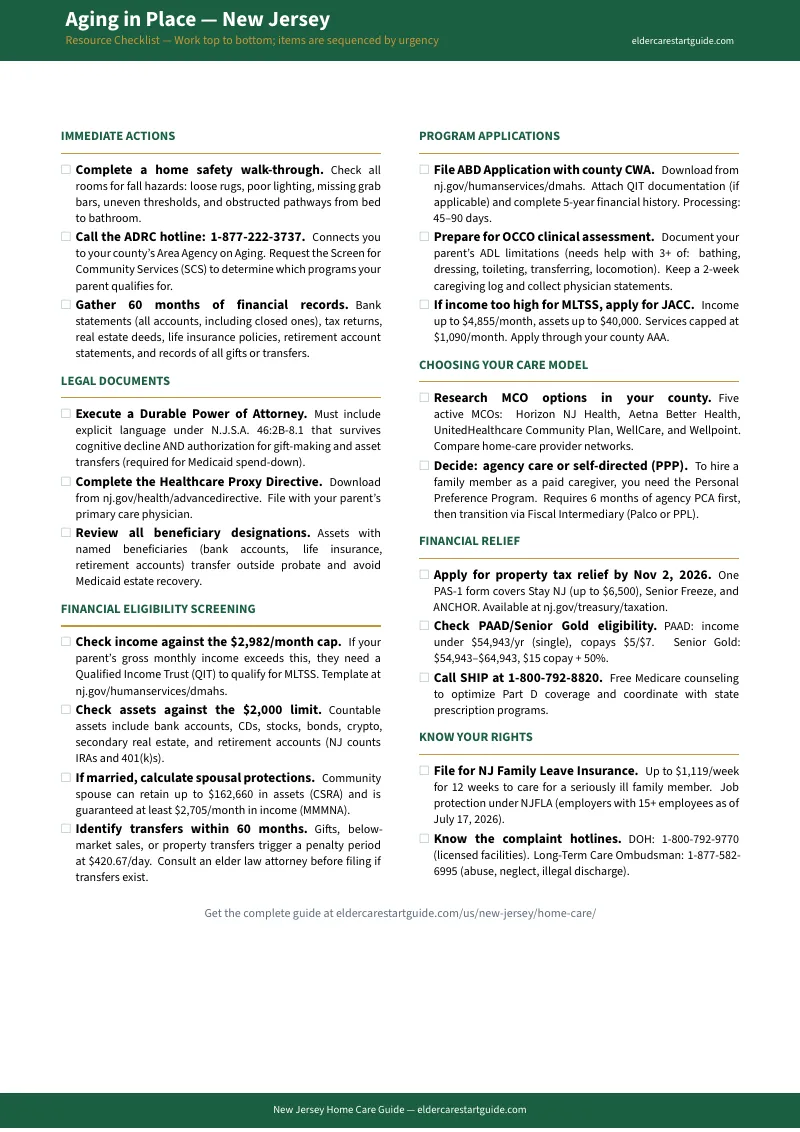
Plus: The New Jersey Aging in Place Resource Checklist — a one-page printable reference with every critical action item in priority order, from the first ADRC call through assessment, application, QIT setup, and legal documents, with key county contacts at a glance.
10 Standalone Printable Worksheets
Every tool you need to bring to a meeting, fill in at the kitchen table, or hand to a sibling coordinating from out of state — included as separate PDFs you can print individually:
- Home Safety Assessment — Room-by-room fall prevention and accessibility checklist
- Financial Eligibility Worksheet — Map income and assets against NJ's 2026 MLTSS thresholds
- NJ Choice Assessment Preparation — Before, during, and after checklists for the OCCO clinical evaluation
- Application Document Checklist — Every document the County Welfare Agency needs for the ABD application
- Program Comparison — Side-by-side reference for MLTSS, PPP, JACC, SRCP, and PACE
- PPP Enrollment Guide — Step-by-step path to getting paid as a family caregiver through Palco
- 60-Month Look-Back Audit — Identify transfer penalties before filing the Medicaid application
- Legal Documents Checklist — DPOA, healthcare proxy, and advance directive requirements
- MCO Comparison Worksheet — Evaluate NJ's five managed care organizations side by side
- Property Tax Relief Reference — Stay NJ, Senior Freeze, and ANCHOR with deadlines and eligibility
Who This Is For
- The adult child whose parent just had a fall or hospital stay — you need a safe home care plan before discharge, and you're facing a 122-day Medicaid processing timeline with zero knowledge of where to start
- The family member who has been providing unpaid care for months — you're physically and financially exhausted, and you didn't know New Jersey will actually pay you through the Personal Preference Program
- The family whose parent is "over the limit" — the CWA denied the application because of $3,000 in savings or $3,200 in monthly income, and you don't know about the QIT or which assets are actually exempt
- The family trying to protect the home without a $15,000 legal retainer — you need to understand look-back exposure, estate recovery exemptions, and caregiver child rules before paying an attorney $400 an hour to explain them
- The caregiver whose parent makes too much for Medicaid but too little for private pay — JACC bridges that gap with higher limits and no look-back, and most families have never heard of it
- The out-of-state sibling coordinating care remotely — you need every county ADRC, CWA, and AAA contact in one document so you can manage the process without being physically present
Why Not Use Free Resources?
New Jersey publishes Medicaid eligibility rules across the Division of Medical Assistance and Health Services, the Division of Aging Services, and 21 separate county welfare agencies. The state's NJ FamilyCare website explains general Medicaid — not the MLTSS-specific clinical assessment process. County ADRCs provide referrals but cannot advise on spend-down strategies or QIT setup. The JACC program is administered at the county level with no centralized application guide.
Elder-law attorneys in New Jersey charge $300 to $500 an hour, with comprehensive Medicaid planning running $6,000 to $15,000. Medicaid planning agencies charge $3,000 to $5,000 — and are legally restricted from providing the asset-protection advice families actually need. National referral brokers like A Place for Mom are free to families but earn commissions from facilities, exclude Medicaid-funded options, and route you through sales calls rather than public benefits.
This guide is 100% independent — no facility commissions, no attorney referral fees, no sponsored recommendations. It organizes New Jersey's fragmented system into one action plan for .
100% Satisfaction Guarantee
If the guide does not help you navigate New Jersey's home care system more confidently, email us for a full refund. No conditions, no time limit.
Start with the free checklist or get the complete guide
Download the New Jersey Aging in Place Resource Checklist at no cost — a one-page reference with every critical action item in priority order. If you need the full system mapped out, the complete guide covers every program, threshold, and decision point for .