
Your Parent Needs More Help — And New Jersey's System Has No Single Map
The signs have been building: missed medications, a fall that went unnoticed, a refrigerator full of expired food, conversations that loop in circles. You know something has to change. But when you start researching New Jersey's elder care system, you find dozens of disconnected state websites, dense administrative code, and "free" referral services that steer families toward facilities paying them $3,000–$6,000 in placement commissions.
Meanwhile, the clock is ticking. A hospital discharge planner may be pressuring you to find placement within 48 hours. Or you have been managing everything alone for months and you are running out of capacity. Either way, the questions are the same: Does my parent qualify for MLTSS? What does assisted living cost in New Jersey versus home care? How do I check a facility's real inspection history — not their marketing brochure? Which MCO should manage my parent's care plan? And what happens to my parent's assets if they need Medicaid?
The MLTSS Navigator: Every Program, Threshold, and Decision Point in One Sequence
The Choosing Care in New Jersey Guide translates New Jersey's elder care system — Managed Long Term Services and Supports, the MCO managed-care network, OCCO clinical screenings, the three assisted-living license types, county-level financial eligibility, and surrogate court guardianship — into a single step-by-step plan. It starts with assessing your parent's actual needs using the state's own ADL framework, walks you through every care setting with New Jersey-specific cost data, and ends with the exact 90-day application sequence for Medicaid MLTSS benefits.
This is not a generic national overview. Every threshold, contact number, cost figure, and regulatory reference is specific to New Jersey's 2026 programs.
What's Inside
A Clinical Warning-Signs Framework — an objective ADL-based checklist for evaluating whether your parent can remain safely in their current living situation. Covers medication management, wandering, falls, nutritional decline, and the Nursing Facility Level of Care standard — so you can assess the situation with data rather than guilt, and document observations before involving state agencies.
New Jersey Care Setting Comparison with Real Costs — home health aides average $34–$38/hour in New Jersey. Assisted living averages $8,462/month. Nursing home care runs $12,775–$14,448/month depending on room type. The guide runs side-by-side scenarios showing exactly when home care becomes more expensive than facility care — 24/7 in-home care exceeds $20,000/month, often making facility placement more cost-effective — and explains the three distinct assisted living license types (ALR, CPCH, ALP) and what each can legally provide.
The Complete MLTSS Enrollment Map — New Jersey delivers all Medicaid long-term care through Managed Care Organizations, not directly. The guide maps both eligibility tracks in parallel: the OCCO clinical screening (Nursing Facility Level of Care determination using the LTC-2E portal) and the county Board of Social Services financial application. It explains how the two tracks converge at MCO enrollment and what your parent's care manager does once approved.
2026 Financial Eligibility Thresholds + Spend-Down Strategy — $2,000 individual asset limit. $2,982 monthly income cap. Community Spouse Resource Allowance of $32,532–$162,660. Home equity exemption up to $1,130,000. The guide walks through the complete financial picture: Qualified Income Trusts for income above the cap, the 60-month look-back period, the $420.67 daily penalty divisor for uncompensated transfers, and compliant spend-down strategies including irrevocable funeral trusts, home modifications, and the caregiver-child exemption.
Facility Vetting with State Inspection Data — step-by-step instructions for using the NJDOH Health Facilities Evaluation portal, reading inspection surveys, and interpreting enforcement actions — before you schedule a single tour. Under New Jersey law, facilities must post their most recent inspection report in their lobby. The guide shows you how to read it.
The Long-Term Care Ombudsman and Complaint System — how to access free, confidential advocacy for residents of nursing homes and assisted living facilities, when to use the Ombudsman versus the NJDOH complaint process, and the exact contact channels (877-582-6995) for reporting safety concerns.
Legal Authority Foundations — what happens when your parent loses cognitive capacity without a Durable Financial Power of Attorney or Healthcare Proxy in place, the full county surrogate court guardianship process ($200 filing fee, two physician certifications within 30 days, court-appointed attorney, surety bond, annual accounting requirements), and the documents you need organized before engaging the state system.
The 90-Day Care Transition Timeline — a phased action plan from clinical intake through MCO enrollment. Phase I: clinical screening (days 1–15). Phase II: financial compilation (days 15–30). Phase III: legal preparation (days 30–45). Phase IV: financial restructuring (days 45–60). Phase V: facility selection (days 60–75). Phase VI: Medicaid filing and MCO enrollment (days 75–90+). Each phase lists the exact actions, contacts, and documents required.
Plus 8 Standalone Printable Tools — an ADL warning-signs assessment worksheet, a care setting cost comparison with fill-in fields for your family's numbers, the complete MLTSS enrollment map, a 2026 financial thresholds reference card, a facility vetting worksheet with tour questions and contract red flags, the 90-day transition timeline with checkboxes, a legal authority checklist for POA and guardianship, and a contacts directory with every state agency phone number and essential form. Print what you need, bring it where you need it.
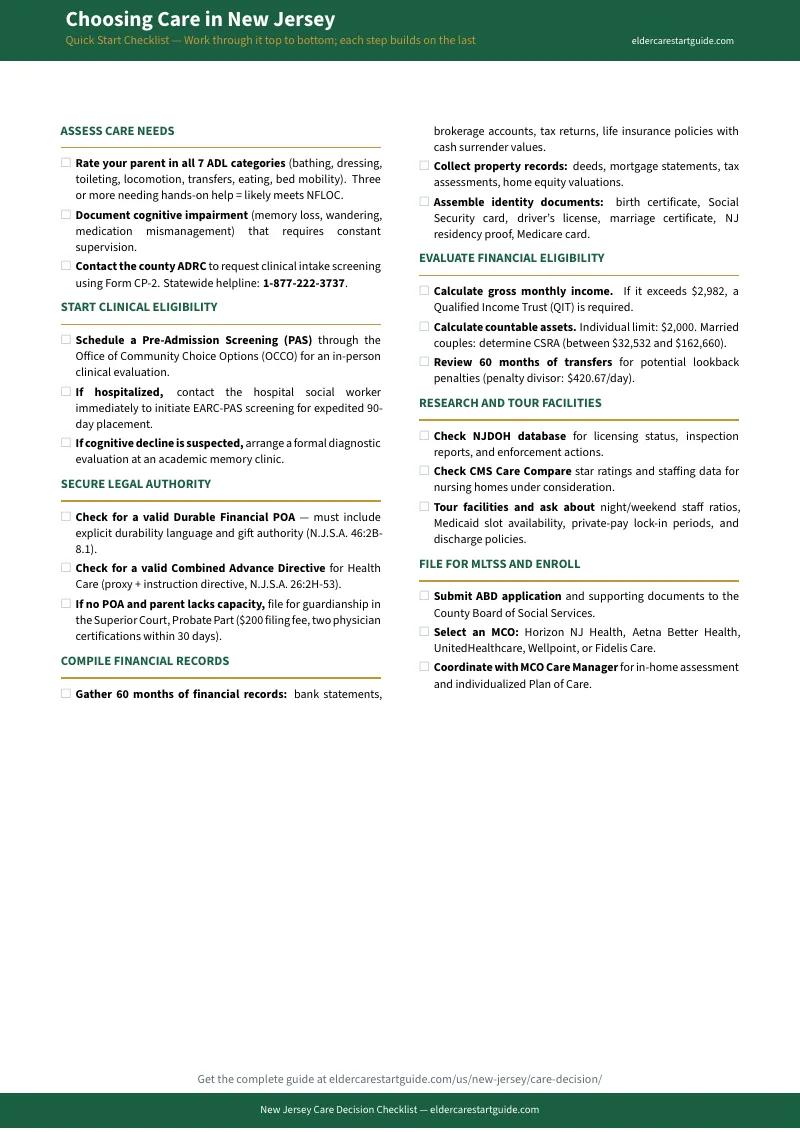
Plus: The New Jersey Care Decision Checklist — a one-page printable reference with every critical action item, key contact, threshold, and deadline in priority order.
Who This Is For
- The adult child facing a hospital discharge deadline — your parent cannot go home safely and you have days, not weeks, to understand your options and make a placement decision
- The family caregiver approaching burnout — you have been managing everything and it is no longer sustainable, but you do not know how to transition to professional care or what New Jersey programs can help
- The family navigating Medicaid MLTSS for the first time — your parent's savings are running out and you need to understand eligibility rules, spend-down strategies, and the dual-track application process before assets are depleted
- The sibling group that cannot agree — you need an objective cost-comparison framework and structured decision process to move the family from emotional opinions to data
- The long-distance coordinator — your parent lives in New Jersey and you are managing their care from another state, needing the state agencies, county contacts, and application steps mapped in one place
Why Not Use Free Resources?
New Jersey publishes thousands of pages of administrative code, regulatory guidance, and program descriptions across DMAHS, NJDOH, the Division of Aging Services, and 21 county Boards of Social Services websites. The information exists — but it is written in dense bureaucratic language, spread across dozens of disconnected portals, and frequently outdated.
County ADRCs are understaffed. Securing an appointment for options counseling can take weeks — time that a family dealing with a hospital discharge or escalating safety concerns does not have. And the state does not provide a proactive, strategic sequence of actions. They process applications. They do not tell you what to do first, what to prepare, or how to avoid the errors that trigger 60-day denial delays.
"Free" national referral services like A Place for Mom operate on placement commissions — they receive 50–100% of the first month's rent when your parent signs a lease at a partnered facility. They will not recommend lower-cost community options, facilities that accept MLTSS Medicaid, or any provider outside their paying network.
An elder law attorney charges $300–$500 per hour, with Medicaid planning packages running $3,000–$15,000. For families with straightforward estates, the guide demonstrates which steps you can handle yourself — and for those who do need legal counsel, it ensures you arrive at that first meeting with organized documentation rather than paying $400 an hour for basic data collection.
The Choosing Care in New Jersey Guide is 100% independent — no placement commissions, no facility partnerships, no sponsored recommendations. It organizes New Jersey's public system into one clear action plan for .
100% Satisfaction Guarantee
If the guide does not help you navigate New Jersey's elder care system more confidently, email us for a full refund. No conditions, no time limit.
Start with the free checklist or get the complete guide
Download the New Jersey Care Decision Checklist at no cost — a one-page printable reference with the most critical action items in priority order. If you need the full system mapped out, the complete guide covers every program, threshold, and decision point for .