
The Bank Won't Let You Touch Your Parent's Accounts — And the Hospital Wants a Decision by Friday
Your parent had a fall. Or a stroke. Or you just noticed they've been paying the same bill three times and forgetting to eat. You've been handling things informally — paying bills from a joint account, calling the doctor, driving them to appointments. Then something breaks: the bank refuses to let you manage the CD rollover. The hospital discharge planner says your parent can't go home and you need to arrange a skilled nursing placement within 72 hours. Social Security tells you a power of attorney doesn't work for benefit payments. You discover that being their adult child gives you exactly zero legal standing.
Now you're racing. You need legal authority to make financial decisions, medical decisions, and government benefit applications — and you're not sure your parent can still sign the documents that would give it to you. If they can't, your only path runs through the New Hampshire Probate Division, where a guardianship petition takes weeks or months and requires proving incapacity beyond a reasonable doubt.
The New Hampshire Legal Authority Navigator: Every Path to Decision-Making Power in One Sequence
The New Hampshire Power of Attorney & Guardianship Kit maps every route to legal authority — from the simplest power of attorney signing to a full guardianship petition — into a single, step-by-step sequence built on New Hampshire's actual statutes. It starts with assessing your parent's capacity, walks you through the execution requirements for each document type, and covers the federal processes that New Hampshire law can't reach.
This is not a generic national overview. Every statute citation, filing fee, witness rule, asset threshold, and agency contact is specific to New Hampshire's 2026 laws and programs.
What's Inside
Capacity Assessment Guide — a structured framework for evaluating whether your parent can still legally execute documents. Dementia does not automatically disqualify someone under New Hampshire law — what matters is comprehension at the moment of signing. The guide helps you assess readiness, prepare for the signing conversation, and document the process in case capacity is later challenged.
Durable Financial Power of Attorney (RSA 564-E) — Complete Execution Walkthrough — New Hampshire treats all financial powers of attorney as durable by default, meaning they survive your parent's future incapacity. The guide covers the mandatory notarization requirement under RSA 564-E:105, the statutory Disclosure Statement your parent must receive, the Agent Acknowledgment you must sign before acting, and the specific powers you should include or exclude based on your parent's situation.
Health Care Advance Directive (RSA 137-J) — Witness Rules That Can Void the Document — New Hampshire's healthcare directive combines a healthcare power of attorney with a living will. The execution rules are stricter than the financial POA: you need two witnesses, and certain people are disqualified — including the healthcare agent, the parent's spouse, heirs, the attending physician, and anyone employed by the parent's care facility. One wrong witness invalidates the entire directive. The guide flags every disqualification and includes a witness eligibility checklist.
Adult Guardianship (RSA 464-A) — The Full Court Filing Sequence — when your parent has already lost capacity and no POA exists, guardianship is the only remaining path. The guide walks through the complete process: drafting the petition, paying the $260 court filing fee, service through the county sheriff, mandatory background checks, the court-appointed defense attorney, and the evidentiary hearing where you must prove incapacity beyond a reasonable doubt. It includes timelines, required court forms (NHJB-2165-PE and related filings), and practical guidance on what the judge will ask.
Social Security Representative Payee — The Process No POA Can Replace — the Social Security Administration does not accept any private power of attorney for managing retirement or disability benefits. You must apply separately through the local SSA field office as a Representative Payee. The guide covers the application process, the in-person interview, what documentation to bring, and the annual accounting obligations that come with the role.
Choices for Independence (CFI) Waiver Navigation — New Hampshire's primary Medicaid home-care program for seniors who need nursing-home-level care but want to stay home. The guide covers the full eligibility path: clinical assessment (nursing facility level of care), financial thresholds ($7,500 asset cap for single applicants, $2,982 monthly income cap), the ServiceLink Level One Screen, and the income spend-down pathway for applicants who exceed the cap. It explains how to prepare for these assessments so your parent's care needs are accurately documented.
Asset Protection and the 60-Month Look-Back — New Hampshire enforces a strict 60-month look-back period on all asset transfers before a Medicaid application. The penalty is calculated using the average monthly private-pay nursing home rate of $12,275. The guide covers which transfers trigger penalties, which are exempt, how the family home is treated during your parent's lifetime versus after death, and how the state's Medicaid Estate Recovery Program works.
Long-Term Care Facility Rights and the Complaint System — how to access the Long-Term Care Ombudsman for free confidential advocacy, when to use the Ombudsman versus filing a complaint with the Bureau of Health Facilities Administration, and the exact channels for reporting safety concerns about a facility.
8 Standalone Printable Worksheets — pull out the sections you need and bring them with you. Each is a separate PDF you can print independently:
- Capacity Assessment Conversation Guide
- Financial POA Execution Checklist
- Healthcare Directive Witness Eligibility Checklist
- Guardianship Filing Sequence
- Representative Payee Application Checklist
- CFI Waiver Eligibility Worksheet
- Asset Inventory & Look-Back Worksheet
- Key Contacts & Filing Reference
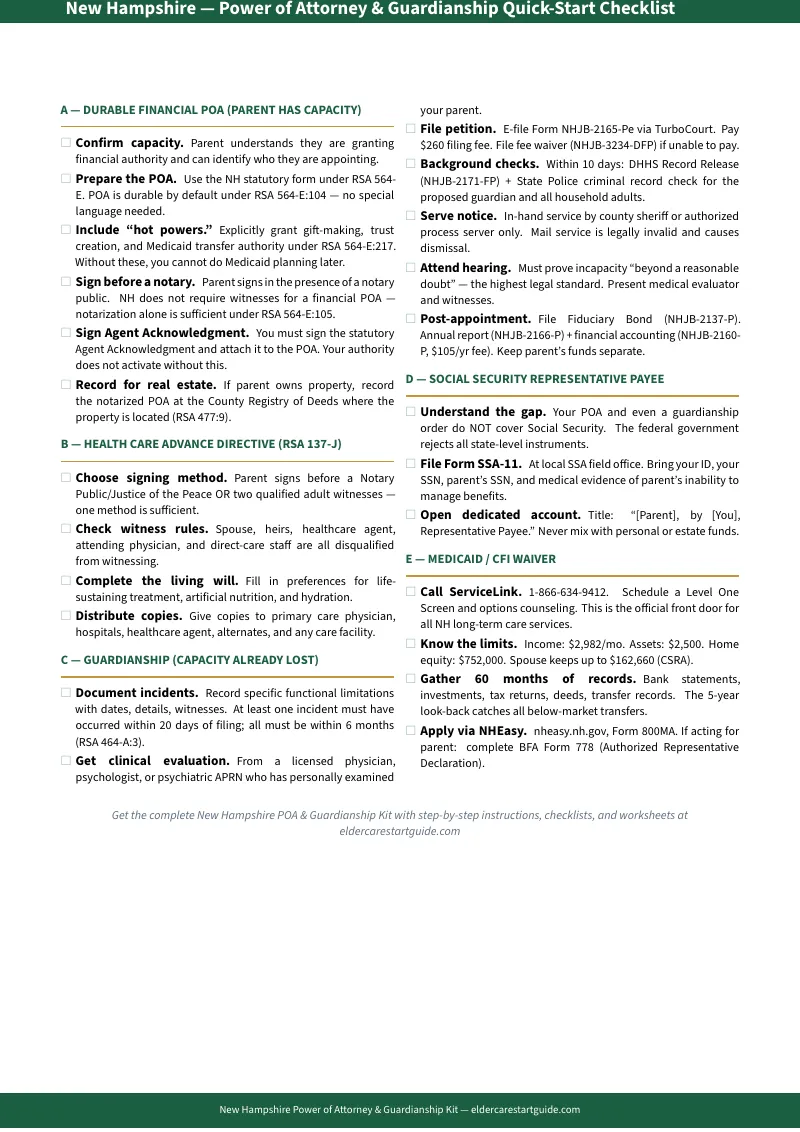
Plus: The New Hampshire Legal Authority Quick-Start Checklist — a one-page printable reference with every critical action item, key contact, statute reference, and deadline in priority order.
Who This Is For
- The adult child who needs to act before capacity is gone — your parent can still sign documents today, but you see the window closing and need to get financial and healthcare POAs executed correctly while there's still time
- The family facing a hospital discharge deadline — a discharge planner says your parent can't go home safely and you need legal authority to sign facility admission contracts, access medical records, and submit benefit applications within days
- The family that missed the POA window — your parent can no longer sign, and you need to understand the full guardianship process: what it costs, how long it takes, what the court requires, and how to prepare
- The caregiver managing federal benefits — you've been told Social Security won't accept your power of attorney and you need the Representative Payee application process mapped out
- The family navigating Medicaid for the first time — your parent's savings are running out and you need to understand CFI waiver eligibility, spend-down strategies, and asset protection rules before making irreversible decisions
Why Not Use Free Resources?
New Hampshire provides blank statutory forms for financial POA and healthcare directives on the Judicial Branch website. ServiceLink offers options counseling and Medicaid application support. The Probate Division publishes guardianship petition forms. The information exists — but it is scattered across disconnected state portals, written in statute-level language, and structured for compliance rather than action.
A blank RSA 564-E form does not explain which powers to include for managing a parent's long-term care finances. The RSA 137-J form does not flag the witness disqualifications that can void the document. The probate court's guardianship packet does not tell you how to prepare for the evidentiary hearing or what the judge will actually ask. ServiceLink counselors are overextended and cannot draft legal documents or provide legal representation.
An elder law attorney in New Hampshire charges $300–$500 per hour, with comprehensive estate planning packages running $3,500–$5,500. For families dealing with straightforward POA execution or a standard guardianship petition without contested assets, the kit covers the same statutory ground — and for those who do need legal counsel, it ensures you arrive at that first meeting with organized documentation and clear questions rather than paying premium hourly rates for basic orientation.
This kit is 100% independent — no referral commissions, no facility partnerships, no sponsored recommendations. It organizes New Hampshire's legal authority system into one clear action plan for .
100% Satisfaction Guarantee
If the kit does not help you navigate New Hampshire's legal authority process more confidently, email us for a full refund. No conditions, no time limit.
Start with the free checklist or get the complete kit
Download the New Hampshire Legal Authority Quick-Start Checklist at no cost — a one-page reference with every critical action item in priority order. If you need the full process mapped out, the complete kit covers every statute, filing requirement, and decision point for .