
Your parent's diagnosis changed everything. New Hampshire's care system assumes you already know how it works.
One week you're a daughter helping Mom with errands. The next, a hospital discharge planner is telling you she can't go home without a 24-hour safety plan — and you're supposed to figure out Medicaid waivers, memory-care licensing, and powers of attorney by Friday.
Meanwhile, every source you find sends you somewhere else. ServiceLink gives you accurate information buried in bureaucratic PDFs. The national senior-care sites give you friendly overviews — then sell your phone number to facility chains, and the sales calls start. The elder-law attorney can answer everything, at $300 to $500 an hour. And the "free" placement agency that offers to help? They're paid on commission by the facilities they recommend.
What nobody hands you is a neutral, step-by-step sequence: what to do first, in what order, under which New Hampshire rule.
The New Hampshire Dementia Care Roadmap
This guide is a complete, New Hampshire-specific action sequence for families navigating dementia and memory care — from the first safety scare through Medicaid approval and beyond. We call it a roadmap because order matters: sign the power of attorney while your parent still has capacity, check a facility's license type before you tour it, understand the estate-recovery clock before you file the Medicaid application. Get the order wrong and you pay for it — in guardianship court fees, involuntary discharge notices, or a lien on the family home.
No lead-capture forms. No referral commissions. No sales calls. Just the rules, the deadlines, and the steps — organized.
What's Inside
- The safety threshold playbook — how to trigger New Hampshire's Missing Vulnerable Adult Alert (Silver Alert, RSA 106-J) if your parent wanders, and how the DMV medical-review process (RSA 263:6-d) actually works when driving becomes unsafe. Because "take away the keys" is not a plan.
- The capacity-window legal sequence — the exact execution requirements for a durable financial POA under RSA 564-E (notarization, disclosure statement, agent acknowledgment) and the healthcare directive under RSA 137-J (two qualified witnesses, no notary). Get these signed while your parent still understands them — because the alternative is guardianship court, where you must prove incapacity beyond a reasonable doubt, the same standard as a criminal trial, with documented incidents within 20 days of filing.
- He-P 804 vs. He-P 805, decoded — New Hampshire doesn't issue a "memory care" license. He-P 804 facilities must evacuate residents unassisted and cannot lock their doors. He-P 805 facilities can secure wandering-prevention exits and provide 24/7 nursing. Place a wanderer in the wrong one and you'll get an involuntary discharge notice within months. The guide shows you what to ask on every tour.
- The 2026 Medicaid numbers, in plain English — the $2,982 monthly income cap, the $7,500 effective asset limit, the spousal protections (Community Spouse Resource Allowance up to $162,660; monthly income allowance up to $4,066.50), the medically-needy spend-down path for over-income applicants, and New Hampshire's transferee-liability trap under RSA 167:16-a — where the nursing home itself can come after the person who received transferred assets.
- The CFI waiver application, step by step — what the Choices for Independence waiver actually covers (personal care, adult day, nursing oversight — but never room and board), the full application timeline from ServiceLink intake to the nurse's Medical Eligibility Assessment, and what to do if you're denied or waitlisted.
- Estate recovery defense — how New Hampshire's Estate Recovery Unit reaches beyond probate into joint accounts, life estates, and trusts; the automatic bars (surviving spouse, minor or disabled child); and the Caregiver Child and Sibling hardship waivers under He-W 895.04 — including the strict 30-day filing window that most families learn about too late.
- Every ServiceLink ADRC, all ten counties — the full directory with contact information, plus the Family Caregiver Support Program, adult day and respite options, and assistive technology resources most families never hear about.
- The professional-fee playbook — when you genuinely need an elder-law attorney, when a Medicaid planner is enough, and the exact document checklist to assemble before either one bills you an hour. A standard consultation runs $250–$500; showing up prepared can cut that engagement in half.
Plus 8 Printable Worksheets
Everything above in the guide, plus fill-and-print tools built for the moments they matter:
- Wandering & Safety Emergency Card — fill in your parent's ID, medications, and destinations before you need it; hand it to police in the first minute of a Silver Alert
- Legal Documents Tracker — the RSA 564-E and RSA 137-J execution requirements as checklists, plus the dated incident log that powers both guardianship petitions and the Medicaid clinical case
- Memory Care Tour Scorecard — compare three facilities side by side on the He-P 804/805 questions, staffing, training records, and the mandatory Disclosure Summary Form
- Care Cost & Funding Runway Worksheet — New Hampshire's 2026 median costs against your parent's income and savings, so you know your runway in months before the first facility quote lands
- Medicaid Eligibility Self-Check — run your parent's income and assets against the 2026 limits in 15 minutes, including the spend-down math and spousal protections
- CFI Waiver Application Tracker — the 60-day timeline step by step, the 10-day verification packet, and the evidence packet that beats the MEA's dementia "cognitive gap"
- Estate Recovery Defense Checklist — the Caregiver Child affidavit requirements to assemble now, and the 30-day hardship-waiver deadline tracker for the week of the death
- Professional Meeting Prep Worksheet — the document packet and question list that cut a $300–$500/hour engagement's billable hours
Who This Is For
- Adult children in New Hampshire who just got the diagnosis — and know the legal and financial clock is already ticking
- Exhausted caregivers who need home-based help through Medicaid but can't decode the CFI waiver's rules
- Families facing a hospital discharge who must arrange safe memory care in days, not months
- Anyone who wants to protect the family home from estate recovery — before filing anything
Why Not Just Use the Free Sites?
Because "free" has a business model. The national directories are lead generators — their advice ends where your contact information begins. The placement agencies are paid by the facilities they steer you toward, which quietly biases them against the Medicaid home-care options that might serve your parent better. And ServiceLink, for all its value, hands you administrative code and unstructured PDFs — accurate, but unusable when you're making decisions at 11pm after a fall.
This guide is the opposite trade: you pay once, and in return you get the whole sequence — state-specific, deadline-accurate, conflict-free — that you can act on tonight. We never see your name, and no facility ever hears you're looking.
Our Guarantee
If the guide doesn't give you a clear next step for your family's situation, email us at any time for a full refund. No forms, no questions.
Start Tonight
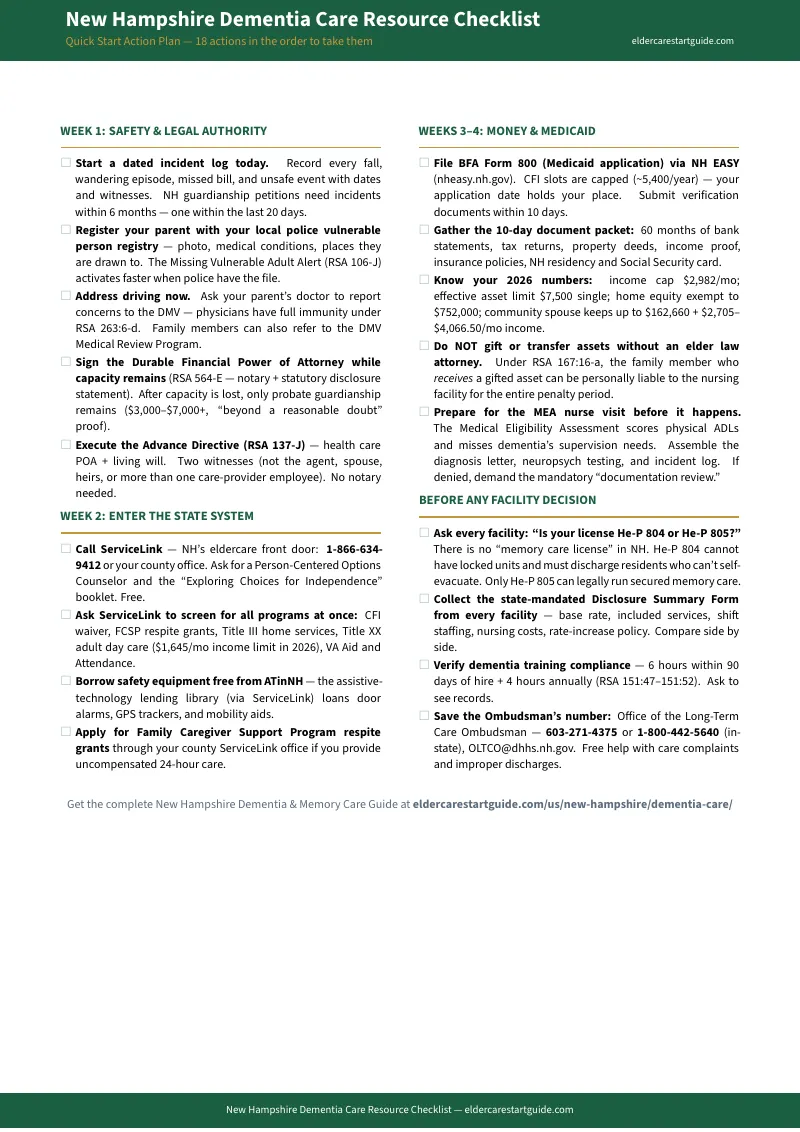
Not ready for the full guide? Grab the free New Hampshire Dementia Care Resource Checklist — the key phone numbers and first steps on one page.
Ready for the whole roadmap? Get the complete guide and know exactly what to do next — in the right order, under the right New Hampshire rule.