Your Parent Needs a Nursing Home. Nevada's Bill Is $11,000 a Month — and Their Income Is $48 Over the Limit.
Your parent needs long-term care. The nursing home costs $134,503 a year. Their Social Security and pension add up to $3,030 a month — $48 over Nevada's strict income cap. In Nevada, there is no medically needy spend-down, no deductible, no workaround. They are simply disqualified.
You called the Division of Welfare and Supportive Services. They mentioned a "Qualified Income Trust." You searched online and found the term "Miller Trust." But nobody told you how to set one up under Nevada law, which bank to open the account with, what to deposit each month, or what happens when the monthly math is wrong. One mistake and your parent loses Medicaid eligibility — retroactively.
Meanwhile, the Frail Elderly waiver — the program that could keep your parent at home — has roughly 3,100 capped slots and a significant waitlist. The Aging and Disability Services Division administers these waivers, not your local county social services office. And the clinical Nursing Facility Level of Care assessment can deny your parent entirely if the evaluator scores their needs below the threshold.
The Nevada Medicaid Asset Protection Playbook
This is not a reprint of eligibility limits from the state website. It is the process around the limits — the part that $3,000–$15,000 elder law attorneys explain in billable consultations and that free government portals never cover.
The guide covers every financial threshold, every legal instrument, every waiver program, and every asset protection strategy available under Nevada law — organized in the order you will actually need them, from the first hospital discharge through Medicaid approval to estate recovery after your parent passes.
What's Inside
- Miller Trust Setup — Step by Step — Nevada is an income-cap state. If your parent's gross income from any source exceeds $2,982/month, they must establish a Qualified Income Trust or be denied outright. The guide walks through the trust language Nevada DWSS requires, how to open the dedicated bank account, the monthly deposit-and-disbursement cycle (Personal Needs Allowance, spousal maintenance, medical expenses, patient liability), and naming the State of Nevada as remainder beneficiary. Covers the timing trap when Social Security cost-of-living adjustments push income over the cap by a single dollar.
- Estate Recovery Defense — Nevada's Broad Recovery Power — Unlike states that only recover through probate, Nevada recovers against the "undivided estate" under NRS 422.054 — meaning joint tenancies, living trusts, and transfer-on-death deeds are all reachable. The guide details every protection structure, the permanent blocks (surviving spouse, child under 21, disabled child of any age), and the undue-hardship waiver with its strict 30-day filing deadline from the state's claim notice.
- Spousal Protection Formulas — When one spouse enters care, the community spouse keeps between $32,532 and $162,660 in assets under the Community Spouse Resource Allowance, plus a Monthly Maintenance Needs Allowance of $2,705 to $4,066.50 per month. The guide walks through the Snapshot Date calculation, the excess shelter allowance, and when to request a fair hearing for a higher income allocation — because most families never learn they can ask.
- The 60-Month Look-Back Audit — Nevada reviews every financial transaction from the past five years. The guide explains what triggers a penalty (uncompensated transfers), what does not (fair-market-value purchases), and why the IRS $19,000 gift-tax exclusion is irrelevant — Nevada Medicaid ignores federal tax code and penalizes the full amount. Includes the penalty calculation using the 2026 divisor of $13,097.70 and the DRA timing trap that starts the penalty only after all other assets are gone.
- Penalty-Free Spend-Down Strategies — The complete list of Nevada-approved ways to legally reduce countable assets without triggering a single day of penalty: paying off debts, prepaying irrevocable funeral contracts (up to $1,500), making home safety modifications, purchasing a handicap-accessible vehicle, and paying for home care with a written caregiver agreement at fair market value. Every strategy is executable even if your parent is entering a facility tomorrow.
- Clinical Assessment — How to Pass — To qualify for any long-term care program, your parent must demonstrate Nursing Facility Level of Care through a state-administered assessment. The guide details both ADL functional and cognitive scoring pathways, what the evaluator is looking for, and how to document your parent's care needs so the assessment reflects reality — because a one-point difference can mean denial.
- Home and Community-Based Waivers — The Frail Elderly waiver, WEARC (Waiver for Elderly Adult Living in Residential Care), and Personal Care Services. What each program covers, what it does not (no room and board under any waiver), capped enrollment and waitlist mechanics, and the paid family caregiver pathway through Intermediary Service Organizations. Explains why ADSD holds sole authority over waiver allocations and what that means for your application.
- DWSS Application Walkthrough — The full application sequence: navigating Access Nevada, the Form 2920 (MAABD) submission, the parallel clinical assessment track, required documentation (60 months of bank statements, income verification, property deeds, vehicle titles, burial contracts), and the 45-day federal processing timeline. Includes how to respond to verification requests without triggering a denial.
- Legal Authority Chapter — Nevada Durable Power of Attorney with the specific Medicaid planning clauses your parent's POA must include (trust-creation authority, gifting authority, real estate conveyance), the Advance Directive for Health Care, and the court-ordered guardianship process when cognitive capacity is already gone.
- Appeals and Denial Recovery — The most common reasons for denial are procedural failures, not actual wealth. The guide details the fair hearing request process, continuation of benefits pending appeal, and how to distinguish between situations you can handle yourself and ones that require an elder law attorney.
Plus: Printable Worksheets and Calculators
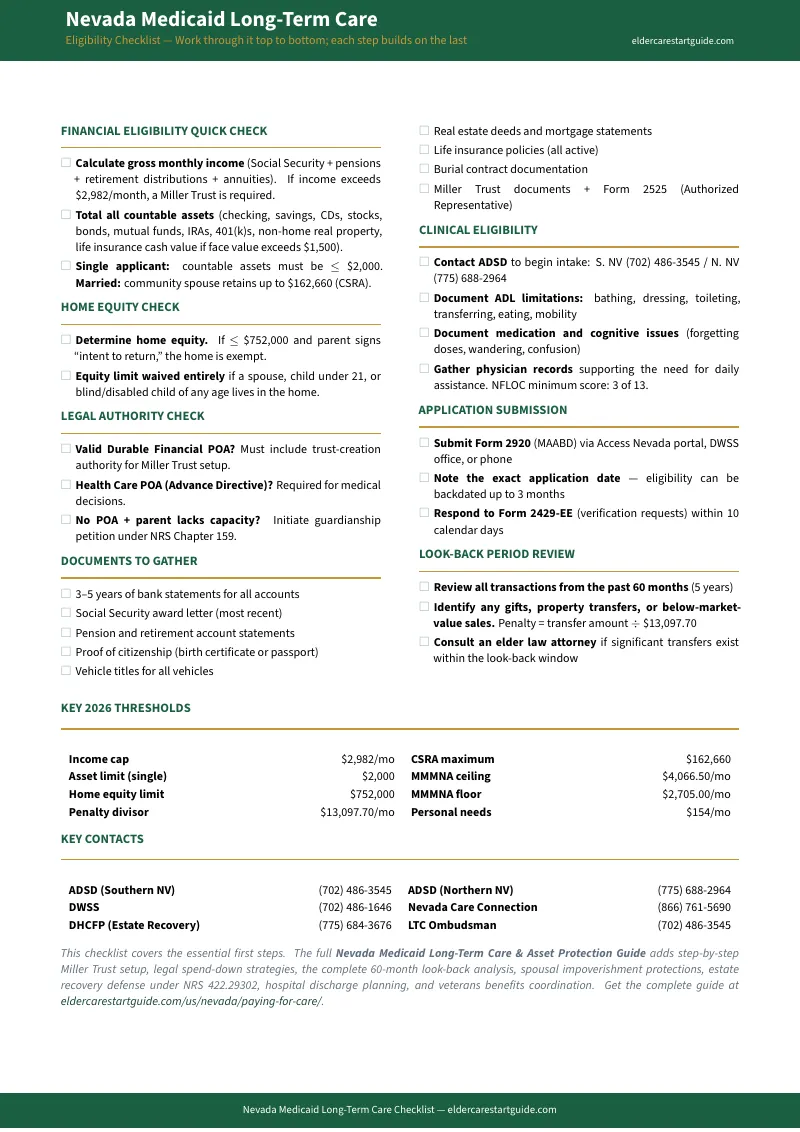
- Nevada Medicaid LTC Eligibility Checklist — A one-page action list with the 20 most critical items: establish legal authority, gather 60 months of financial records, calculate countable vs. exempt assets, set up the Miller Trust if income exceeds the cap, prepare for the clinical assessment, file with DWSS.
- Miller Trust Setup Guide — Step-by-step checklist for establishing the Qualified Income Trust, plus a monthly distribution worksheet for tracking deposits and disbursements.
- Income & Asset Eligibility Calculator — Fill-in worksheet with 2026 Nevada thresholds: income test, countable asset inventory, and eligibility result summary.
- Spousal Protection Calculator — CSRA and MMMNA worksheets with worked examples showing how spousal protections affect patient liability.
- 60-Month Look-Back Audit — Transfer log for recording every gift and sale in the look-back window, penalty calculation using Nevada's divisor, and cure options.
- Spend-Down Planner — Approved penalty-free strategies with checkboxes and a running total tracker to project remaining countable assets.
- Estate Recovery Worksheet — Asset-by-asset audit for probate exposure, permanent blocks checklist, and hardship waiver criteria with the 30-day deadline.
- Application Document Checklist — Every document needed for the DWSS interview, organized by category: legal, financial, income, property, transfers, and application forms.
Who This Is For
- Adult children whose parent is being discharged from the hospital and someone needs to figure out who is paying $11,000+ a month
- Families whose parent's income exceeds $2,982/month and they need a Miller Trust set up correctly — not a generic template that gets rejected by DWSS
- Spouses trying to avoid impoverishment when one partner enters a nursing home
- Families who made gifts or transfers in the past five years and need to understand the look-back penalty before it is calculated for them
- Out-of-state children coordinating long-distance care for a parent in Las Vegas, Reno, or Henderson
- Caregivers researching the Frail Elderly waiver or assisted living waivers who need to understand waitlists, clinical scoring, and the financial eligibility path
- Anyone who has been told "it's too late to protect anything" and wants to know what Nevada's estate recovery rules actually allow
Why Not Free Government Resources?
Access Nevada publishes eligibility limits. Your local ADRC offers options counseling. Brevy and Medicaid Planning Assistance websites list state-specific thresholds.
Here is what none of them provide:
- A step-by-step Miller Trust setup with the exact structure DWSS requires — not a generic "consult an attorney" note
- The specific asset protection strategies that account for Nevada's broad estate recovery power under NRS 422.054, including the hardship waiver process and its 30-day deadline
- A complete spend-down strategy list distinguishing penalty-free moves from penalized transfers — including the caregiver agreement structure that prevents look-back violations
- The clinical assessment preparation guide with both ADL and cognitive pathways to Nursing Facility Level of Care
- The paid family caregiver pathway through Intermediary Service Organizations, with the legal-responsibility exclusion explained
Government sites administer rules. Elder law firms explain them for $3,000 to $15,000. This guide bridges the gap — translating hundreds of pages of Nevada administrative code into a sequence you can execute in an evening.
Satisfaction Guarantee
If the guide doesn't give you a clearer path forward, email [email protected] and we'll make it right.
— Less Than One Hour of an Elder Law Attorney's Time
An initial consultation with a Nevada elder law attorney runs $300 to $500 per hour. A full Medicaid planning engagement can cost $3,000 to $15,000. A court-ordered guardianship proceeding adds thousands more in legal fees and court costs.
This guide won't replace an attorney for complex irrevocable trust drafting or contested guardianship litigation. But for the Miller Trust setup, asset mapping, spend-down documentation, waiver navigation, and DWSS application process that most Nevada families need, it covers 90% of the work at a fraction of the cost — and if you do need an attorney, you'll walk in with a fully organized file instead of a box of unsorted bank statements.
Start with the free checklist to see if the approach fits your situation. The full guide goes deeper — every threshold, every strategy, every form, every contact number.