
The Hospital Gave You 48 Hours. Now What?
Your parent is in a Nevada hospital bed. A case manager hands you a discharge notice and says they need the room. You have two days — maybe less — to figure out where your parent goes next, who pays for it, and what happens if they're not ready to go home.
You're searching "discharge rights Nevada" at midnight while your parent asks you to make sure they don't end up somewhere they can't leave. The hospital's discharge planner is helpful, but they work for the hospital — their job is to free the bed, not to audit your parent's Medicare status or file an appeal on your behalf.
The Discharge Transition Blueprint
This guide is the independent advocate that sits in your corner, not the hospital's. It walks you through every decision point — from the moment you receive the discharge notice to the day your parent is settled — with Nevada-specific rules, exact phone numbers, and fill-in worksheets you can use at the bedside.
It's built around the specific regulatory landscape that Nevada families face: the ADSD-administered Frail Elderly waiver system, Acentra Health and Commence Health QIO appeal processes, Qualified Income Trusts (Miller Trusts) for families above the income cap, and Nevada's CARE Act caregiver protections that require hospitals to train you on every medical task before discharge.
What's Inside
- The QIO Appeal Protocol — the exact steps to contact Acentra Health (Southern Nevada) or Commence Health (Northern Nevada) and file a fast-track appeal that stops the discharge clock. Includes a template for writing the beneficiary perspective statement that reviewers actually read.
- The Observation Status Audit — a decision tree to determine whether your parent has been placed on observation status instead of inpatient admission. This single classification can cost families the entire SNF rehab benefit — Days 1-20 at 100% Medicare coverage, Days 21-100 at $204.50/day coinsurance in 2026.
- The ADSD Waiver Navigator — Nevada's home care system runs through the Aging and Disability Services Division, not county social services. This section breaks down the Frail Elderly waiver, COPE, and Personal Care Services, including functional eligibility criteria, NFLOC scoring, and how to initiate an assessment through your regional ADRC office.
- The Medicaid Pending Shield — how to move your parent into a skilled nursing facility before the Medicaid application is approved, including eviction protections, the DWSS application timeline, and a patient liability calculator so you know exactly what to pay the facility each month.
- The Miller Trust Builder — a step-by-step breakdown of Nevada's Qualified Income Trust requirement for anyone above the $2,982/month income cap, including which assets fund the trust, how distributions work, and what happens to the trust balance after death.
- The Asset Protection Toolkit — spousal impoverishment protections (up to $162,660 in countable assets in 2026), the home equity exemption, MERP estate recovery rules under NRS 422.29302, and the 30-day hardship waiver filing deadline.
- The CARE Act Compliance Checklist — a point-by-point verification tool ensuring the hospital has designated you as caregiver, provided advance notice, and delivered hands-on training on every medical task. Includes the HCQC complaint phone number and filing procedure if the hospital skips any step.
Who This Is For
- You just got the discharge notice and need to know your rights — tonight
- You're managing your parent's care from out of state and need a Nevada-specific resource directory with direct phone numbers
- Your parent's 100-day Medicare rehab benefit is running out and you need a plan for what comes next
- You want to understand whether your parent qualifies for home care through the Frail Elderly waiver or COPE — and what to do if county social services says they can't help
- You're worried about protecting the family home and your parent's assets during a Medicaid application
Why Not Just Use Free Resources?
Nevada has dedicated public agencies — ADSD, the Division of Welfare and Supportive Services, the Long-Term Care Ombudsman, regional ADRCs — and you should absolutely use them. But here's what they can't do for you:
The hospital discharge planner can hand you a list of nursing homes, but they won't audit your parent's medical records for observation status, draft a Medicare appeal, or review a facility admission contract for "responsible party" language that could make you personally liable for your parent's bills.
The ADRC can explain waiver eligibility, but their care coordinators are managing dozens of families. They won't sit with you at midnight and walk you through the exact sequence of forms and phone calls when the hospital is discharging your parent in 36 hours.
This guide takes what those agencies know and organizes it into the step-by-step order you need it, with fill-in worksheets, phone scripts, and decision trees built for families making these decisions under pressure.
What's Included
- 15-chapter guide — covers admission status, CARE Act rights, discharge appeals, observation status, SNF transitions, rehab coverage, Medicaid Pending, Frail Elderly and COPE waivers, spousal impoverishment, Miller Trusts, MERP estate recovery, home safety, legal authority, and professional referrals
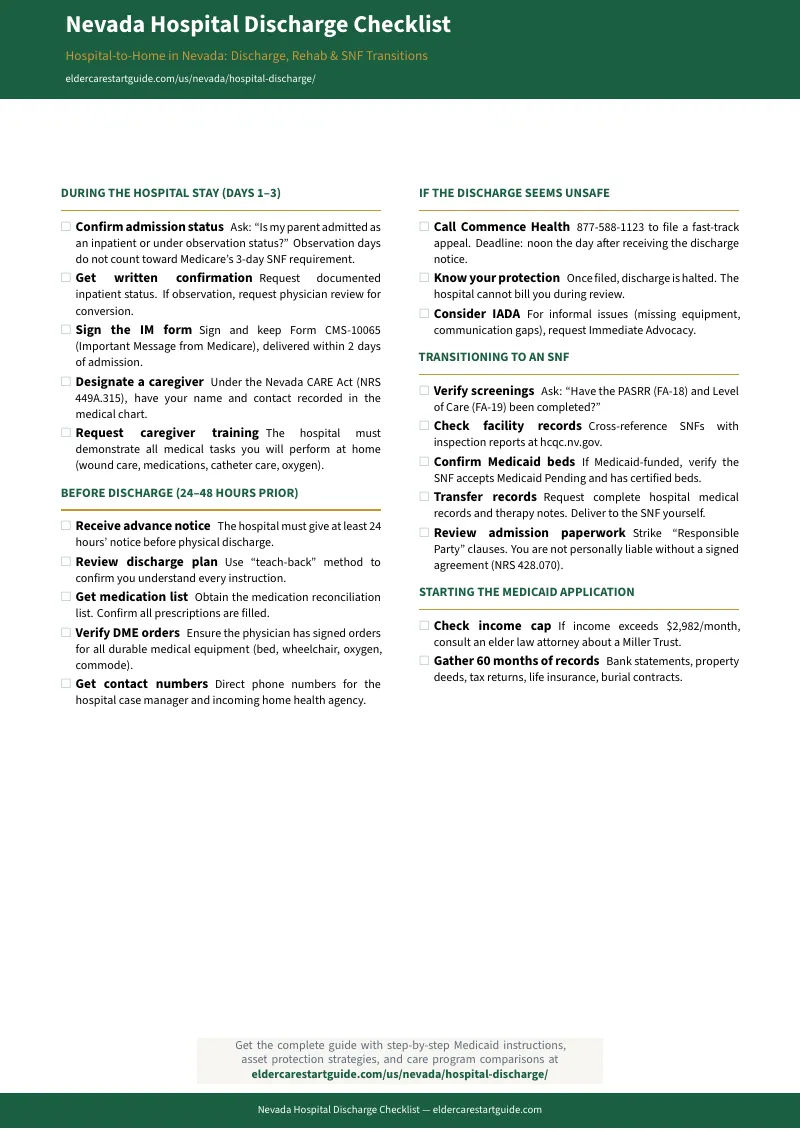
- One-page discharge checklist — 20-item rapid-reference checklist for bedside use
- 10 standalone printable worksheets — QIO Appeal Protocol, Observation Status Audit, ADSD Waiver Navigator, Medicaid Pending Shield with patient liability calculator, Miller Trust Builder, Asset Protection Toolkit, CARE Act Compliance Checklist, Home Safety Preparation Checklist, Contact Directory with every phone number and financial threshold, and SNF Evaluation Worksheet
- Filial Responsibility Reference — what Nevada law actually says about your personal liability, and how to protect yourself during facility admission
- Medicaid Application Document Checklist — every document you need to gather for the 60-month look-back, organized by category
Satisfaction Guarantee
If the guide doesn't help you navigate your parent's transition, email us and we'll refund your purchase. No forms, no waiting period.
— Less Than One Hour of Elder Law Attorney Time
Nevada elder law firms typically charge $300 to $500 per hour. This guide won't replace an attorney for complex trust or guardianship work — but it will help you organize your parent's financial and clinical documents so that if you do consult one, you arrive fully prepared and save hours of billable time.
Download the free checklist to see the approach. When you're ready for the full blueprint, the complete guide is here.