
Your Parent Needs Help at Home. Nevada Has Programs That Pay for It — But Two Separate Agencies Guard the Door.
Your parent is struggling. Maybe they fell last month. Maybe they just stopped cooking, stopped showering, started leaving the front door unlocked at night. Either way, you're the one who noticed, and now you're the one trying to figure out how to keep them safely at home without watching their savings vanish at $30 per hour for private care.
You searched "Medicaid home care Nevada" and discovered that the state has programs — waivers, personal care services, something called COPE. But then you called Nevada Care Connection and got transferred. You called DWSS about financial eligibility and were told to also contact ADSD for the functional assessment. You learned that your county social services office can't actually approve any of this. And nobody told you that the waiver you need has a waitlist — or that your parent's income might be $200 too high to qualify unless you set up something called a Miller Trust.
Meanwhile, you priced out private home care. In Las Vegas, agencies charge $28 to $35 per hour. Full-time care runs $6,700 to $8,400 per month. Your parent's Social Security and pension won't cover it, and their savings will be gone in under two years.
The Nevada Home Care Navigation System
This is not a list of program definitions from the ADSD website. It is the process around the programs — the part that $300-to-$500-per-hour elder law attorneys explain in billable consultations and that state caseworkers never have time to walk you through.
The guide covers every step from the first crisis call to Nevada Care Connection through securing state-funded home care, establishing legal authority with Nevada's statutory POA forms, qualifying for Medicaid under the $2,000 asset limit and $2,982 income cap, choosing between PCS and the Frail Elderly Waiver, getting paid as a family caregiver through an ISO, protecting the family home from estate recovery, and managing care long-term — organized in the order you will actually need them.
Nevada's system has a structural trap most families discover too late: two separate state divisions — DWSS for financial eligibility, ADSD for clinical assessment — must both approve your parent before any Medicaid home care begins. County social services offices cannot authorize Medicaid HCBS waivers. If you call the wrong office first, you lose weeks while your parent waits without funded care.
What's Inside
- Crisis Response Roadmap — Your parent is being discharged or just had a safety failure at home. This section tells you exactly who to call (Nevada Care Connection — Southern NV: 702-364-2273 / Northern NV: 877-861-1893), what to request from the hospital discharge planner, how to get a clinical assessment started through ADSD, and how to establish legal authority with Nevada's statutory Power of Attorney forms before your parent's capacity declines further.
- Dual-Agency Application Walkthrough — The complete process for navigating DWSS (financial) and ADSD (clinical) simultaneously. How to submit the DWSS 2960-EG application for Medicaid financial eligibility, what the ADSD assessor evaluates during the in-home Level of Care screening, how to document your parent's worst-day capabilities to ensure adequate care hours, and the specific strategies for passing the nursing-facility-level-of-care threshold.
- Programs Compared Side by Side — State Plan Personal Care Services (entitlement, no waitlist) versus the Frail Elderly Waiver (not an entitlement, ~4,419 slots, waitlist common) versus COPE (state-funded, no Medicaid required) versus PACE (all-inclusive, capitated). Each program's eligibility criteria, service packages, application processes, and practical trade-offs — compared in one place so you know where to apply and in what order.
- Miller Trust Setup and Financial Strategy — If your parent's monthly income exceeds $2,982, they need a Qualified Income Trust (Miller Trust) to qualify for Medicaid home care. The guide explains how the trust works, what it must contain to satisfy Nevada Medicaid, and the legitimate spend-down strategies for assets above the $2,000 limit — including home modifications, irrevocable burial trusts, and mortgage payoff. Many families with straightforward finances can prepare the trust without a full legal engagement.
- 60-Month Lookback and Estate Recovery — Nevada's Medicaid program reviews 60 months of financial transfers before the application date. The guide explains what triggers a penalty period, which transfers are exempt, and how Nevada's Medicaid Estate Recovery program works — including the critical fact that Nevada defines the recoverable estate broadly enough to reach non-probate assets like living trusts, joint tenancies, and life estates. It also details every protection: no liens while your parent resides in the home, automatic deferrals for surviving spouses, children under 21, and disabled children.
- Getting Paid as a Family Caregiver — Two paths: the Medicaid self-directed PCS program through an Intermediary Service Organization (ISO) that handles payroll, timesheets, and background checks, or the state-funded COPE program for families who don't qualify for Medicaid. The guide clarifies that Nevada Medicaid excludes spouses and legal guardians from PCS compensation — but adult children, siblings, and other relatives are eligible. Step-by-step background check, enrollment, and timesheet compliance.
- Legal Authority Without Court — Nevada's statutory Power of Attorney under NRS 162A lets you establish financial and healthcare decision-making authority without petitioning for guardianship. The guide covers both the Financial POA and the Advance Directive for Health Care, explains when each is needed, and walks you through execution requirements (notarization, witnesses, capacity). If capacity is already lost, it explains the guardianship petition process and its costs.
- Home Safety and Modification Funding — Room-by-room safety assessment for fall risks, cognitive hazards, and nutritional gaps, plus the funding map: the Assistive Technology for Independent Living (AT/IL) program through ADSD, the RAMP program from Nevada Senior Services for ramps and grab bars, and VA housing grants (HISA, SHA, SAH) for veterans. The Frail Elderly Waiver does not cover home modifications — families who don't know this waste months applying through the wrong channel.
- Agency Vetting and Hiring — How to verify an agency's license through the Nevada Bureau of Health Care Quality and Compliance, the minimum training requirements under NAC 449 (8 hours annually), questions to ask about caregiver background checks, back-up coverage protocols, and the critical difference between agency-directed and self-directed care arrangements. Plus a printable Agency/Provider Evaluation Scorecard.
- Community Safety Net — COPE for middle-income seniors, Older Americans Act programs through the Area Agency on Aging (meals, transportation, legal assistance), the National Family Caregiver Support Program (free respite, no income test), the Southern Nevada Respite Voucher Program through the Alzheimer's Association, PACE, adult day care, and county-level homemaker services.
Plus: 4 Printable Worksheets and a 20-Item Resource Checklist
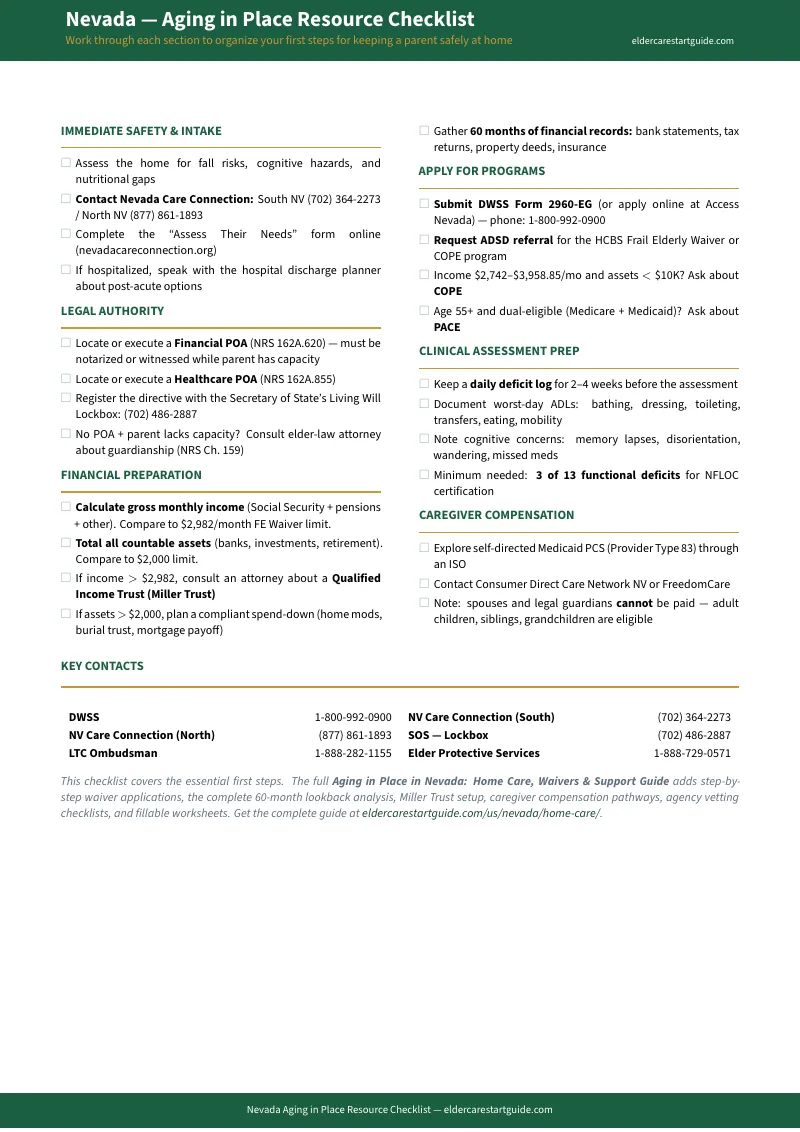
- Nevada Aging in Place Resource Checklist — A 20-item action list organized by priority: immediate safety assessment, legal authority steps, financial preparation against the $2,000/$2,982 limits, program applications, and ongoing management tasks.
- Financial Eligibility Pre-Screen — Tally every income source and countable asset against Nevada Medicaid limits, with Miller Trust guidance and exempt-asset categories.
- 60-Month Document Gathering Checklist — Complete list of financial records needed for the lookback review: bank statements, tax returns, property deeds, insurance policies, and transfer documentation.
- Functional Deficit Log — Structured form for documenting your parent's worst-day capabilities across ADLs, cognitive function, and safety concerns — designed to support the ADSD assessor's Level of Care determination.
- Agency/Provider Evaluation Scorecard — Side-by-side comparison template for evaluating home care agencies on licensing, training, coverage, specializations, and cost.
Who This Is For
- Adult children whose parent is being discharged from the hospital and someone needs to figure out how to pay for home care that costs $6,700 to $8,400 per month in Nevada
- Families who know their parent qualifies for some kind of Medicaid home care but can't figure out whether to call DWSS, ADSD, or Nevada Care Connection first — or what to do when one agency says the other agency handles it
- Caregivers providing full-time care who need income and want to get paid through the Medicaid self-directed PCS program or COPE but don't know how to navigate the ISO enrollment, background checks, or timesheet requirements
- Families whose parent's income is $200 above the Medicaid cap and who need to understand what a Miller Trust is, whether they need a lawyer to set one up, and how quickly it takes effect
- Anyone who heard that "Medicaid takes your house" and wants to understand what Nevada's estate recovery program actually reaches — and what the specific protections are
- Out-of-state siblings coordinating a Nevada parent's care remotely with no idea which of the state's multiple agencies to contact first
Why Not Free Government Resources?
The ADSD publishes program descriptions. Nevada Care Connection has a screening form. DWSS has application forms you can download. The Division of Health Care Financing and Policy posts waiver regulations.
Here is what none of them provide:
- A step-by-step dual-agency application strategy showing you how to run the DWSS financial track and the ADSD clinical assessment in parallel — instead of discovering after six weeks that you needed to file with both agencies from the start
- An assessment preparation guide that explains how the ADSD caseworker scores your parent's Level of Care and how to document functional deficits on the parent's worst days — not best days — to avoid an inadequate care-hour authorization
- A program comparison that puts PCS, the Frail Elderly Waiver, COPE, and PACE side by side with eligibility criteria, service differences, and waitlist reality — not four separate brochures on four different state websites
- A Miller Trust explanation in plain language — when you need one, what it must contain, and whether your parent's situation is straightforward enough to set up without an elder law attorney
- An estate recovery analysis explaining which ownership structures Nevada can reach after death (including non-probate assets) and which are protected — not a "consult a lawyer" footnote
Government sites publish regulations. This guide compiles fragmented state, federal, and county data into a single, sequential process you can follow from crisis to stable home care — without paying an elder law attorney $300 to $500 per hour to explain things you can learn yourself.
Your Parent's Safety Net
Every week you spend researching is a week your parent goes without the funded care they may already be entitled to. Medicaid PCS applications are processed based on the date of filing — but only if you file.
Get the guide. File the forms. Start the clock.
Get the Nevada Home Care Guide →
The free checklist gives you the 20-item action list to start immediately. The full guide gives you every chapter, every form reference, every spend-down strategy, and the complete dual-agency application framework.