
Your Parent Has Dementia. Nevada Has Three Separate Agencies. Nobody Gave You a Map.
The neurologist just said "moderate Alzheimer's." The hospital discharge planner is telling you to "explore options." But every option in Nevada runs through a different state division — ADSD handles the functional assessment, DWSS determines financial eligibility, DHCFP manages provider billing — and none of them share a single intake form or phone tree.
Meanwhile, private memory care in Las Vegas is running $5,000–$6,250 a month. Your parent's savings would last 18 months at best. You've heard Medicaid might help, but you're also hearing about estate recovery liens, a 60-month look-back period, and a court case called Ullmer that lets Nevada place a lien on the family home even while a surviving spouse lives in it.
You need answers, not another pamphlet.
The Nevada Memory Care Transition System
This isn't a collection of tips about "staying positive" or a directory of facilities. It's a structured system for navigating Nevada's specific dementia care bureaucracy — the three-division maze, the Medicaid waiver pathways, the asset protection rules, and the legal authority steps you need to take before your parent loses the capacity to sign documents.
The guide translates Nevada's regulatory language into decision sequences: which program to apply for based on your parent's income bracket, how to document functional deficits so the ADSD assessment reflects reality instead of a good-day visit, and exactly which assets are vulnerable to recovery after death under NRS 422.054.
What's Inside
- Three-Division Navigation Roadmap — The complete pathway through ADSD (functional assessment), DWSS (financial eligibility), and DHCFP (provider authorization). Covers who to call first, what forms each division requires, and how to avoid the common mistake of starting at county social services instead of state-level intake.
- NFLOC Self-Assessment Worksheet — A pre-visit tool that mirrors the 13-point functional deficit scoring system Nevada uses to determine waiver eligibility. Families frequently downplay symptoms during evaluations — this worksheet helps you document medication management problems, ADL deficits, and cognitive-behavioral issues accurately before the state assessor arrives.
- Frail Elderly Waiver vs. COPE Decision Guide — Side-by-side comparison of Nevada's two main community-based programs. The FE Waiver requires Medicaid eligibility ($2,000 assets, $2,982/month income cap) and a minimum NFLOC score of 3. The COPE program fills the gap for middle-income families ($2,742–$3,958.85/month income, $10,000–$30,000 asset limits). The guide shows exactly which pathway fits your parent's financial profile.
- Memory Care Facility Inspection Checklist — Nevada doesn't license "memory care" as a standalone category — facilities operate under a Residential Facility for Groups license with a dementia-care endorsement from the Bureau of Health Care Quality and Compliance. This checklist covers the mandatory 1:6 caregiver ratio, 8-hour annual staff training requirement, secured perimeter standards, and how to verify endorsements using the HCQC database.
- 60-Month Financial Organizer — A structured document-gathering system organized around Nevada's Medicaid look-back rules. Covers which bank records, property deeds, vehicle titles, and transfer documents you need, and explains the 2026 nursing home divisor of $9,949.26 used to calculate transfer penalties.
- Estate Recovery Protection Guide — Plain-language explanation of Nevada's expanded "undivided estate" recovery rules under NRS 422.054 and the Ullmer ruling. Covers the Community Spouse Resource Allowance (up to $162,660 in 2026), the child caregiver exemption, irrevocable burial trusts, and allowable home modifications — the legitimate protections that are available before professional legal counsel.
- Legal Authority Timeline — When to execute a Durable Power of Attorney for Healthcare, how to work with mobile notaries under the 2026 competency guidelines, the legal standard for capacity in Nevada (understanding what you own, who your family is, and what the document does), and the full guardianship process for families who waited too long.
- Silver Alert and Wandering Prevention Protocol — The six statutory criteria for activating a Nevada Silver Alert, the 72-hour filing window, highway sign activation requirements, and GPS tracking options for the home environment.
- Cost Comparison Worksheets — Side-by-side cost planning across all care levels: Adult Day Health (~$1,809/month), assisted living (~$5,000/month), memory care ($4,688–$6,250/month), and skilled nursing ($9,733–$10,646/month) using Nevada-specific rates.
- Qualified Income Trust (Miller Trust) Setup Guide — Step-by-step instructions for establishing a QIT when your parent's income exceeds the $2,982/month Medicaid cap but their care needs clearly require waiver services.
Who This Is For
- Adult children in Nevada managing a parent with dementia or Alzheimer's — especially if the diagnosis came with no roadmap for what to do next
- Families facing a memory care placement decision and trying to understand facility licensing, costs, and which programs offset the bill
- Caregivers who need to establish legal authority before their parent loses the capacity to sign documents
- Anyone starting the Medicaid waiver process in Nevada who wants to avoid application mistakes that trigger denial or penalty periods
- Families concerned about Medicaid estate recovery and the family home
Why Not Just Use Free Resources?
Nevada Care Connection has options counseling. The ADSD website has the waiver applications. But the information is spread across three separate state divisions, each with its own forms, phone numbers, and eligibility criteria. Options counselors can explain programs but are prohibited from filling out applications or recommending financial strategies. And none of the free resources will tell you how the Ullmer ruling affects your parent's home, what score your parent needs on the 13-point functional assessment, or that starting at county social services instead of state-level ADSD intake delays the entire process.
Private elder law attorneys in Las Vegas and Reno provide customized planning — at $300–$500 per hour. A full Medicaid planning engagement can run $5,000–$15,000. This guide doesn't replace professional legal counsel for complex trust and estate work. But it prevents the common mistakes that make urgent legal counsel necessary, and helps you arrive at an attorney's office with organized documents and clear questions instead of spending billable hours learning terminology.
Satisfaction Guarantee
If the guide doesn't give you a clearer path forward within 48 hours, email us for a full refund. No hoops, no forms.
— Less Than One Hour of Elder Law Advice
For a fraction of what a single consultation costs, you get the complete system: three-division navigation, NFLOC self-assessment, waiver eligibility comparison, facility inspection tools, financial organizers, estate recovery protections, legal authority planning, and every worksheet you need to navigate your parent's care transition in Nevada.
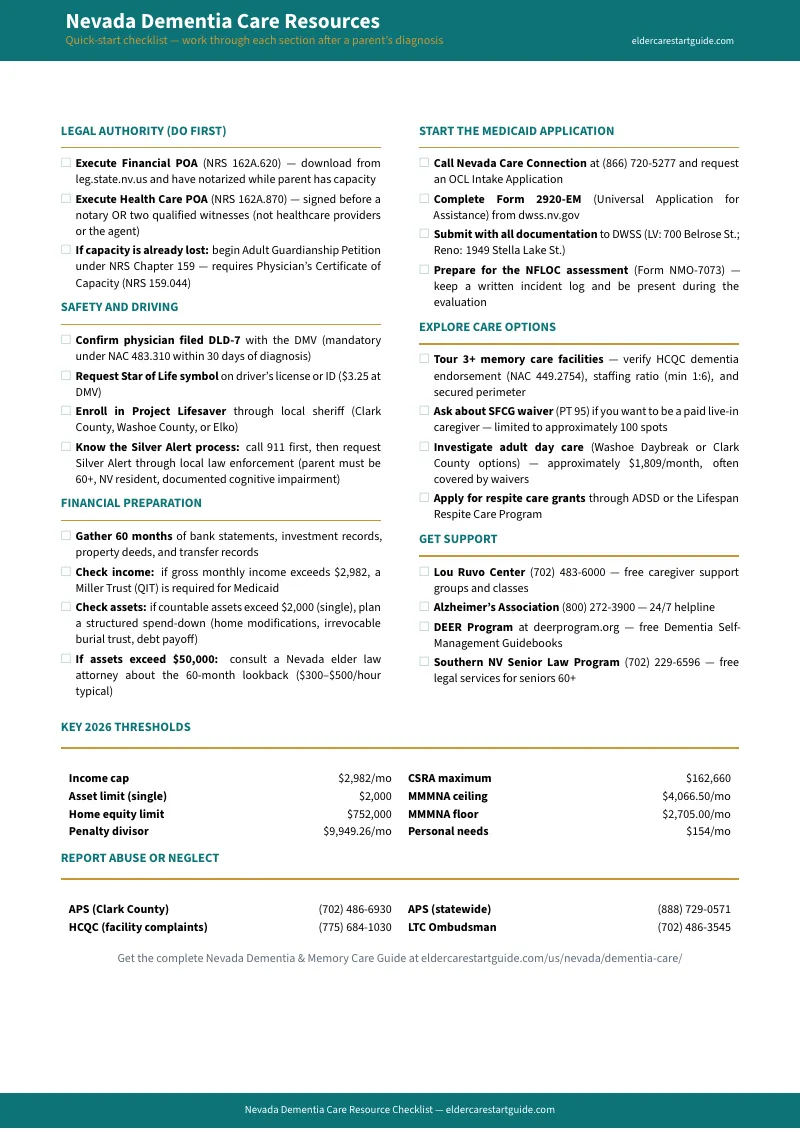
Download the free one-page checklist to see the framework, or get the full guide with all 13 chapters plus 10 standalone printable tools — the NFLOC self-assessment worksheet, 60-month financial organizer, facility inspection checklist, cost comparison worksheets, legal authority timeline, Silver Alert and wandering prevention protocol, waiver comparison guide, estate recovery protection guide, Miller Trust setup guide, and Medicaid application steps.