
Your Parent Needs More Help. Nevada's Care System Has Rules Nobody Told You.
Your parent fell last week. Or maybe it wasn't a fall — maybe it was the third time in a month you found spoiled food in the refrigerator, or the neighbor called because your parent was wandering the street at dusk. Something shifted, and now you're awake at 2 AM searching "assisted living in Nevada" while trying to figure out how any of this works.
You called the county social services office. They couldn't help — because Nevada doesn't run long-term care through counties. You looked at assisted living costs and discovered that "assisted living" in Nevada isn't even a standalone license — it's an endorsement on a Residential Facility for Groups permit. You found out that Medicaid might help pay for home care, but the Frail Elderly Waiver has over 2,100 people on the waitlist. And you learned that Nevada is an income-cap state, which means if your parent earns more than $2,982 per month, Medicaid will deny them outright — unless they set up something called a Qualified Income Trust that nobody at the state agency mentioned.
Meanwhile, the clock is ticking. Your parent's safety needs are real. The care decisions you make in the next few weeks will shape their quality of life and your family's finances for years.
The Nevada Care Decision Navigation System
This is not a list of phone numbers you can find on ADSD's website. It is the process around the system — the part that elder law attorneys explain for $300 to $500 an hour and that state agency portals bury across a dozen websites.
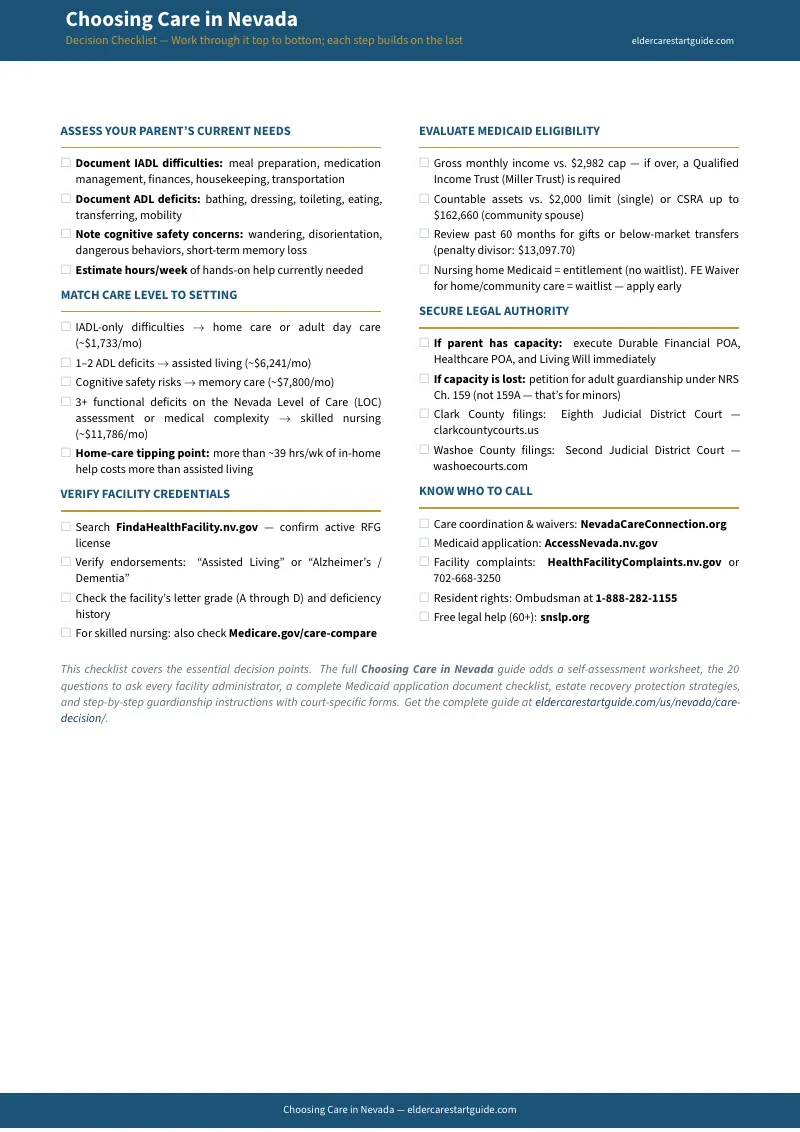
The guide walks you through every decision in the order it actually arrives: recognizing when your parent's needs have outgrown their current situation, understanding what each care level provides and costs, evaluating facilities using the state's own inspection data, navigating Medicaid eligibility and the Frail Elderly Waiver, protecting the family home from estate recovery, and securing the legal authority you need to act on your parent's behalf. Every threshold, every deadline, every contact is specific to Nevada.
What's Inside
- How Nevada's Eldercare System Actually Works — The three state agencies you need to know (DWSS for financial eligibility, DHCFP for coverage policy, ADSD for care coordination), why county social services can't unlock home care waivers, and the critical difference between nursing home Medicaid (entitlement, no waitlist) and the Frail Elderly Waiver (capped slots, months-long waitlist). Understanding this structure before you pick up the phone saves weeks of dead-end calls.
- Functional Self-Assessment Worksheet — A structured tool modeled on the state's 13-point Level of Care assessment. Document your parent's IADL and ADL deficits, cognitive safety concerns, and hours of care needed — so you walk into the state assessment with accurate data instead of underreporting your parent's needs and getting denied.
- Nevada's Licensing System Decoded — There is no "assisted living license" in Nevada. Facilities operate as Residential Facilities for Groups with specific endorsements. The guide explains what each endorsement covers, how to verify credentials on the HCQC database, what the state letter grades (A through D) actually measure, and the specific requirements for the Alzheimer's and Dementia endorsement (locked exits, 1:6 staffing ratio, secure outdoor access). Knowing these rules before you tour keeps you from paying memory care prices for a facility that doesn't hold the endorsement.
- Facility Evaluation System — 20 Questions for Every Tour — The questions administrators hope you don't ask: night and weekend staffing ratios, involuntary discharge criteria, medication management protocols, hospice coordination policies, and bed-hold rules during hospitalizations. Plus the contract provisions to insist on before signing — because the marketing brochure and the admission agreement are not the same document.
- 2026 Cost Breakdown by Care Setting — Current median costs for home care ($7,055/month at 44 hours per week), adult day care ($1,733/month), assisted living ($6,241/month), memory care ($7,800/month), and skilled nursing ($11,786 to $14,463/month). Includes a cost projection worksheet and the tipping-point calculation for when home care costs more than assisted living — because many families overpay for in-home care when residential care would be both safer and cheaper.
- Medicaid Eligibility — Every Threshold, Every Rule — The 2026 income cap ($2,982/month), the $2,000 countable asset limit, the $162,660 Community Spouse Resource Allowance, the 60-month look-back period, and the penalty divisor for uncompensated transfers. Plus the complete Qualified Income Trust (Miller Trust) walkthrough — the mechanism Nevada requires for anyone over the income cap, since the state has no spend-down option.
- Estate Recovery Protection — Nevada's Medicaid Estate Recovery Program recovers from the "undivided estate," including joint tenancies, living trusts, and deeds upon death — not just probate assets. The guide covers the specific exemptions (surviving spouse, disabled child, caretaker child who lived in the home), the hardship waiver process, and the planning considerations that determine whether the family home is vulnerable after your parent passes.
- Legal Authority — POA and Guardianship — If your parent still has capacity: the Durable Financial POA, Healthcare POA, and Living Will/Advance Directive they need to sign now. If capacity is already gone: the full adult guardianship petition process under NRS Chapter 159, including physician capacity assessment, court-appointed visitor investigation, notice to relatives, and the ongoing reporting obligations that make guardianship a permanent administrative commitment.
- Hospital Discharge Under Pressure — Your parent's right to appeal a discharge, what to demand from the hospital social worker before your parent leaves, and how to bridge the gap when home care services or facility placement aren't immediately available. This chapter exists because most families face their biggest care decision during the worst possible moment — a 48-hour hospital discharge window with no plan in place.
- Complete Medicaid Application Walkthrough — The document checklist, the AccessNevada submission process, what happens after you file, the timeline for approval, and exactly what to do if the application is denied — including the fair hearing process.
Who This Is For
- Adult children whose aging parent is declining and who need to determine the right care level — home care, assisted living, memory care, or skilled nursing — under Nevada's specific system
- Families trying to qualify a parent for Medicaid long-term care but confused by Nevada's income-cap rules, the Qualified Income Trust requirement, and the $2,000 asset limit
- Caregivers who need to evaluate assisted living or memory care facilities and want to verify licensing endorsements, read inspection histories, and ask the right questions on tours
- Families facing a hospital discharge and needing to make placement decisions under pressure — with no existing care plan
- Anyone who needs legal authority to manage a parent's care and finances but isn't sure whether a Power of Attorney is still possible or if guardianship is the only option
- Families concerned about Nevada's aggressive estate recovery program and looking to understand what protections exist for the family home
Why Not Free Government Resources?
ADSD publishes program descriptions. AccessNevada has application forms. The HCQC database lists licensed facilities. Nevada Care Connection answers general questions.
Here is what none of them provide:
- A decision sequence that tells you what to evaluate first, what to apply for second, and what documents to have ready at each step — not a directory of agencies arranged alphabetically
- The Qualified Income Trust explained in plain language — why you need one, how it works, what income goes in and what comes out — instead of a single line on the DHCFP website that says "contact an attorney"
- The facility licensing endorsement system explained so you understand that "memory care" is a marketing term and the Alzheimer's/Dementia endorsement is the regulatory reality — and what happens if the facility your parent lives in doesn't actually hold it
- The estate recovery exposure analysis that shows exactly how Nevada's "undivided estate" recovery standard differs from the probate-only standard used in most states — and what that means for the family home
- A self-assessment tool that uses the same functional categories as the state's Level of Care instrument, so you can gauge your parent's needs before the official evaluator arrives
State agencies administer programs. Elder law attorneys explain them at $300 to $500 per hour. This guide bridges the gap — translating hundreds of pages of Nevada Revised Statutes, administrative codes, and agency procedures into a sequence you can work through in an evening.
Satisfaction Guarantee
If the guide doesn't give you a clearer path forward for your parent's care in Nevada, email [email protected] and we'll make it right.
— Less Than One Hour of an Elder Law Attorney's Time
An initial consultation with a Nevada elder law attorney runs $300 to $500. A Medicaid planning engagement can exceed $5,000. A guardianship proceeding adds thousands more in court costs and legal fees.
This guide won't replace an attorney for complex trust litigation or multi-state asset planning. But for the care-level assessment, facility vetting, Medicaid eligibility analysis, and application process that most Nevada families need, it covers the full navigation at a fraction of the professional cost — and if you do need an attorney, you'll walk in with organized records and the right questions instead of starting from zero.
Start with the free checklist to see if the approach fits your situation. The full guide goes deeper — every threshold, every contact, every strategy, every form.