Your parent's nursing home bill is $8,000 a month. Every day without a plan costs your family real money.
The hospital discharge planner just told you that your parent cannot go home safely. The nursing facility admissions office wants either a private-pay commitment or proof that a Medicaid application is in progress. And you have just discovered that a semi-private room in Nebraska costs between $8,000 and $9,000 per month — roughly $96,000 to $108,000 a year.
You start searching online for answers. But what you find is almost entirely wrong for Nebraska. National senior care websites tell you the asset limit is $2,000 and that your parent needs a Miller Trust if their income is too high. In Nebraska, neither of those rules applies. The asset limit is $4,000. There is no income cap and no Miller Trust requirement. Nebraska uses a completely different system — a medically needy spend-down — that most national guides do not even mention.
The generic advice does not just waste your time. It leads families to hire attorneys for trusts they do not need, to panic over income thresholds that do not exist in Nebraska, and to miss the state-specific strategies that could protect tens of thousands of dollars in family assets.
The Nebraska Medicaid Protection System — one guide built entirely around how Nebraska actually works.
This is not a national overview with a Nebraska footnote. Every dollar figure, every eligibility rule, every form reference, and every planning strategy in this guide is built from Nebraska's administrative code, DHHS regulations, and the actual processes that families encounter when they walk into a county office or file through iServe Nebraska.
The result is a step-by-step system that takes you from "my parent needs care and I don't know how to pay for it" to a completed, defensible Medicaid application — without the $3,000 to $7,000 in elder law fees that crisis planning typically requires.
What's Inside
- The Nebraska Funding Comparison — a side-by-side breakdown of private pay, Medicare, institutional Medicaid, the Aged and Disabled Waiver, and PACE through Immanuel Pathways. You will know exactly which program fits your parent's clinical needs and financial situation before you make a single call.
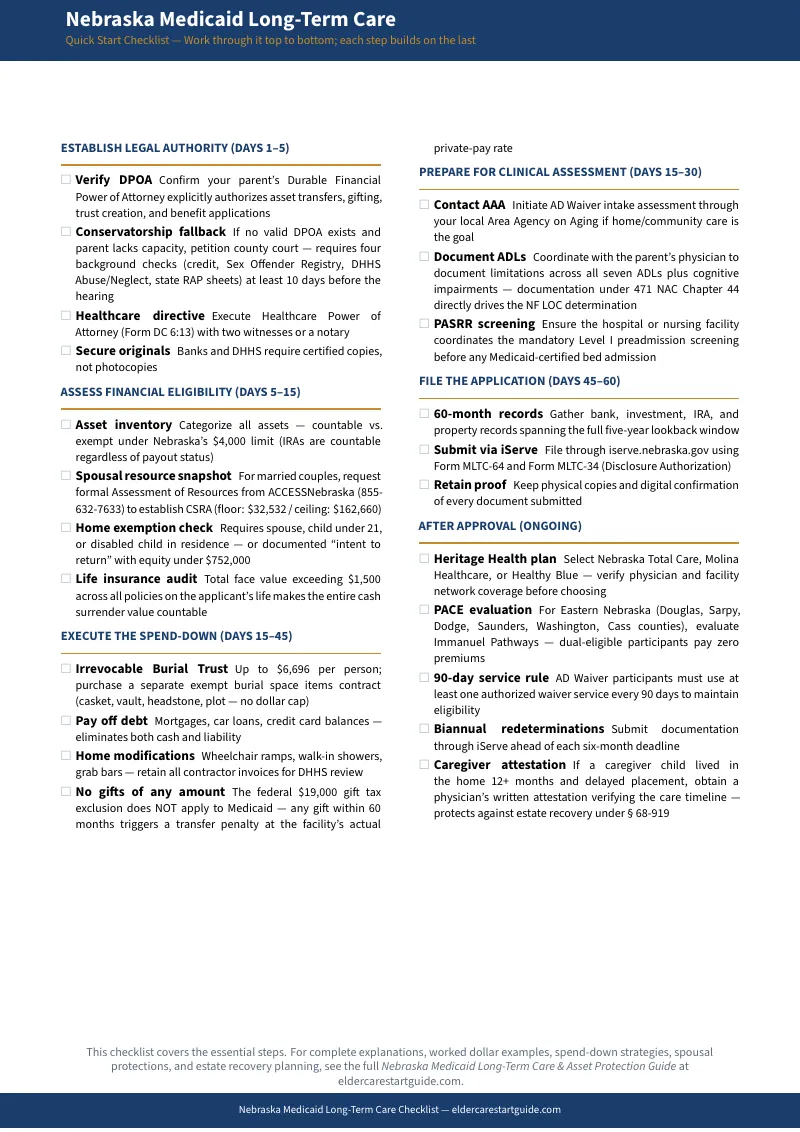
- The Asset Categorization Worksheet — Nebraska treats IRAs as countable, exempts burial trusts up to $6,696, and uses a $4,000 limit instead of the federal $2,000 default. The worksheet walks through every asset type your parent owns and tells you exactly how Nebraska classifies it — countable or exempt.
- The Spend-Down Strategy Guide — state-approved ways to reduce excess assets legally: home accessibility modifications, mortgage and debt payoff, irrevocable burial trusts, and vehicle purchases. Each strategy includes the documentation requirements that prevent DHHS from treating it as a disqualifying transfer.
- The Spousal Protection Calculator — step-by-step calculations for the Community Spouse Resource Allowance (50% of joint assets, floor of $32,532, ceiling of $162,660) and the Minimum Monthly Maintenance Needs Allowance ($2,705/month, adjustable up to $4,066.50 when housing costs exceed the $812 shelter standard). Your healthy spouse will know exactly what they can keep.
- The Lookback Audit Worksheet — a 60-month financial review template that identifies every transfer DHHS will flag. It includes the penalty calculation formula (total transfers divided by the specific facility's private-pay rate), fractional-month rules, and the process for resolving penalties through asset return.
- The iServe Application Walkthrough — a screen-by-screen guide to Nebraska's online benefits portal, including which forms to submit, how to complete the assets and income sections, and a documentation checklist covering 60 months of bank statements, deeds, insurance policies, and burial arrangements.
- The Clinical Assessment Prep Guide — what the Nursing Facility Level of Care assessment actually measures (ADL limitations, risk factors, cognitive impairment) and how to document your parent's condition accurately so the assessment reflects their real care needs. Includes the PASRR preadmission screening timeline.
- The Estate Recovery Protection Checklist — Nebraska's expanded recovery program under § 68-919 reaches joint tenancies, transfer-on-death deeds, and living trusts. The checklist explains which exemptions apply, including the caregiver-child exemption that requires two years of documented in-home care.
- The AD Waiver and LRI Guide — how to access the Aged and Disabled Waiver for in-home care and assisted living, navigate the DHHS service coordinator transition, and register a family member as a paid caregiver through the Legally Responsible Individual program — including the DD-26 assessment and shift documentation requirements.
Who This Is For
- Adult children managing a parent's hospital-to-facility transition — you need to understand Nebraska's eligibility rules and get a Medicaid application filed before private-pay costs consume the savings.
- Families protecting the community spouse — your mother or father is entering a nursing home, and the spouse at home needs to keep enough to live on. The CSRA and MMMNA calculations tell you exactly how much.
- Caregivers exploring the AD Waiver as an alternative to a nursing home — your parent wants to stay home, and you need to know whether the waiver covers it, what the spending caps mean, and how the LRI program works.
- Families planning ahead before a crisis hits — your parent is in early decline and you hold power of attorney. You want to understand estate recovery and spend-down rules before making any financial moves.
Why Free Online Resources Get Nebraska Wrong
Free senior care websites generate revenue by selling leads to care facilities and law firms. Their content is written from national templates that default to federal rules — the $2,000 asset limit, the Miller Trust requirement, the standard income cap. None of those apply in Nebraska.
When a Nebraska family follows national advice, they waste weeks preparing Miller Trust paperwork that no one will accept, panic over income thresholds that do not exist here, or miss the medically needy spend-down pathway that could have simplified their entire application. Some families hire an attorney specifically to set up a trust that Nebraska does not require — paying $1,500 to $3,000 for a document that goes straight into a drawer.
This guide is built from Nebraska DHHS administrative code, not national templates. When the national advice and the Nebraska rules conflict, this guide gives you the Nebraska answer — because that is the only answer that matters when your application lands on a DHHS caseworker's desk.
100% Satisfaction Guarantee
If this guide does not help your family navigate Nebraska's Medicaid system with more clarity and confidence, email us and we will refund your purchase. No forms, no justification required.
Start Protecting Your Family's Assets Today
Every month without a plan is another $8,000 to $9,000 in private-pay costs draining your parent's savings. The guide gives you the system to stop the bleeding — qualify for Medicaid coverage, protect the community spouse, and shield the family estate from expanded recovery.
Download includes: the complete 48-page guide, an eligibility checklist, an asset categorization worksheet, a spousal protection calculator, a spend-down strategy planner, a lookback audit worksheet, an iServe documentation checklist, a family emergency financial file, a medical wishes letter template, and an annual review form.
Get the free checklist to see Nebraska's eligibility rules at a glance — or get the full Nebraska Medicaid Long-Term Care & Asset Protection Guide for the complete system, every worksheet, and step-by-step application support.