
The Hospital Says Your Parent Is Going Home Tomorrow. You Haven't Slept in Two Days. Nobody Mentioned That One Phone Call Can Legally Freeze the Discharge.
It's 9 PM. The case manager told you this afternoon that your parent — the one who still can't walk to the bathroom after a hip fracture — is being sent home in the morning. You don't have a hospital bed at home. No physical therapist is lined up. The new medication list doesn't match what your parent was taking before the fall. And the case manager left for the day without explaining what happens next.
You start searching online and find fragments: something about Medicare appeals, a mention of a QIO, a Reddit thread about Nebraska's Aged and Disabled Waiver. But you can't figure out the sequence. Which call do you make first? What's the deadline? What happens if you miss it?
Here's what most Nebraska families don't learn until it's too late: one phone call to Commence Health at 1-888-755-5580 before midnight on the scheduled discharge day triggers an immediate, legally binding freeze. The hospital cannot move your parent. Medicare continues to pay. And the burden shifts from you to the hospital to prove the discharge is safe. That single call is worth more than the social worker's entire discharge packet — but nobody in the hospital is going to suggest it, because their job is to clear the bed.
The Nebraska Discharge Navigation System
This isn't a pamphlet summarizing your rights. The Nebraska Discharge Navigation System maps the exact sequence of calls, forms, assessments, and deadlines you need to follow — from the moment your parent is admitted through post-discharge home care setup and Medicaid eligibility — so you don't lose leverage because you acted in the wrong order.
The critical mistake most families make: they accept the discharge, scramble to arrange home care, and only discover their appeal rights after the window has closed. By that point, the hospital bed is gone, Medicare's coverage clock has restarted, and they're paying out of pocket for rehabilitation their parent was entitled to receive.
The guide puts you in the right order: verify admission status on day one (observation vs. inpatient changes everything), invoke your right to a Detailed Notice of Discharge, file an appeal through Commence Health if the discharge is premature, choose a rehab facility using CMS Care Compare data instead of the hospital's recommended list, prepare for the interRAI assessment while clinical documentation is fresh, and build a Medicaid spend-down plan before your parent's savings evaporate at $8,000 a month in private-pay nursing home costs.
What You Get
- 14-Chapter Guide (48 pages) — The complete Nebraska Discharge Navigation System: verifying admission status and the observation status trap, your discharge rights under federal law and the Commence Health QIO appeal process, PASRR screening for post-acute placement, Medicare SNF coverage rules and the 3-day inpatient requirement, the Aged and Disabled Waiver and 471 NAC 44 level-of-care criteria, Medicaid financial eligibility (Nebraska's $4,000/$6,000 resource limits, MNIL of $392, and compliant spend-down strategies), spousal impoverishment protections and the Community Spouse Resource Allowance, the 60-month lookback and transfer penalties, estate recovery rules, legal authority options (POA, advance directives, CMS Form 1696, guardianship), managing the Medicaid application and "Medicaid Pending" phase, home health care and DME coverage after discharge, three worked examples (spend-down, spousal diversion, transfer penalty calculation), planning worksheets, and a complete contacts directory. Every phone number, every deadline, every Nebraska-specific rule — current for 2026.
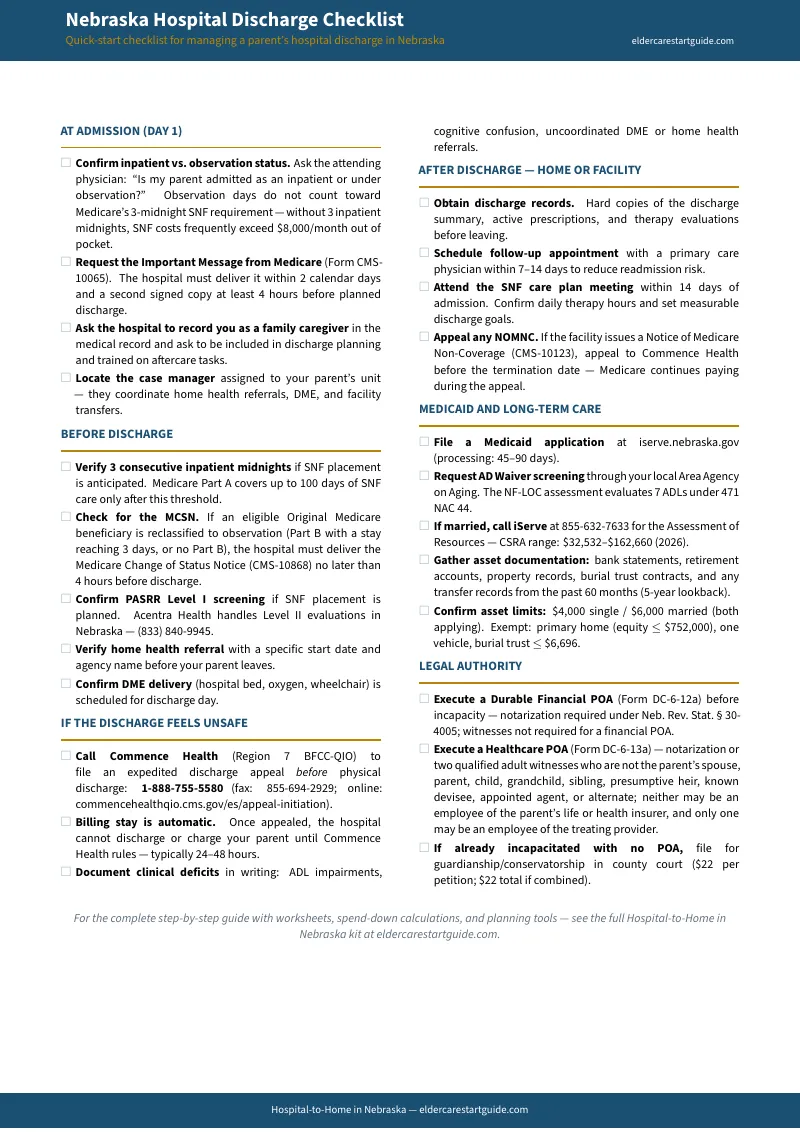
- Quick-Start Checklist (Free Download) — 24 actionable items in priority order: verify admission status, request the Important Message from Medicare, file a Commence Health appeal if needed, screen facilities using CMS Care Compare, initiate the interRAI assessment, begin Medicaid documentation, set up home health and DME, and protect yourself legally. Know exactly what to do tonight, this week, and before your parent leaves the hospital.
- 7 Printable Worksheets — Hospital Status Verification (track the three-midnight count), Discharge Appeal Preparation Sheet (compile clinical evidence for your Commence Health call), ADL Observation Log (two-week daily tracking aligned to 471 NAC 44 categories for the interRAI assessment), Medicaid Spend-Down Calculator (asset inventory and share-of-cost formula for Nebraska's $4,000/$6,000 limits), Spousal Asset Division Worksheet (CSRA split and income diversion), Facility Comparison Checklist (side-by-side evaluation of up to four facilities), and Agency Communication Log (record every call with dates, reference numbers, and outcomes).
Who This Guide Is For
- Adult children in Nebraska managing a parent's discharge from the hospital after a fall, stroke, cardiac event, or other acute crisis — especially if you've never navigated this system before
- Families facing an immediate discharge who need to know their appeal rights and the exact phone number to call before midnight tonight
- Caregivers whose parent is in a skilled nursing facility and just received a Notice of Medicare Non-Coverage — and needs to understand the QIO appeal timeline
- Middle-income families facing long-term nursing home or assisted living costs and trying to protect a parent's savings through Nebraska Medicaid's spend-down rules and spousal protections
- Adult children who lack formal Power of Attorney and believe they have no legal standing to participate in discharge decisions or manage Medicaid paperwork
- Long-distance caregivers coordinating an elderly parent's transition from Omaha, Lincoln, or a rural Nebraska county and needing every DHHS contact, AAA office number, and QIO deadline in one document
Why the Free Information Isn't Working
The hospital case manager's job is to clear the bed. Under DRG reimbursement pressure to minimize length of stay, they hand you a list of nursing homes and a stack of forms. They cannot advise you on how to legally dispute a premature discharge or how to pass the interRAI assessment that determines AD Waiver eligibility.
The Nebraska DHHS portal is the authoritative source — but the information is buried in dense regulatory PDFs written in administrative code language, scattered across dozens of pages with no step-by-step sequence. It will tell you that the NFLOC standard requires "a clinical limitation in at least three ADLs paired with a documented risk factor" under 471 NAC 44, but it won't tell you what to say when the assessor asks your parent to demonstrate a task they can't safely perform, or how to document cognitive decline in the specific language the interRAI tool measures.
The national directories — A Place for Mom, Caring.com — rank well on Google for Nebraska elder care queries, but their business model is referral fees from nursing home chains. They are structurally incentivized to move your parent into a facility, not to help you qualify for the AD Waiver that funds home care and assisted living services at no commission to them. They don't cover Commence Health appeals, the observation status trap, the interRAI assessment, or Medicaid spend-down math — because none of those generate revenue for their advertisers.
Elder law attorneys in the Omaha and Lincoln metro areas charge $250 or more per hour, with comprehensive Medicaid planning packages running $2,000 to $10,000. That's the right call for complex irrevocable trust work — and the guide tells you exactly when to hire one. But at midnight on the night before an unsafe discharge, you need a phone number and a script, not a retainer agreement. And you don't need to pay a lawyer $250 per hour to explain what documents to bring to the DHHS eligibility office or how to calculate a share of cost — that's administrative preparation, not legal advice.
What Nebraska Families Get Wrong
Nebraska's long-term care rules carry several traps that generic national guides miss entirely:
- Nebraska is not a Miller Trust state. If you buy a generic "Medicaid planning" template that includes a Miller Trust (Qualified Income Trust), it won't work here. Nebraska uses the medically needy spend-down pathway instead — a completely different mechanism with different math.
- The $4,000 resource limit is not a typo. Most states follow the federal SSI default of $2,000. Nebraska sets its single-applicant limit at $4,000 and its married-couple limit at $6,000 when both spouses apply. Generic guides that cite $2,000 lead families to spend down farther than Nebraska requires, wasting thousands of dollars.
- Service coordination just moved. As of April 2026, the League of Human Dignity no longer handles AD Waiver service coordination — DHHS does. Families following outdated information are calling a number that no longer connects them to their case manager.
- Nebraska has no filial responsibility law. Unlike Pennsylvania or New Jersey, Nebraska cannot hold you personally liable for your parent's nursing home bills. But if you sign the facility admission agreement in your own name instead of as "Authorized Representative," you may have just volunteered for a debt that the law otherwise wouldn't touch.
Satisfaction Guarantee
If this guide doesn't give you a clear, actionable path through your parent's hospital discharge in Nebraska, email [email protected]. We read every message.
— Less Than 10 Minutes of a Nebraska Elder Law Attorney's Time
Omaha and Lincoln elder law attorneys charge $250 or more per hour. A private geriatric care manager runs $150 to $250 per hour. A single missed deadline — failing to call Commence Health before midnight, letting observation status go unchallenged, signing a facility admission as yourself instead of as your parent's representative — can cost your family thousands in uncovered rehabilitation, personal liability, or an unnecessary five-year Medicaid penalty period.
This guide won't replace an attorney when you need one (and it tells you exactly when that is). But it will make sure you don't lose your appeal window because you didn't know it existed, don't accept a placement your parent can't afford because the hospital pressured you to choose in two hours, and don't fail the interRAI assessment because nobody told you what the assessor is actually scoring.
Download the free Quick-Start Checklist to see the 24 most urgent action items. When you're ready for the complete system, the full guide is waiting.