
Your Parent Needs Help at Home. Nebraska Has Two Programs That Pay for It — But the State Just Reorganized Both of Them.
Your parent left the stove on again. Or the hospital called and said "you need to arrange home care before we discharge." Now you're the one Googling "Nebraska Medicaid home care" at 11 PM, finding out that the Division of Developmental Disabilities was renamed to the Division of Disability and Aging in July 2026, that Aged and Disabled Waiver service coordination was moved from the League of Human Dignity to DHHS in April 2026, and that half the government web links from last year are broken.
You found out Nebraska has something called State Plan PAS that can pay a family member to provide care. But nobody told you that spouses and legal guardians are excluded. You also discovered that Nebraska is a "Share of Cost" state with no hard income cap — but you can't find a single page that explains how the spend-down math actually works with a Medically Needy Income Level of $392 per month.
Meanwhile, you priced out private home care. About $34 per hour for a home care aide in Nebraska. That's roughly $62,000 a year for 35 hours a week. Your parent's savings won't last two years at that rate.
The Nebraska Care Coordination System
This is not a list of eligibility rules you can find on dhhs.ne.gov. It is the process around the rules — the part that $250-to-$500/hour elder law attorneys explain in billable consultations and that overworked DHHS caseworkers don't have time to walk you through.
Nebraska recently unified its aging and disability programs under a single Division of Disability and Aging, and centralized all AD Waiver case management directly under DHHS. The guide maps this new administrative reality — not the pre-2026 structure that most online resources still describe. It covers every step from your first Area Agency on Aging call through a completed Plan of Services and Supports, including who to contact at each stage and what forms to file through the iServe Nebraska portal.
What's Inside
- The iServe Application Walkthrough — Nebraska's online portal handles Medicaid, HCBS waiver, and PAS applications. The guide walks you through program selection, required documents, and how to apply for multiple programs simultaneously without triggering processing delays. The portal changed after the April 2026 service coordination transition — the guide reflects the current workflow.
- Two Care Programs Compared Side by Side — State Plan PAS covers personal care (bathing, dressing, transfers) for anyone who meets Medicaid financial rules and has an assessed ADL need — no Nursing Facility Level of Care required. The Aged and Disabled Waiver is broader (home modifications up to $10,000, adult day services, respite, assistive technology) but requires the higher clinical threshold. The guide explains when to apply for one, the other, or both.
- The interRAI Assessment Preparation Strategy — DHHS uses the interRAI functional assessment to determine whether your parent meets the Nursing Facility Level of Care. It measures ADL limitations, fall history, complex medical needs, and cognitive impairment. Parents routinely minimize their struggles during the assessment and get denied. The guide explains what the assessor measures, how the scoring works, and how to document your parent's daily limitations beforehand so the result reflects reality — not a snapshot of a "good day."
- Medicaid Financial Eligibility — Spend-Down Explained — Nebraska is a "Share of Cost" (medically needy) state with no hard income cap and no Miller Trust requirement. The Medically Needy Income Level is $392 per month. Any income above that amount must be spent on documented medical or care expenses before Medicaid coverage kicks in. The guide walks through the exact calculation, shows which everyday expenses count toward your threshold, and explains both the receipt submission method and the direct-pay method through the waiver provider.
- Spousal Impoverishment Protections — When one spouse needs Medicaid for home care, the Community Spouse Resource Allowance protects up to $162,660. The countable asset limit is $4,000 for a single applicant (double the federal SSI default), $8,000 for couples where both apply, or $6,000 when only one spouse applies for Regular Medicaid or PAS. The guide details the CSRA calculation, the asset floor, and the exempt asset categories.
- Getting Paid to Care for Your Parent — State Plan PAS lets adult children, siblings, and friends enroll as independent Medicaid providers — but not spouses or legal guardians. The guide covers the enrollment process, background check requirements, EVV time logging, and how to draft a personal care agreement that satisfies the 60-month look-back rules. Plus the LB937 Caregiver Tax Credit (up to $2,000 per year, or $3,000 for veterans and dementia caregivers) — a benefit that most national resources don't mention.
- Estate Recovery and the Family Home — Nebraska's Medicaid Estate Recovery Program pursues claims after the beneficiary's death. The primary residence is exempt during the applicant's lifetime if equity is under $752,000 and certain occupancy conditions are met. The guide covers the 60-month look-back period, penalty calculations, and legitimate asset protection strategies — including the PAS exception that exempts State Plan PAS from the look-back entirely.
- Non-Medicaid Programs You're Probably Missing — Social Services for Aged and Disabled Adults (SSAD), the Disabled Persons and Family Support program (DPFS), the Lifespan Respite Program, the National Family Caregiver Support Program, and PACE (Program of All-Inclusive Care for the Elderly). Each has different eligibility rules and can layer on top of waiver services. The guide maps all of them.
- Home Modifications and Assistive Technology — Room-by-room safety assessment checklist, plus Nebraska-specific funding: the AD Waiver's $10,000 home modification cap per five-year period, the Assistive Technology Partnership (ATP) for assessments and equipment, and how to combine funding sources. Includes Personal Emergency Response Systems (PERS) covered under the waiver.
- 8-District AAA Directory and Key Contacts — Every regional Area Agency on Aging (Eastern Nebraska Office on Aging, Aging Partners, Blue Rivers, and all eight districts) with direct phone numbers and service descriptions. Plus DHHS contacts, court resources, tax credit forms, and the key financial thresholds to verify annually.
Plus: Printable Standalone Worksheets and References
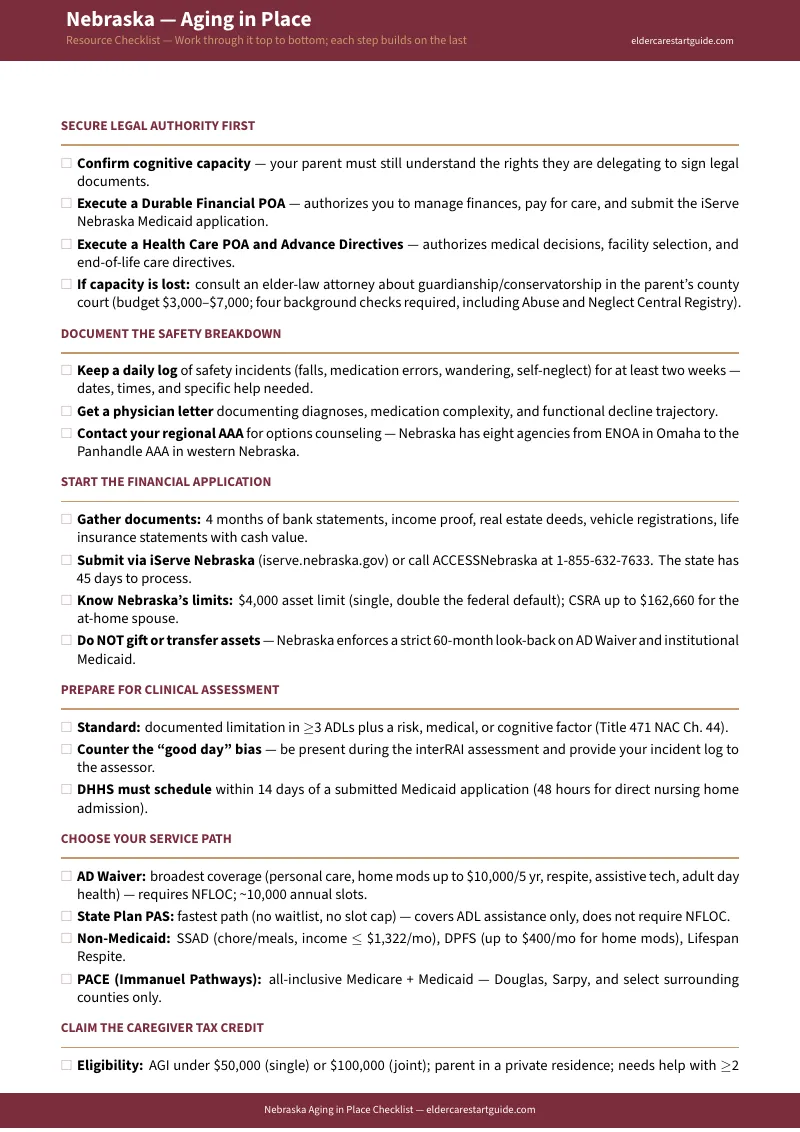
- Nebraska Aging in Place Resource Checklist — A 25-item action list organized by phase: secure legal authority, document the safety breakdown, start the financial application, prepare for the clinical assessment, choose your service path, claim the caregiver tax credit, and monitor and maintain.
- Medicaid Asset Worksheet — Tally every countable asset against the $4,000 limit, with exempt/countable status and spend-down strategy tracker.
- Spend-Down Calculator Worksheet — Monthly share-of-cost math: income, the $392 MNIL, excess calculation, and qualifying expense tracker.
- Care Model Comparison Chart — PAS vs. AD Waiver side by side: eligibility thresholds, covered services, caregiver rules, and when to apply for each.
- Home Safety Assessment — Room-by-room checklist with Nebraska modification funding sources.
- interRAI Preparation Worksheet — Self-screening worksheet for the seven ADLs and four clinical standards the state evaluates.
- Caregiver Tax Credit Worksheet — LB937 eligibility criteria, expense tracker, and Form 3165/3165C instructions.
- Emergency Care Binder — Five-tab organizer template for medical, legal, financial, benefits, and care log records.
- Key Contacts Reference — All eight AAA districts, DHHS phone numbers, court resources, and local resource fill-in fields. Print and keep on the fridge.
Who This Is For
- Adult children whose parent is being discharged from the hospital and someone needs to figure out how to pay for home care that costs over $62,000 a year
- Families who want to pay a relative through PAS but don't understand the provider enrollment process, the EVV requirements, or the spouse/guardian exclusion
- Families confused by Nebraska's spend-down system — they know their parent's income is "too high" for Medicaid but don't realize Nebraska has no hard income cap and no Miller Trust requirement
- Anyone terrified that Nebraska Medicaid will seize their parent's home after death — and who wants to understand what estate recovery actually reaches and what's protected
- Caregivers who don't know about the LB937 tax credit and are paying out of pocket for care expenses they could be claiming
- Out-of-state siblings coordinating Nebraska home care applications remotely and trying to navigate a state system that reorganized twice in 2026
Why Not Free Government Resources?
DHHS publishes eligibility limits. The iServe portal takes applications. The Area Agencies on Aging answer phones.
Here is what none of them provide:
- A post-reorganization walkthrough that maps the current DHHS structure — not the pre-April 2026 League of Human Dignity coordination system that most online resources still describe
- An interRAI assessment preparation strategy explaining how the scoring works and how to document your parent's limitations accurately enough to qualify — not just "call and wait for a visit"
- A spend-down calculation worksheet that shows the exact monthly math with the $392 MNIL — not a link to the iServe portal with no instructions
- A care model comparison so you can choose between PAS and the AD Waiver based on your parent's actual clinical and financial situation — not two separate brochures that never mention each other
- An estate recovery analysis explaining which assets are at risk and which are protected — including the critical PAS look-back exemption that almost nobody mentions
Government sites publish regulations. This guide compiles fragmented state, federal, and county data into a single, sequential process you can follow from crisis to stable home care — without paying an elder law attorney to explain things you can learn yourself.
Your Parent's Safety Net
Every week you spend researching is a week your parent goes without the funded care they may already be entitled to. Nebraska Medicaid coverage can be retroactive to the application date — but only if you file.
Get the guide. File the forms. Start the clock.
Get the Nebraska Home Care Guide →
The free checklist gives you the 25-item action list to start immediately. The full guide gives you every chapter, every form reference, every spend-down calculation, and the complete care coordination framework.