
Your Parent Needs a Nursing Home. Montana's Tab Is $9,600 a Month — and the $2,000 Asset Limit Means Nearly Everything Has to Go.
Your parent can no longer live alone. The discharge planner at the hospital is asking about long-term placement. You searched "Montana Medicaid nursing home" and found the same eligibility table on five different websites: $2,000 asset limit, $994 income threshold, 60-month look-back. Those numbers are correct. What none of those sites explain is what to actually do about them.
You called the regional Office of Public Assistance. They gave you a phone number for apply.mt.gov and said the processing window is 45 days. You asked whether your parents' joint savings of $180,000 would disqualify your father and whether your mother could keep the house. They said you should "consult an elder law attorney." The nearest one charges $300 to $500 per hour, is a two-hour drive from your rural county, and has a six-week waitlist.
Meanwhile, your parent's nursing home bed is costing $8,200 to $10,333 per month at private-pay rates. Medicare's rehabilitation coverage is counting down — full coverage for the first 20 days, $217 daily coinsurance through day 100, then nothing. Every week without a Medicaid application filed is another week of savings gone.
The Montana Care Finance Blueprint
This is not a summary of eligibility limits from the DPHHS website. It is the process around the limits — the part that elder law attorneys explain in $300-per-hour consultations and that government portals never cover.
The guide covers every financial threshold, every spend-down strategy, every waiver program, and every asset protection mechanism available under Montana law — organized in the order you will actually need them, from the first hospital discharge through Medicaid approval to estate recovery after your parent passes.
Montana families have one structural advantage that most never learn about: Montana is a medically needy state. There is no hard income cap and no requirement for a Qualified Income Trust (Miller Trust). If your parent's monthly income exceeds $994, they qualify by spending the excess on care. That single distinction changes the entire application strategy — and it is where this guide starts.
What's Inside
- Medically Needy Spend-Down — Montana's No-Trust Pathway — Unlike income-cap states like Idaho and Wyoming, Montana does not require a Miller Trust. If your parent's income exceeds $994/month, the guide walks through the Medically Needy Income Limit of $525/month, the spend-down calculation, and how to document every deductible medical expense so DPHHS accepts the math on the first submission.
- Asset Mapping — What Counts and What Doesn't — The $2,000 countable asset limit is strict, but the exempt asset list is broader than most families realize. The guide details every exempt category: the primary home (up to $752,000 equity, or unlimited if the spouse resides there), one vehicle, irrevocable prepaid burial plans, personal belongings, term life insurance, and wedding rings. Includes the countable-vs.-exempt worksheet with spaces for each asset class.
- Spousal Protection Formulas — When one spouse enters care, the community spouse keeps between $32,532 and $162,660 in assets under the Community Spouse Resource Allowance. The guide walks through the Snapshot Date calculation, the Minimum Monthly Maintenance Needs Allowance ($2,705 to $4,066.50/month), the excess shelter allowance, and when to request a fair hearing for a higher income allocation — because most families never learn they can ask.
- The 60-Month Look-Back Audit — Every financial transaction from the past five years is reviewed by DPHHS. The guide explains what triggers a penalty, what does not, and why the IRS gift-tax exclusion is irrelevant. Includes the penalty calculation using Montana's daily divisor of $306.27, worked examples (a $50,000 gift creates a 163-day penalty), and the DRA timing rule that delays the penalty start until the applicant is otherwise eligible and in a facility.
- Penalty-Free Spend-Down Strategies — Every approved way to legally reduce countable assets without triggering a single day of penalty: paying off the home mortgage, making accessibility modifications, purchasing an irrevocable prepaid burial plan, buying a handicap-accessible vehicle, and paying for home care with a properly structured Personal Care Agreement at fair market value. Every strategy is executable even if your parent is entering a facility tomorrow.
- Estate Recovery Defense — Montana's Expanded Program — Under MCA 53-6-167, Montana recovers against both probate and non-probate assets, including joint tenancies, life estates, and transfer-on-death deeds. The guide details every protection mechanism: the permanent blocks (surviving spouse, child under 21, disabled child), the TEFRA lien rules during the recipient's lifetime, the three-year spousal recovery window, the Caregiver Child Exemption for penalty-free home transfers, and the undue hardship waiver under ARM 37.82.431 for working family farms and ranches.
- Big Sky Waiver Navigation — Montana's primary home and community-based waiver covers personal care, adult day care, respite, home modifications, and assisted living placement — but not room and board. The guide covers capped enrollment (approximately 2,800 active members), the waiting list (averaging 354 individuals), and the priority scoring system generated by the Wait List Criteria Tool (Form SLTC-146). Includes the strategy of applying for both nursing facility Medicaid and the waiver simultaneously.
- Community First Choice — Paid Family Caregivers — Montana's 1915(k) program allows Medicaid-eligible individuals to receive personal care at home, including from paid family caregivers — including spouses. The guide covers the functional eligibility criteria, the self-directed option, and how to coordinate CFC with the Big Sky Waiver for combined coverage.
- Clinical Assessment Preparation — Mountain Pacific Quality Health (MPQH) administers the clinical screening to establish Nursing Facility Level of Care. The guide details both ADL functional and cognitive scoring pathways, what the evaluator looks for, and how to document your parent's care needs so the assessment reflects reality.
- DPHHS Application Walkthrough — Applications are filed through apply.mt.gov, by phone at 1-888-706-1535, or in person at a regional Office of Public Assistance. The guide covers the 45-day processing window, required documentation (five years of bank statements, income verification, property deeds, vehicle titles), and how to respond to verification requests without triggering a denial.
- Legal Authority Chapter — Montana Durable Power of Attorney, Healthcare Directive, and the court-ordered guardianship/conservatorship process when cognitive capacity is already lost. Covers the specific Medicaid planning clauses your parent's POA must include and the cost differential between POA preparation and court proceedings ($3,000 to $5,000 for guardianship vs. under $100 for a POA).
Plus: Printable Worksheets and Calculators
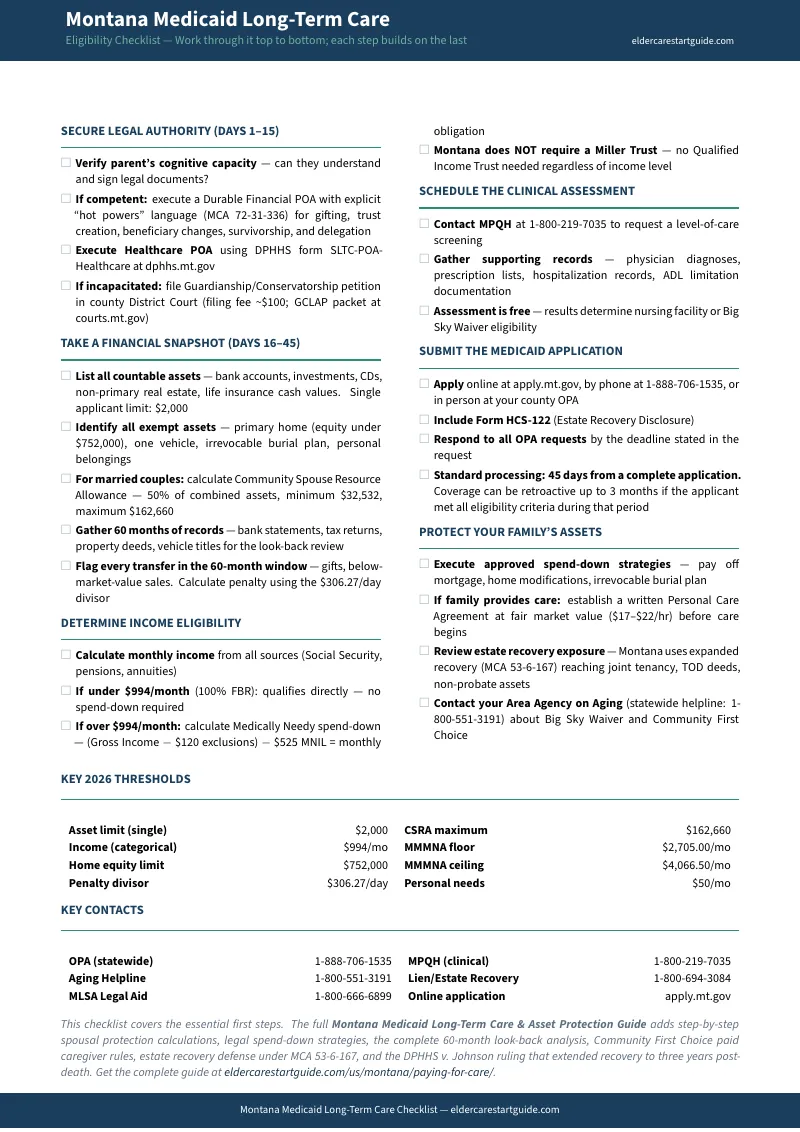
- Montana Medicaid LTC Eligibility Checklist — A one-page action list covering legal authority, financial records, asset classification, clinical assessment preparation, and application filing
- Medicaid Financial Snapshot Worksheet — Fill-in tables recording every countable and exempt asset for both spouses against the $2,000 limit, plus a monthly income inventory — the document you bring to your first OPA caseworker meeting
- Spousal Resource Allocation Calculator — Step-through CSRA worksheet (combined assets → 50% share → $32,532 floor / $162,660 ceiling → spend-down target) plus the MMMNA income calculation and shelter-cost documentation table
- 60-Month Transaction Review Worksheet — Transfer log for the full look-back window, penalty calculation using Montana's $306.27 daily divisor, and cure options
- Monthly Spend-Down Tracker — One printable sheet per month: the obligation calculation and a running log of qualifying medical expenses so DPHHS accepts the math
- Estate Recovery Worksheet — Asset-by-asset audit for probate and non-probate exposure under MCA 53-6-167, permanent blocks checklist, and hardship waiver criteria
- Application Document Checklist — Every document needed for the DPHHS interview organized by category: identity, income, assets, medical, and estate planning — plus a submission record for tracking your caseworker and deadlines
- Agency Communication Log — A call log for every DPHHS, OPA, MPQH, and Area Agency on Aging conversation — date, person, what was discussed, what was promised, follow-up — with the key phone numbers printed on the sheet
Who This Is For
- Adult children whose parent is being discharged from the hospital and someone needs to figure out who is paying $8,200 to $10,333 a month
- Families trying to understand how the $2,000 asset limit works alongside a spouse's right to keep up to $162,660
- Families who made gifts or transfers in the past five years and need to understand the look-back penalty before DPHHS calculates it for them
- Rural Montana families navigating the system without a nearby elder law attorney — and needing a clear action plan they can follow themselves
- Spouses trying to avoid impoverishment when one partner enters a nursing home
- Caregivers researching the Big Sky Waiver or Community First Choice who need to understand waitlists, clinical scoring, and the financial eligibility path
- Families on or near tribal reservations who need to understand how tribal trust land protections coordinate with state Medicaid programs
- Anyone who has been told "it's too late to protect anything" and wants to know what Montana's estate recovery rules actually allow
Why Not Free Government Resources?
DPHHS publishes eligibility limits. Your regional Area Agency on Aging offers options counseling. National sites like Medicaid Planning Assistance and Brevy list state-specific thresholds.
Here is what none of them provide:
- The complete medically needy spend-down calculation with the MNIL, worked examples, and documentation requirements — not a generic "you may qualify through spend-down" note
- The specific asset protection strategies that account for Montana's expanded estate recovery power under MCA 53-6-167, including the hardship waiver process and the three-year spousal recovery window
- A complete spend-down strategy list distinguishing penalty-free moves from penalized transfers — including the Personal Care Agreement structure that prevents look-back violations
- The clinical assessment preparation guide with both ADL and cognitive pathways to Nursing Facility Level of Care through MPQH
- The Big Sky Waiver waitlist scoring strategy using Form SLTC-146 — because most families assume the list is first-come, first-served when it is not
Government sites administer rules. Elder law firms explain them for $300 to $500 per hour. This guide bridges the gap — translating Montana's administrative code into a sequence you can execute in an evening.
Satisfaction Guarantee
If the guide doesn't give you a clearer path forward, email [email protected] and we'll make it right.
— Less Than One Hour of an Elder Law Attorney's Time
An initial consultation with a Montana elder law attorney runs $300 to $500 per hour. A full Medicaid planning engagement costs thousands. A court-ordered guardianship proceeding adds $3,000 to $5,000 in legal fees and court costs alone.
This guide won't replace an attorney for complex irrevocable trust drafting or contested guardianship litigation. But for the medically needy spend-down calculation, asset mapping, look-back documentation, waiver navigation, and DPHHS application process that most Montana families need, it covers 90% of the work at a fraction of the cost — and if you do need an attorney, you'll walk in with a fully organized file instead of a box of unsorted bank statements.
Start with the free checklist to see if the approach fits your situation. The full guide goes deeper — every threshold, every strategy, every form, every contact number.