
The Bank Locked You Out. The Hospital Wants a Signature. Your Parent Can't Sign.
Your parent had a fall, a stroke, or a cognitive decline — and suddenly every institution in Montana needs proof that you can legally act on their behalf. The bank froze the accounts. The hospital discharge planner wants a designated surrogate before releasing your parent. The DPHHS eligibility worker requires a signed authorization before they'll even start a Big Sky Waiver application.
You're stuck in the legal-authority gap: responsible for everything, authorized for nothing.
Montana gives you two pathways. If your parent still has cognitive capacity, you can establish authority quickly and privately through voluntary documents. If capacity is already gone, you face a court-supervised guardianship that costs $3,000–$7,000, takes months, and becomes a matter of public record. The problem is that nobody explains which pathway you're on, what to do first, or how to get Montana's banks, hospitals, and state agencies to accept your documents once you have them.
The Montana Legal Authority Roadmap
This kit replaces the confusion with a step-by-step system built for Montana's specific legal codes, Medicaid rules, and institutional landscape — not a generic POA overview with "Montana" pasted in. It covers both pathways in the order families actually experience them: capacity assessment, document execution, institutional acceptance, benefit applications, and asset protection.
It's built for the adult child who became the family's legal coordinator overnight — whether you're in Billings, out on a ranch in McCone County, or managing everything from another state while your parent lives hundreds of miles from the nearest elder law attorney.
What's Inside
Montana Durable Financial Power of Attorney
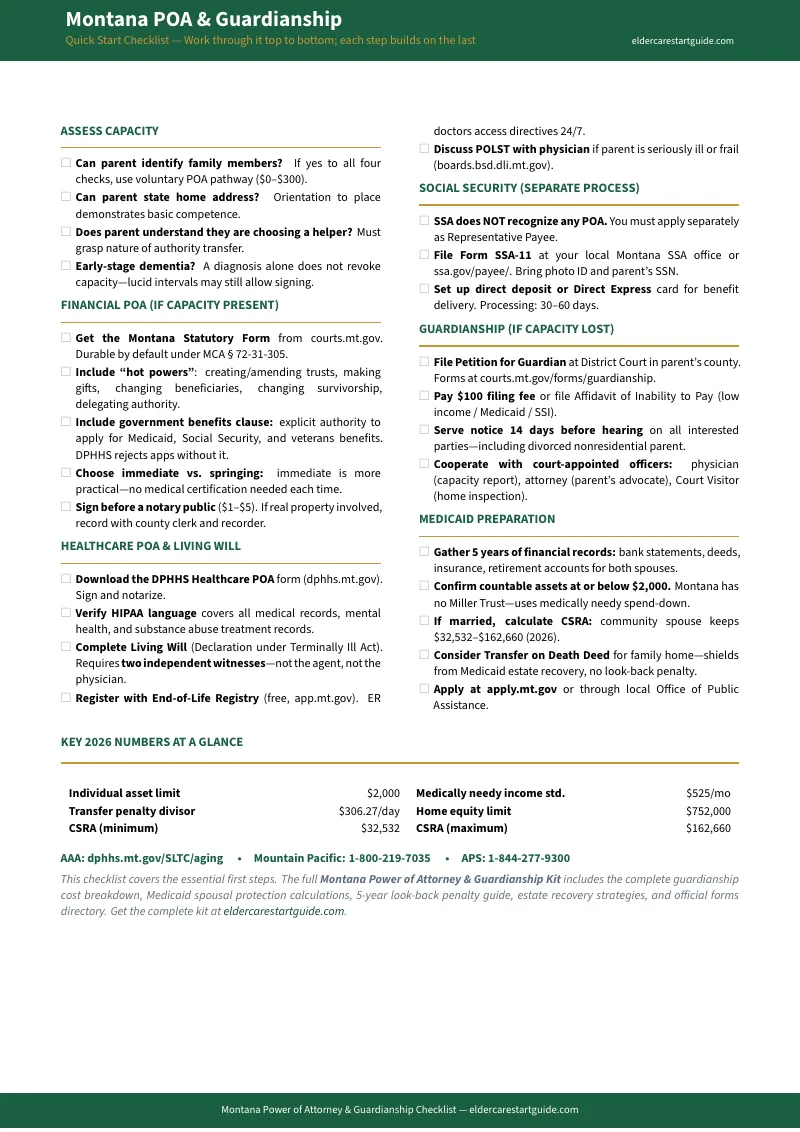
A complete walkthrough of the Montana Uniform Power of Attorney Act (Title 72, Chapter 31, Part 3), including which authority categories to grant, the mandatory notarization requirements under §72-31-305, how to structure "springing" powers with medical certification triggers, and the exact process to get Montana banks and financial institutions to accept the document — including what to do when they refuse. Montana POAs are automatically durable unless the document explicitly says otherwise, and most families don't know that.
Health Care Power of Attorney & Advance Directives
Healthcare decisions require a completely separate document from financial authority — the Montana Statutory Form Power of Attorney explicitly excludes medical matters (§72-31-353). This section covers how to execute a Health Care POA, integrate HIPAA release clauses so hospitals actually share information with you, coordinate it with a Living Will, and register documents with Montana's End-of-Life Registry through the Department of Justice so emergency room physicians across the state can access your parent's directives during a crisis.
The Representative Payee Trap
Social Security ignores every Power of Attorney — it doesn't matter how well it's drafted. To manage your parent's Social Security income, you must apply as a Representative Payee at a local Montana SSA office through a separate federal process with its own rules, direct deposit mandates, and recordkeeping requirements. Most families discover this after weeks of trying to use their POA at the bank, losing months of benefit management time. This section covers the full application process and the recent federal rule changes that exempt certain family members from annual reporting.
Guardianship When Capacity Is Already Gone
If your parent can no longer understand or communicate decisions, voluntary documents are off the table. This section covers the full guardianship petition process in Montana District Court under the Uniform Guardianship, Conservatorship, and Other Protective Arrangements Act (UGCOPAA) — the medical evaluation requirements (conducted within 30–90 days of filing), the court visitor interview, family notice rules, and the distinction between a guardian (personal/medical decisions) and a conservator (financial management). Montana courts will not grant guardianship unless you prove that less restrictive alternatives are unavailable or insufficient.
Emergency Temporary Guardianship
When a parent faces immediate risk of serious physical harm or financial exploitation, Montana allows an expedited emergency petition with hearings typically scheduled within 1–2 days — bypassing the standard 20-day family notice requirement. But emergency appointments are temporary: limited to 23 days for the person and 30 days for the estate, with a full petition required within 30 days. This section covers the exact filing sequence so you don't waste the narrow window.
Medicaid, Big Sky Waiver & Asset Protection
Montana's Medicaid long-term care program and Big Sky Waiver fund nursing home and in-home care — but only after you prove your parent meets strict financial limits ($2,000 countable assets for single applicants, $994/month income cap). This section covers the 2026 thresholds, the Medically Needy spend-down at $525/month, spousal impoverishment protections (Community Spouse Resource Allowance), the 5-year look-back penalty period, Medical Care Savings Accounts, and the Medicaid Estate Recovery Program — including how Montana's expanded recovery can reach joint tenancies and beneficiary deeds after a parent passes.
Montana Resource Directory
Every contact mapped for a frontier state: all Area Agencies on Aging (including Rocky's Agency on Aging and Southwest Montana Aging and Disability Services), regional Aging and Disability Resource Centers, tribal elder programs, Montana Legal Services Association offices, MSU Extension contacts, local SSA offices, and DPHHS regional divisions — organized by the type of help you need, not by bureaucratic hierarchy.
2026 Financial Thresholds Quick Reference
A single-page reference card with every dollar amount you need during a crisis: Medicaid asset limits, income caps, spend-down thresholds, spousal allowances, court filing fees, attorney rate ranges, and notarization costs — all current for Montana's 2026 rules.
Who This Is For
- Adult children in Montana who need legal authority to manage a parent's finances, medical care, or benefit applications — and don't know which documents they need or where to start
- Families facing a dementia diagnosis who need to establish authority while their parent still has capacity, before the guardianship window becomes the only option
- Out-of-state family members coordinating remotely for a parent in rural Montana, tribal communities, or small towns far from legal services
- Families approaching Medicaid who need to understand Montana's Big Sky Waiver, spend-down rules, and estate recovery before savings run out
- Siblings in conflict who need an objective, state-requirement-based framework for agreeing on who holds authority and how decisions get documented
Why Free Forms Aren't Enough
Montana Legal Services, MontanaLawHelp.org, and MSU Extension publish legitimate statutory forms — but they're scattered across different departments with no coordination. A blank form does not explain how to combine the financial POA with the healthcare POA, which authority categories to check and which to skip, how to handle notarization in a county with no public notary, or how to get institutions to accept the document once it's signed.
National platforms like LegalZoom and US Legal Forms generate documents from templates that often miss Montana-specific details — like the Mountain Pacific Quality Health screening requirement for Big Sky Waiver eligibility, or the fact that Social Security refuses all POAs entirely.
Elder law attorneys in Montana charge $195–$500 per hour and are concentrated in Billings, Missoula, Great Falls, and Bozeman. For families in rural counties or on tribal land, getting to an attorney's office is its own logistical problem.
This kit bridges that gap — handling the procedural and administrative work families can do themselves, and telling you exactly when a situation has crossed the line where you genuinely need an attorney.
Satisfaction Guarantee
If this kit doesn't give you the clarity and confidence to establish legal authority for your parent, email us for a full refund. No forms, no hoops, no time limit.
— Less Than a Single Hour of Professional Help
A Montana elder law attorney charges $195–$500 per hour. A Medicaid planning specialist runs $2,000–$5,000 for a full engagement. A contested guardianship can exceed $7,000 in court costs and attorney fees alone. This kit handles the process navigation you can do yourself — and saves the professional fees for the decisions that actually require one.
Download the free Montana Power of Attorney Quick-Start Checklist to start, or get the complete kit with the full 16-chapter guide, actionable checklist, 8 standalone printable worksheets, and Montana resource directory — 10 PDFs in total.