
Your Parent Needs Help at Home. Montana Runs Three Overlapping Programs and Nobody Explained How They Fit Together.
The doctor says your parent can no longer manage bathing, meals, or medication independently. A discharge planner mentions "home and community-based services." Your Area Agency on Aging says to call DPHHS. DPHHS says to contact Mountain-Pacific Quality Health for a clinical screening, then the Office of Public Assistance for the financial review. Two agencies, two applications, two sets of eligibility rules — and the Big Sky Waiver has a waitlist that does not work by first come, first served.
Meanwhile, private home care in Montana is running $38–$42 per hour through licensed agencies. At 25 hours a week, that is over $4,100 a month. A nursing home runs about $8,456. You can feel the family savings draining in real time, and every free resource you find is either a generic national article that has never heard of the Big Sky Waiver, or a raw DPHHS policy manual written for case managers.
You do not need another pamphlet. You need a system.
The Montana Home Care Navigation System
This is not a directory of agencies or a collection of tips about "staying positive during caregiving." It is a step-by-step system for navigating Montana's specific home care bureaucracy — the three-program maze, the clinical scoring process, the Medicaid financial thresholds, the home protection rules, and the family caregiver enrollment pathway that lets an adult child get paid through state programs.
The guide translates Montana's regulatory language into decision sequences: which program to apply for based on your parent's income and asset profile, how to prepare for the Mountain-Pacific assessment so the reviewer sees a realistic picture instead of a good-day visit, and exactly how the 2026 spend-down calculation works with the new $391 ABD deduction that reduces the monthly obligation by nearly half for home care applicants.
What's Inside
- Three-Program Comparison and Bridge Strategy — The Big Sky Waiver, Community First Choice, and Personal Care Services side by side. BSW has the broadest services (home modifications, adult day care, spouse caregiver payments) but a scored waitlist. CFCS is an entitlement with no waitlist and covers personal care immediately. The guide maps the bridge strategy most families use: apply for CFCS now, request BSW for the long-term extras.
- Mountain-Pacific Assessment Prep Guide — Montana's clinical screening uses a 0–3 ADL scoring system across bathing, mobility, toileting, transfers, and eating, plus a cognitive supervision check. Families frequently understate symptoms during the evaluation. This prep tool walks you through each scoring parameter so you document reality — the falls, the missed medications, the incidents — before the reviewer arrives.
- 2026 Medicaid Financial Eligibility Breakdown — The $994/month income cap, the $2,000 asset limit, the Community Spouse Resource Allowance (up to $162,660), the Monthly Maintenance Needs Allowance ($2,705 minimum effective July 2026), and the home equity interest limit ($752,000). Includes the complete medically needy spend-down calculation with Montana's new ABD deduction.
- Spend-Down Calculator Worksheet — Enter your parent's monthly income, apply the deductions, and calculate the exact monthly obligation. The worksheet incorporates the $20 general disregard, the $525 Medically Needy Income Limit, and the $391 ABD deduction — showing the real number you need to cover through medical expenses or cash payment.
- Paid Family Caregiver Enrollment Guide — How to hire yourself or a relative as your parent's paid caregiver under the self-directed CFCS/PCS option. Covers the legally responsible relative rules (spouses and parents of minors require an "extraordinary care" finding or geographic access exception), Consumer Direct Montana payroll setup, and Electronic Visit Verification compliance — including what to do when GPS fails in rural areas.
- Home Protection and Estate Recovery Strategy — The 60-month look-back period, the penalty divisors ($8,456 semi-private / $9,277 private), and the three legal exemptions that allow penalty-free home transfers: the caregiver child exemption (two years of in-home care), the sibling exemption (one year of co-ownership and residency), and the 18-month pre-death lien residency distinction that creates a trap between months 12 and 18.
- Caregiver Child Documentation Checklist — If you plan to invoke the caregiver child exemption, this checklist maps every piece of evidence you need: residency affidavits from neighbors and physicians, structured daily care logs, primary address documentation using Montana-specific records, and the timeline for establishing the two-year residency requirement.
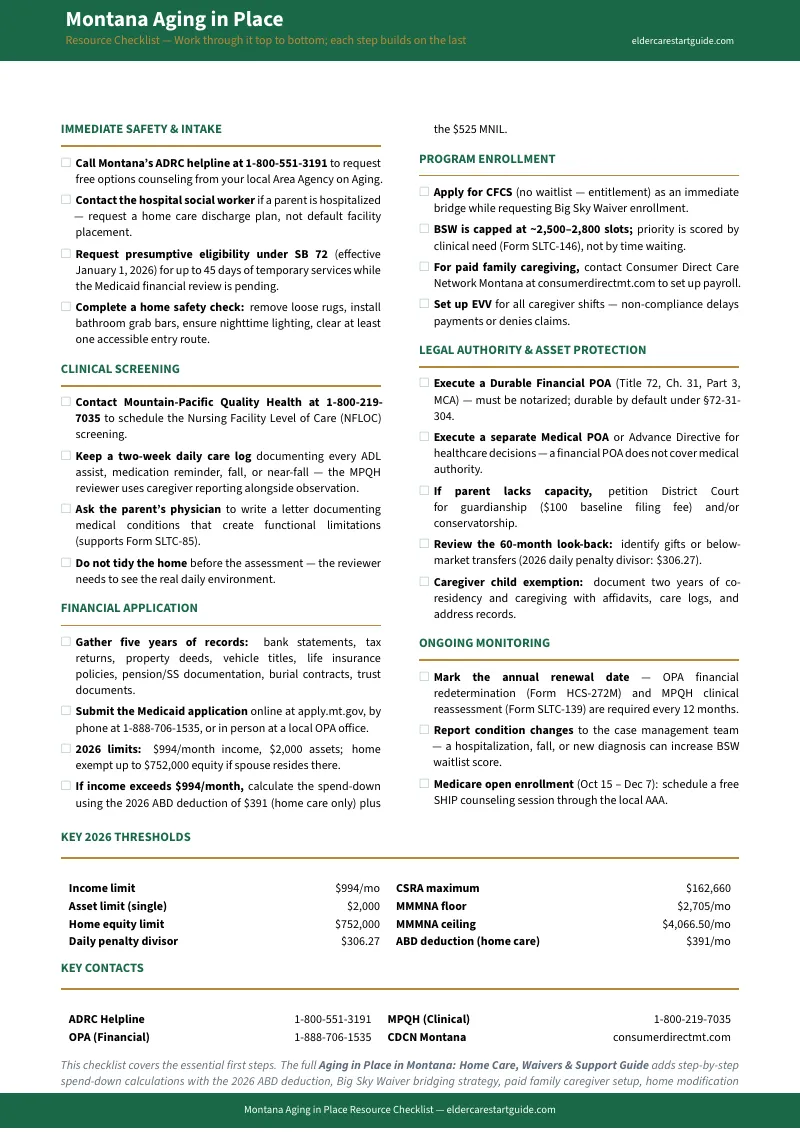
- Crisis Discharge Protocol with SB 72 Presumptive Eligibility — When a parent is hospitalized and the discharge clock starts, this protocol covers the first 72 hours: who to call (MPQH at 1-800-219-7035 for clinical screening, ADRC at 1-800-551-3191 for immediate community resources), how to activate presumptive eligibility under Senate Bill 72 for up to 45 days of temporary services, and the documents to gather before the financial application.
- Tribal Aging Programs Navigator — Montana's seven reservations operate parallel aging services through Title VI and tribal council programs. Chapter 9 covers how tribal home modification, meal delivery, and elder support programs coordinate with state Medicaid — for families with members on and off reservation land.
- Home Safety Assessment and Winter Prep Checklist — A room-by-room walkthrough covering fall risks, bathroom grab bars, lighting, heating safety, and Montana-specific winter hazards. Designed to complete before the clinical assessment so the home environment reflects the real conditions your parent navigates daily.
Who This Is For
- Adult children in Montana helping a parent stay safely at home — whether you are managing a crisis discharge this week or planning ahead for a progressive diagnosis
- Families trying to understand the difference between the Big Sky Waiver, CFCS, and PCS and which program fits their parent's situation
- Caregivers who want to get paid for the care they are already providing, through Montana's self-directed Medicaid programs
- Anyone preparing for the Mountain-Pacific clinical screening and wanting to understand the scoring system before the evaluator arrives
- Families concerned about losing the family home to Medicaid estate recovery and needing to understand the look-back rules and legal exemptions
- Out-of-state adult children coordinating care for a parent in rural or frontier Montana who need a single reference for the entire system
Why Not Just Use Free Resources?
The ADRC helpline connects you with an options counselor. The DPHHS website has the program manuals. Area Agencies on Aging offer free consultations. But the information is fragmented across multiple state divisions, each with its own forms, phone trees, and eligibility criteria. Options counselors explain programs but cannot fill out applications, recommend financial strategies, or tell you how to prepare for the clinical assessment. And none of the free resources map out the bridge strategy, the spend-down calculation with the 2026 ABD deduction, the scored BSW waitlist mechanics, or the 12-to-18-month trap in the sibling exemption.
Private elder law attorneys in Billings, Missoula, and Helena handle the complex cases — at $300–$500 per hour, with planning engagements running $2,500–$10,000. This guide does not replace legal counsel for high-asset trust work or contested guardianship. But it organizes the upstream work so you arrive at a consultation with documents gathered, programs identified, and questions prepared — instead of spending billable hours learning terminology.
Satisfaction Guarantee
If the guide does not give you a clearer path forward, email [email protected] for a full refund. No time limit, no hoops.
— Less Than One Hour of Elder Care Consultation
For a fraction of what a single professional consultation costs, you get the complete system: three-program comparison, clinical assessment preparation, Medicaid eligibility breakdown, spend-down calculator, paid caregiver enrollment guide, home protection strategies, crisis discharge protocol, tribal aging navigator, home safety checklist, and every form reference and contact you need to navigate your parent's care in Montana.
Download the free one-page checklist to see the framework, or get the full 14-chapter guide with all six standalone printable tools — the application document tracker, home safety assessment, spend-down calculator worksheet, caregiver child documentation checklist, EVV shift log, and agency communication log.