Montana's Memory Care System Splits Financial Eligibility, Clinical Screening, and Community Support Across Three Separate Agencies — and None of Them Tell You About the Others
Your parent has dementia. Maybe a wandering episode during a Montana winter brought it into sharp focus. Maybe a hospital discharge planner just told you to find a care facility within 48 hours. Either way, you're now navigating a system that was designed for state caseworkers and elder law attorneys — not for a family trying to hold things together under impossible time pressure.
You call the Aging and Disability Resource Center at 1-800-551-3191 and learn that the Big Sky Waiver might cover your parent's care — but only if they pass a functional assessment through Mountain Pacific Quality Health, and only if their countable assets are under $2,000. You search for memory care facilities and discover that Montana doesn't issue a standalone memory care license — every facility operates under a Category C endorsement on its assisted living license, and the only way to know whether one actually provides dementia-specific care is to ask the right questions during a tour. You hear about the medically needy spend-down pathway and realize Montana doesn't use Miller Trusts like neighboring states — but nobody explains how the six-month budget period works or which medical expenses actually count toward the threshold.
The Montana Dementia Care Coordination System
This guide maps every Montana-specific program, clinical threshold, financial limit, and application pathway into a single chronological sequence. It starts with the legal authority decisions you must make while your parent still has cognitive capacity, moves through safety planning and Silver Alert activation for Montana's extreme climate, and walks you through the complete Medicaid application process — including how to prepare for the Mountain Pacific Quality Health assessment that determines whether your parent qualifies for waiver-funded care.
What makes this different from state websites and national caregiving portals: it connects the systems that Montana treats as separate bureaucracies. Your parent's Level of Care assessment score determines whether they meet the Nursing Facility Level of Care standard. That clinical threshold determines whether they qualify for the Big Sky Waiver or Community First Choice. Their program enrollment determines which care services are covered — but not room and board, which follows completely different payment rules depending on whether the facility is a private assisted living community or a nursing home. Their financial eligibility requires understanding the medically needy spend-down, the 60-month lookback, and the spousal impoverishment protections — all of which follow Montana-specific rules that differ from neighboring states. And their estate recovery exposure after death depends on Montana's expanded rules under MCA § 53-6-167, which reach assets that standard probate-avoidance techniques do not protect. These are not independent decisions. The guide shows how each one flows into the next so you can sequence the applications correctly and avoid the gaps that cost families months of coverage or tens of thousands of dollars in penalties.
What's Inside
- The Complete Guide (13 chapters) — covers Montana's dementia care system from the first 30 days after diagnosis through legal authority (durable POA under MCA § 72-31-304, advance directive, DOJ End-of-Life Registry, guardianship under UGCOPAA), safety planning and Silver Alert activation, Category C memory care facility vetting under ARM 37.106.2891–2898, community-based programs through Community First Choice and the Big Sky Waiver, Medicaid financial eligibility including the medically needy spend-down, spousal protections (Community Spouse Resource Allowance up to $162,660 and Monthly Income Allowance up to $4,067), expanded estate recovery and the caregiver-child home exemption, filing the Medicaid application, post-placement advocacy, worksheets, and a contacts directory
- Medicaid Financial Eligibility Worksheet — the 2026 income threshold ($994/month categorically needy), individual asset limit ($2,000), married couple protections, medically needy spend-down calculator with the $525 MNIL threshold, and a fillable asset categorization tool separating countable from exempt resources
- Category C Facility Tour Scorecard — a printable comparison worksheet for evaluating three memory care communities side-by-side against staffing ratios, dementia training hours, secured exit protocols, healthcare plan compliance under the 21-day mandate, Medicaid acceptance, and red flags — designed for a state where the Category C endorsement is the only regulatory distinction between standard assisted living and memory care
- Wandering Response and Silver Alert Sheet — pre-formatted fields for Silver Alert activation through local law enforcement and the DOJ, a printable 911 Emergency Profile, voluntary law enforcement registration form, home safety modifications for Montana's sub-zero winter conditions, and GPS tracking and door alarm options
- Five-Year Lookback Audit Worksheet — a fillable transfer log covering 60 months of financial history, Montana's daily penalty divisor, exempt transfer categories, and a Medicaid-compliant personal care agreement template for compensating family caregivers without triggering penalty periods
- Assessment Preparation Worksheet — Mountain Pacific Quality Health screening explained in plain English, Activities of Daily Living scoring breakdown, cognitive-behavioral symptom documentation guide, and a 30-day functional journaling template to prevent the "good day" effect during the clinical assessment
- Care Transition Timeline — a month-by-month planning calendar covering the sequence from legal authority execution through program applications, facility selection, placement, and post-placement compliance deadlines
- Crisis Contacts Sheet — ADRC statewide line (1-800-551-3191), all 10 regional Area Agencies on Aging with counties served, tribal Title VI aging programs, Long-Term Care Ombudsman, Adult Protective Services, Alzheimer's Association 24/7 helpline, and DPHHS QAD Licensure Bureau — on one printable page
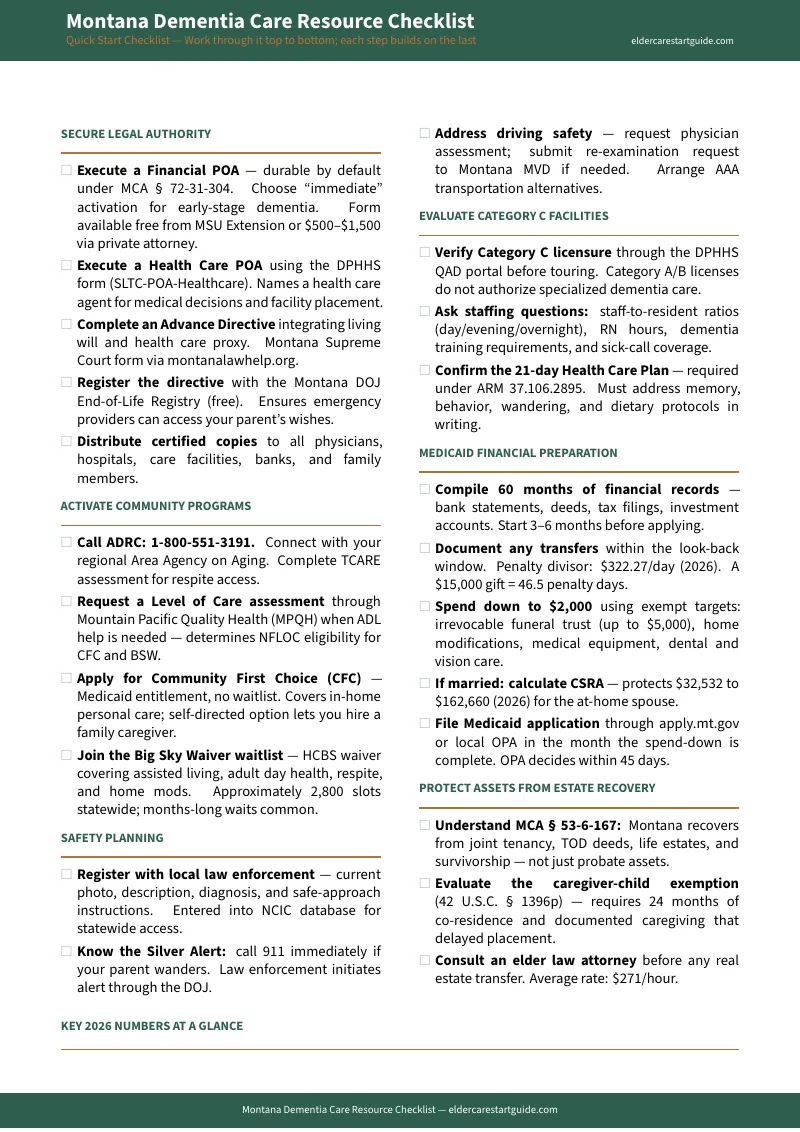
- 25-Item Dementia Care Checklist (free) — the essential actions from legal authority through program enrollment, facility evaluation, and safety planning in a single printable page
Who This Is For
- Adult children coordinating memory care for a parent in Montana who need to understand which state programs exist and how to apply for them in the right order
- Families facing a hospital discharge where the parent can't return home safely and a care placement decision must happen within days
- Caregivers whose parent is paying $7,762+ per month for private-pay memory care and needs to transition to Medicaid-funded options before the savings run out
- Anyone preparing for the Mountain Pacific Quality Health functional assessment who needs to document their parent's real daily deficits and prevent the "good day" effect that causes clinical denials
- Families trying to protect the family home and other assets from Montana's expanded estate recovery program, which can claim non-probate property including joint tenancy and transfer-on-death deeds
- Rural Montana families coordinating care across vast distances — where the nearest qualified Category C facility may be 100+ miles away
- Out-of-state adult children coordinating care from a distance who need Montana-specific agency contacts, program names, and application pathways — not generic national caregiving advice
Why Free Resources Leave You Stuck
Montana's DPHHS and the regional Aging and Disability Resource Centers publish program descriptions, application packets, and informational brochures. But these documents are written by compliance officers to protect the state's regulatory position, not to help families secure benefits. You can find the Big Sky Waiver description on the DPHHS website, but you won't find an explanation of how to document cognitive-behavioral symptoms so the Mountain Pacific assessment accurately captures your parent's needs, or how to sequence a Community First Choice application alongside a Big Sky Waiver waitlist placement so your parent gets immediate in-home support while waiting for the comprehensive waiver.
National directory sites like A Place for Mom will list Montana memory care facilities — and then sell your phone number to the ones that pay referral commissions. They don't explain that Montana uses the Category C endorsement system instead of a standalone license, so their "memory care" listings are functionally identical to their assisted living listings. They have no incentive to explain that a facility without Category C endorsement is operating a locked dementia unit outside its legal authority.
Elder law attorneys provide expert, personalized guidance — at an average of $271 per hour in Montana. For complex asset protection strategies involving trusts or ranch property, professional counsel is essential. But you shouldn't be paying attorney rates to learn the basic difference between the Big Sky Waiver and institutional Medicaid, understand what the functional assessment evaluates, or figure out how Montana's medically needy spend-down works differently from the Miller Trust states next door. Using this guide to organize your documentation and understand the system before your first consultation can save thousands in billable hours.
Satisfaction Guarantee
If the guide doesn't help you identify at least one program, eligibility pathway, or protection strategy you weren't already aware of, email us for a full refund. No forms, no time limit.
Navigate Montana Dementia Care with Confidence
Download the free checklist to get the essential action items — or get the full toolkit for and receive all 10 PDFs: the 13-chapter guide, Medicaid financial eligibility worksheet, Category C facility tour scorecard, wandering response and Silver Alert sheet, five-year lookback audit worksheet, assessment preparation worksheet, care transition timeline, crisis contacts sheet, estate recovery defense checklist, and the printable checklist.