Your parent needs care and Montana scattered the rules across four ALF categories, a swing bed transfer mandate, and a Medicaid waiver with no guaranteed slot.
Your mother was admitted to a Critical Access Hospital after a fall in a rural county. The discharge planner says that under ARM 37.40.405, if a nursing home bed opens within 25 miles, she must be transferred within 72 hours. You have never heard of this rule. You don't know whether your mother meets "Nursing Facility Level of Care." You don't know whether the nearest assisted living holds a Category A, B, C, or D license — or what the difference means for a parent who needs medication management. And you are learning all of this while the clock runs.
You start searching. DPHHS has the rules — across dozens of policy pages, licensing portals, and administrative rule citations. The Big Sky Waiver page says it covers home and community-based services, but the income limit is $994 per month and the program maintains a waitlist with no published timeline. You discover that Montana's estate recovery statute (MCA 53-6-167) reaches joint tenancies and transfer-on-death deeds — assets your family assumed were protected. Meanwhile, A Place for Mom is offering "free" placement advice funded by commissions from the facilities it recommends.
You are not failing. You are operating inside a system that was designed for administrators and case managers, not families.
The Montana Care Decision Navigator
This is a complete, conflict-free action plan — not a government summary, not a referral site's brochure, and not a $300-per-hour elder law consultation. It is the exact checklists, care-setting comparisons, licensing breakdowns, financial worksheets, and enrollment walkthroughs a Montana family needs to evaluate every type of care, navigate the Big Sky Waiver, protect a home from estate recovery, and manage a crisis hospital discharge across the vast distances that define this state.
A 14-chapter guide, a 20-item action checklist, and eight standalone printable tools — a care-setting comparison, Big Sky Waiver eligibility worksheet, hospital discharge crisis protocol, spend-down planner, estate recovery protection checklist, facility vetting walkthrough, AAA and tribal resource directory, and a care decision framework. Ten PDFs total, built for the 2026 regulatory environment and organized around the precise administrative moments where families lose time, money, or benefits they cannot recover.
What's inside — and the problem each section solves
Four-Category ALF Licensing Breakdown
The problem: Montana licenses assisted living under four categories — A (basic personal care, max 3 ADL dependencies, no medication administration), B (skilled nursing, 4+ ADL dependencies), C (specialized memory care), and D (limited nursing in adult foster care). Choosing the wrong category means your parent could face a mandatory discharge the moment their health declines past the facility's legal authority.
A side-by-side breakdown of all four categories with their care limits, staffing requirements, and discharge triggers. Which categories allow medication administration. Which can manage insulin. What happens when a Category A resident becomes bedbound. How to verify a facility's exact license category through the DPHHS Bounds Licensing System and Provider Portal before you sign an admission agreement.
Big Sky Waiver Eligibility and Enrollment
The problem: The Big Sky Waiver is Montana's 1915(c) home and community-based services program — it can fund personal care, adult day health, respite, home modifications, and assisted living. But it is not an entitlement. It has a waitlist. The 2026 income limit is $994 per month and the asset limit is $2,000. And Montana does not use Miller Trusts or Qualified Income Trusts for over-income applicants — it uses a medically needy spend-down pathway that no one explains to families in plain language.
A complete walkthrough of BSW eligibility, the clinical assessment process through Mountain Pacific Quality Health (MPQH), the spend-down calculation, and what to do while your parent waits for a slot. Includes the entitlement alternatives — Community First Choice (CFC) and personal assistance services — that provide immediate coverage without a waitlist.
Hospital Discharge Crisis Protocol
The problem: Your parent is in a Critical Access Hospital and the discharge team is pressuring you to accept a transfer. Under the swing bed rule (ARM 37.40.405), a hospital can only keep a patient for skilled nursing care if there is no appropriate vacant nursing home bed within 25 miles. If a bed opens, the transfer must happen within 72 hours — and you may not know how to appeal.
A step-by-step emergency protocol: how to request a clinical review, document why the proposed transfer is inappropriate, appeal before the deadline, and evaluate alternatives including the Big Sky Waiver, CFC, and in-home care. Plus Medicare's 100-day skilled nursing timeline so you know exactly when coverage ends and private-pay or Medicaid must take over.
Medicaid Spend-Down and Asset Protection
The problem: Your parent's income exceeds the $994 monthly Medicaid limit and you have been told they "don't qualify." That is not the full picture. Montana uses a medically needy spend-down framework — but nobody walks families through the deductible calculation or explains which assets are exempt.
A plain-language explanation of how excess monthly income becomes a deductible that triggers full Medicaid coverage once met. The 60-month look-back period and its exceptions. Spousal impoverishment protections including the Community Spouse Resource Allowance. Which transfers trigger penalties and which don't. The complete documentation checklist for a Medicaid application — every form, financial statement, and verification document you need before filing.
Estate Recovery and Home Protection
The problem: Montana's estate recovery statute (MCA 53-6-167) reaches beyond probate to joint tenancies, transfer-on-death deeds, and certain trusts. Families assume the family home is safe. It may not be — unless specific legal steps are taken before a Medicaid claim begins.
A detailed walkthrough of pre-death liens versus post-death recovery. The surviving spouse, minor child, and disabled child exemptions. Montana's Declaration of Homestead filing. The undue hardship waiver process. When to consult an elder-law attorney versus when the guide's worksheets are sufficient — and how to use the guide as an intake organizer to compress a multi-hour legal engagement into one efficient session.
Rural and Tribal Care Navigation
The problem: With 33% of Montana's population in rural or frontier areas and 80% of communities under 2,000 residents, many families coordinate care across distances that would be unthinkable in other states. Some parents live 100 miles from the nearest clinic, pharmacy, or grocery store. Tribal elder programs add another coordination layer.
A guide to accessing Montana's nine Area Agencies on Aging, tribal elder programs like the CSKT Elder Services Program, the Long-Term Care Ombudsman network, SHIP Medicare counseling, and the statewide Aging and Disability Resource Link (ADRL). How to navigate the overlap between state Medicaid and tribal programs when your parent qualifies for both.
Who this is for
- The adult child in Billings, Missoula, or Bozeman managing a parent's care on a remote ranch or in a small community where home care agencies may not reach
- The family facing a hospital discharge deadline who needs to evaluate care settings, financial programs, and legal authority under extreme time pressure
- The family with a parent whose income exceeds the $994 Medicaid limit who needs to understand the medically needy spend-down — not accept "doesn't qualify" as the final answer
- The family protecting a home or agricultural property from Medicaid estate recovery who needs the specific legal steps before an elder-law attorney appointment at $300 an hour
- The family navigating between state programs and tribal elder services who needs a clear map of which resources overlap and which require separate applications
Why not the free alternatives?
The DPHHS website and AAA directories? They have the rules — across dozens of administrative pages, licensing portals, and program manuals. They will tell you the programs exist. They will not hand you a sequential action plan, a side-by-side care-setting comparison, or a spend-down calculation worksheet. The information is scattered across the system. The action sequence is not anywhere.
A Place for Mom or Care.com? These are commission-driven referral platforms. The moment you enter your contact information, you receive calls steering your parent toward facilities that pay referral fees. They will never explain the Big Sky Waiver, the medically needy spend-down, or family caregiver options — because those pathways eliminate their revenue.
An elder law attorney? For complex estates and guardianship proceedings, absolutely worth the $300 to $500 per hour. Professional guardianship in Montana runs $135 per hour on top of that. But walking into the appointment with disorganized paperwork is expensive at $5 per minute. Use this guide as the intake organizer: arrive with your parent's asset inventory, Medicaid eligibility assessment, and estate recovery protection strategy already mapped out, and compress a multi-hour engagement into one efficient session.
A fair, simple guarantee
If this guide does not give you a clearer, more confident path through Montana's elder care system than the free tools you have been struggling with, reply to your receipt at any time and we will refund you in full. No forms, no friction. You are already dealing with enough of both.
Start where you are
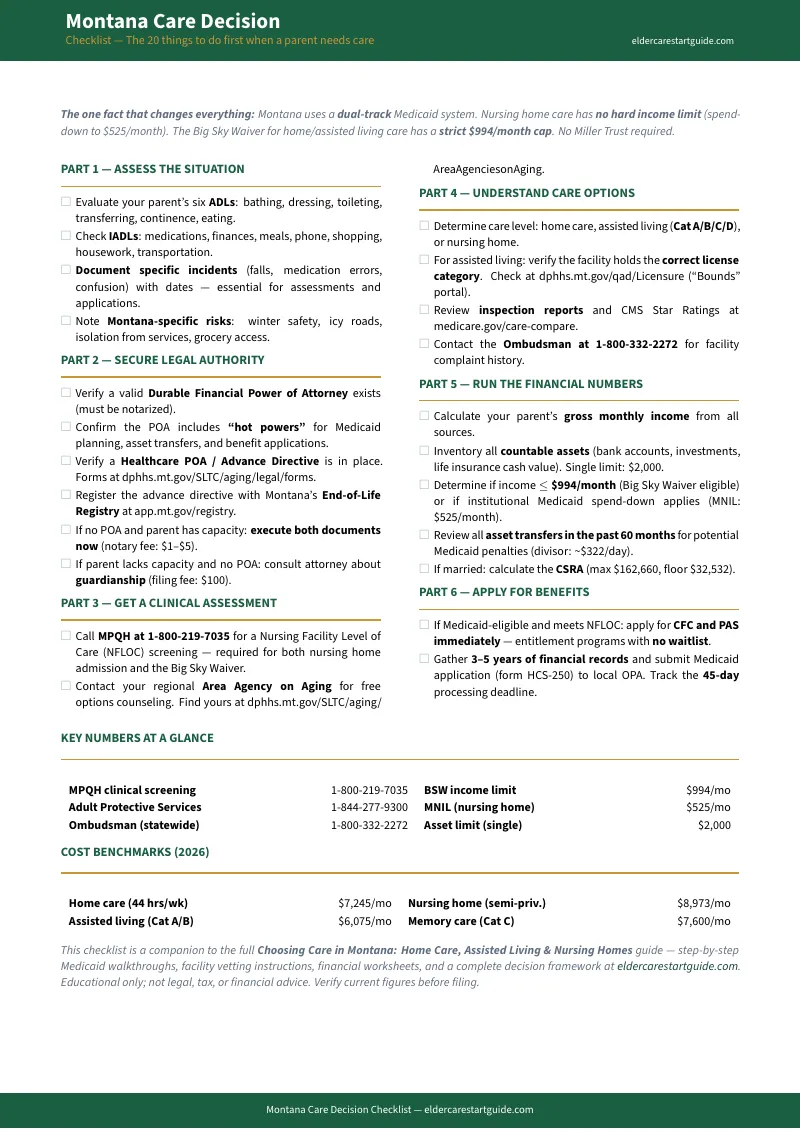
Not ready to buy? Start with the free Montana — Choosing Care Decision Checklist — a one-page map of the key assessments, contacts, and action steps you need. When you are ready to move from "what to do" to "here is exactly how to do it," the full guide is — less than five minutes with an elder law attorney, and yours to keep permanently.
Download the guide today and stop losing weeks to a system that was designed for case managers, not families.