
Your Parent Needs a Nursing Home. Missouri Medicaid Will Pay — But Two Separate Agencies Control Whether You Qualify.
Your parent's Medicare skilled nursing benefit ends after 100 days. After that, nursing home care in Missouri runs $9,000 to $12,000 a month out of pocket. You know Medicaid is supposed to cover long-term care. What nobody tells you is that Missouri splits the process across two independent state agencies — the Family Support Division handles finances, and the Division of Senior and Disability Services handles clinical eligibility — and they don't coordinate with each other. You have to satisfy both, simultaneously, with different forms, different offices, and different timelines.
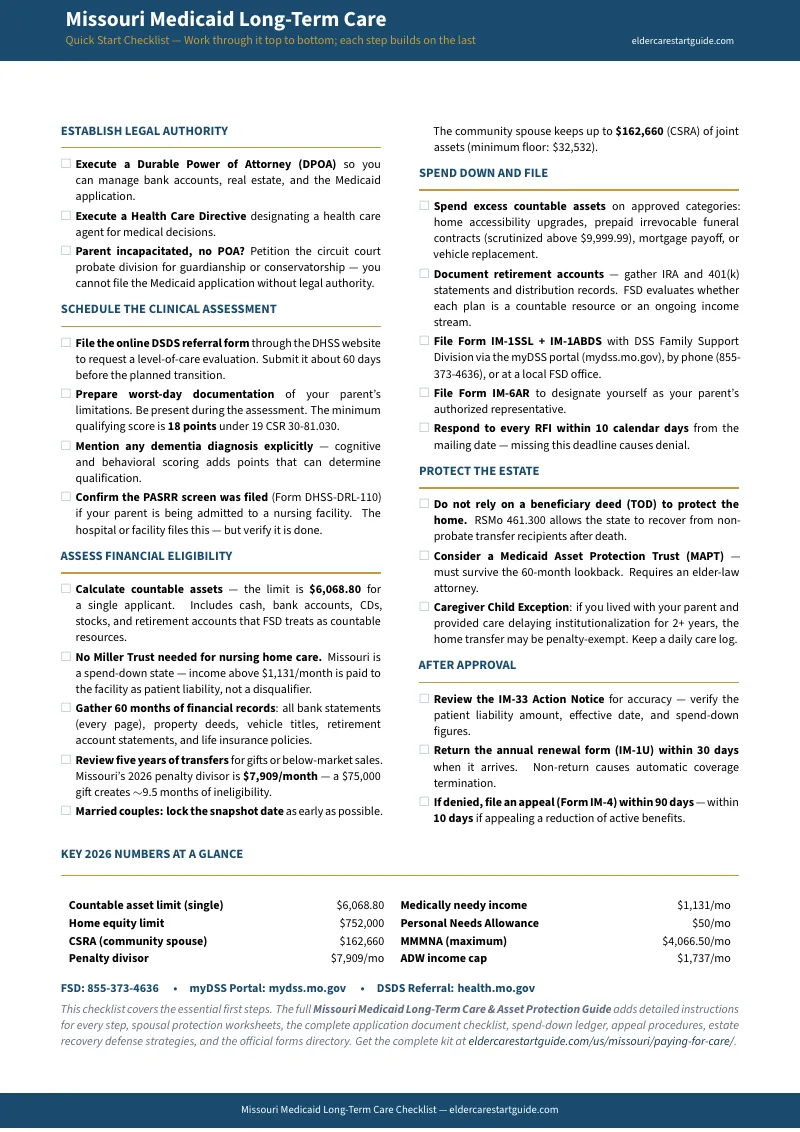
You've searched online and found conflicting information at every turn. Do you need a Miller Trust? (No — Missouri is a medically needy spend-down state, so there's no hard income cap for nursing home care.) Is the asset limit $2,000? (No — it's $6,068.80 in Missouri.) Can the state take the house? (Yes — and unlike most states, Missouri law allows recovery from non-probate transfers too.) Most Medicaid guides are written nationally and get Missouri's rules wrong, because Missouri is a Section 209(b) state with its own eligibility framework that deviates from the standard SSI rules almost every other state follows.
An elder law attorney charges $300 to $500 an hour to explain all of this. A Medicaid planning firm charges $2,000 to $10,000 for the complete process. Most of that time is spent organizing your parent's financial records, explaining the state's rules, and preparing the application. That's exactly what this guide was built to do.
— The Missouri Medicaid Navigation System
The Missouri Medicaid Navigation System is a step-by-step guide that walks you through every stage of securing Medicaid-funded long-term care in Missouri — from the first financial inventory through the clinical assessment, application filing, spousal protections, spend-down strategies, and estate recovery planning. It's the process an elder law attorney follows, translated into plain English with worksheets you fill in yourself.
This isn't a generic "50-state Medicaid overview" with a paragraph about Missouri. It's built entirely around Missouri-specific rules, thresholds, forms, and agencies — including the mechanics that make Missouri different from almost every other state.
What's Inside
- Missouri Financial Eligibility Workbook — a line-by-line worksheet that separates countable from exempt assets using Missouri's $6,068.80 limit. Covers the primary home exemption ($752,000 equity threshold), vehicle exemption, irrevocable prepaid funeral plans, and every other asset category the Family Support Division evaluates. Includes the IRA and 401(k) trap — where FSD evaluates each retirement account individually to determine whether it's a countable resource or an ongoing income stream.
- Medically Needy Spend-Down Calculator — Missouri doesn't use Miller Trusts for nursing home care. If your parent's income exceeds the $1,131 monthly medically needy standard, the excess is paid to the facility as patient liability — not a disqualification. This calculator walks you through both monthly spend-down pathways: paying the premium through the MO Health Portal (mymohealthportal.com), or submitting incurred medical bills to the FSD Spend-Down Unit in Houston, MO. It shows you exactly how much your parent pays and what Medicaid covers.
- Spousal Protection Planner — Missouri allows the community spouse to keep up to $162,660 in assets (the CSRA) with a minimum floor of $32,532, and receive a monthly income diversion of up to $4,066.50 from the institutionalized spouse. This planner walks you through the "snapshot date" calculation — taken on the first day of continuous institutional care — and the strategies that maximize what the healthy spouse retains.
- 18-Point Level-of-Care Assessment Guide — the Division of Senior and Disability Services sends an assessor to evaluate your parent using the InterRAI Home Care tool. Your parent must score at least 18 points to qualify for Medicaid-funded nursing home care or Home and Community-Based Services. This guide explains exactly what the assessor evaluates across six scoring domains — distinguishing early-loss ADLs (dressing, bathing) from late-loss functions (eating, toileting) — and how to document your parent's actual daily limitations so the score reflects reality, not a good-day performance.
- Five-Year Lookback Audit Worksheet — Missouri reviews 60 months of asset transfers before the application date. The 2026 penalty divisor is $7,909 per month. A $75,000 gift to a grandchild creates roughly 9.5 months of Medicaid ineligibility — and the penalty clock doesn't start until your parent is clinically and financially eligible and has applied. This worksheet helps you identify every transfer that could trigger a penalty and shows you the math the caseworker will run.
- Legal Spend-Down Strategy Guide — a catalog of state-approved methods to reduce countable assets below $6,068.80 without triggering lookback penalties: exempt home accessibility upgrades, irrevocable prepaid funeral contracts, Medicaid-compliant annuities for married couples, paying off legitimate debts, and vehicle replacement. Each strategy includes the documentation requirements FSD expects to see.
- Estate Recovery Defense Checklist — Missouri's MO HealthNet Cost Recovery Unit files claims against the deceased recipient's probate estate. But here's what makes Missouri different: Mo. Rev. Stat. § 461.300 allows the state to pull non-probate transfers — beneficiary deeds, payable-on-death accounts, joint tenancy property — back into the estate when the probate estate is insufficient. This checklist covers which standard "avoid probate" strategies actually work in Missouri, which ones don't, and the mandatory exemptions that block recovery (surviving spouse, minor children, disabled dependents).
- Home Care Programs Guide — nursing homes aren't the only option. This section covers Missouri's Aged and Disabled Waiver, Consumer Directed Services (which lets you hire a family member as a paid attendant), the Structured Family Caregiving Waiver (a daily stipend for family caregivers), PACE programs in eligible regions, and the Supplemental Nursing Care grant for assisted living. Each program has its own eligibility rules — this guide maps them.
- Application Process Roadmap — a sequential walkthrough from gathering financial documents through filing Form IM-1SSL and IM-1ABDS with the Family Support Division via the myDSS portal, designating an authorized representative with Form IM-6AR, scheduling the DSDS clinical assessment, responding to caseworker inquiries within the 10-day RFI deadline, and tracking the adjudication timeline. Includes key contacts and the specific offices that handle each step.
- Appeals Guide & Template Letters — if your parent's application is denied or the Level of Care score seems wrong, this section covers the formal appeal process (Form IM-4, filed within 90 days — or 10 days if appealing a reduction in active benefits), preparation strategies, and template letters for communicating with FSD and DSDS caseworkers.
Who This Is For
- Adult children in Missouri facing a parent's transition from hospital or home to nursing facility, assisted living, or Medicaid-funded home care
- Families approaching the Medicare Day-100 cliff who need to secure Medicaid coverage before private-pay costs drain their parent's savings
- Spouses trying to protect household assets when one partner enters long-term care — and not sure how much Missouri law lets them keep
- Caregivers exploring whether they can get paid through Consumer Directed Services or the Structured Family Caregiving Waiver while keeping their parent at home
- Families with a parent who transferred assets in the past five years and needs to understand the lookback consequences — and Missouri's aggressive non-probate recovery — before applying
Why Not Just Use Free Resources?
Missouri publishes its Medicaid rules across two departments: the Family Support Division under the Department of Social Services handles financial eligibility, and the Division of Senior and Disability Services under the Department of Health and Senior Services handles clinical assessments and program authorizations. Each publishes its own manuals in its own regulatory language, organized by bureaucratic function — not by what you need to do next.
National portals like Medicaid Planning Assistance give you a solid overview of Missouri's limits, but they don't cover the specific forms, the monthly spend-down filing mechanics, or the step-by-step InterRAI assessment preparation. Elder care referral services like A Place for Mom or Caring.com will match you with facilities — because they earn commissions from the ones they recommend. They don't cover Medicaid waivers, in-home care programs, or asset protection strategies, because there's no referral fee in those.
Missouri's Area Agencies on Aging are genuinely helpful — but they're staffed for community nutrition programs, SHIP Medicare counseling, and basic resource referrals. They cannot provide strategic advice on asset spend-down, spousal protection calculations, or estate recovery defense.
This guide connects both agencies' rules into one sequential process, with worksheets at every decision point. It's the difference between reading about the rules and actually working through them with your parent's numbers in front of you.
Satisfaction Guarantee
If this guide doesn't help you navigate Missouri Medicaid long-term care more confidently, email us within 30 days for a full refund. No forms, no questions.
Get Started Now
Download the free Missouri Medicaid Eligibility Checklist to see the key thresholds and steps at a glance. When you're ready for the complete process — the spend-down calculator, spousal protection planner, lookback audit worksheet, Level of Care assessment prep, and estate recovery defense — get the full Missouri Medicaid Long-Term Care & Asset Protection Guide.