
Your Parent Needs Help at Home. Missouri Has Three Programs That Pay for It — If You Know Which One to Apply For.
Your parent left the stove on. Or they stopped showering. Or the hospital just called and said "you need to arrange home care." Now you're the one Googling "Missouri Medicaid home care" at midnight, finding out there's something called DSDS and something called FSD and they're in two different departments and neither one answers the phone on Friday.
You found out Missouri has Consumer Directed Services that lets you pay a family member to provide care. But nobody told you that spouses and legal guardians are excluded from CDS — and that the only program that pays spouses requires a documented dementia diagnosis and full-time cohabitation. You also discovered that Missouri has a Medicaid "spenddown" instead of a hard income cap, but you can't find anyone who will explain how the monthly math actually works.
Meanwhile, you priced out private home care. $25 to $28 per hour for a home health aide in Missouri. That's roughly $75,500 a year for 35 hours a week. Your parent's savings won't last two years at that rate.
The Missouri Dual-Agency Navigation System
This is not a list of eligibility rules you can find on the DHSS website. It is the process around the rules — the part that $200-to-$500/hour elder law attorneys explain in billable consultations and that DSDS support coordinators don't have time to walk you through.
Missouri runs home care through two separate agencies that don't automatically share information. DSDS (Division of Senior and Disability Services) handles the clinical assessment. FSD (Family Support Division) handles the financial eligibility. You must push both applications forward simultaneously — and the guide tells you exactly how, in what order, with which forms and phone numbers.
The guide covers every step from your first Area Agency on Aging call through securing state-funded home care, establishing legal authority under Missouri's specific DPOA statutes, qualifying for MO HealthNet under the spenddown framework, choosing between agency care, CDS, and the Structured Family Caregiving Waiver, funding home modifications, protecting the family home from estate recovery, and managing paid caregivers — organized in the order you'll actually need them.
What's Inside
- Dual-Agency Application Walkthrough — Missouri's DSDS and FSD operate independently. The guide maps both pipelines side by side: the MO HealthNet application through FSD (Form IM-1SSL + IM-1ABDS, call 1-855-373-4636) and the HCBS referral through DSDS (call 1-866-835-3505 or email [email protected]). File them simultaneously — waiting for one before starting the other costs you weeks.
- Three Care Models Compared Side by Side — Agency care (professional oversight, no family pay), Consumer Directed Services (pay a family member — but not a spouse or legal guardian), and the Structured Family Caregiving Waiver (pay a spouse or guardian, requires a dementia diagnosis and cohabitation). Who can be hired, what tasks are covered, how payroll works, and which fiscal vendor to contact in each region.
- InterRAI Assessment Preparation — DSDS uses the InterRAI Home Care assessment to determine whether your parent meets the nursing facility level of care. A score of 18+ qualifies. The guide explains how the scoring works, which functional limitations carry the most weight, and how to ensure the assessment accurately captures your parent's daily reality — not just a snapshot of a "good day."
- Missouri Medicaid Financial Eligibility — Spenddown Explained — Missouri is a Section 209(b) state with no hard income cap. If your parent's income exceeds the limit, the excess becomes a monthly "deductible." The guide walks through the exact spenddown calculation, the $20 personal income exemption, the earned income deductions, the Pay-In option (automatic bank draft on the 10th for full-month coverage), and the bill submission method. No Miller Trust needed — Missouri doesn't use them.
- Spousal Impoverishment Protections — When one spouse needs Medicaid for home care, the Community Spouse Resource Allowance protects up to $162,660 in 2026. The guide covers the CSRA calculation, the Minimum Monthly Maintenance Needs Allowance ($2,705 floor, $4,066.50 ceiling), the Snapshot Date that locks in your asset picture, and the shelter-cost override that can push the MMMNA higher.
- Estate Recovery Shield — Missouri's MERP only reaches probate assets. The guide details every non-probate transfer mechanism that protects the family home: beneficiary deeds, joint tenancy with rights of survivorship, POD/TOD account designations, and funded trusts. Plus the caregiver-child exception, surviving-spouse deferral, sibling equity exemption, and the hardship waiver process.
- The 60-Month Look-Back and Penalty Divisor — Missouri's 2026 penalty divisor is $7,909. Every dollar transferred for less than fair market value in the five-year window triggers a penalty period. The guide explains how the penalty is calculated, when it starts running (not when the gift was made — when the applicant is otherwise eligible and out of private funds), and the Medicaid Asset Protection Trust strategy for transfers made more than five years before application.
- Consumer Directed Services — Getting Paid to Provide Care — CDS makes your parent the legal employer. The guide covers eligibility (must demonstrate cognitive capacity to direct own care), fiscal vendor selection (The Whole Person in Kansas City: 816-561-0304, or Services for Independent Living in Columbia), Family Care Safety Registry clearance, payroll and tax compliance, and the caregiver restrictions (adult children yes, spouses and guardians no).
- Home Modifications and Accessibility Funding — Room-by-room safety assessment checklist, plus Missouri-specific funding: USDA Section 504 Home Repair Program (grants up to $10,000 for homeowners 62+), the HeRO Program through MHDC, VA HISA grants ($6,800 service-connected, $2,000 non-service-connected), and Show Me Loans through the state assistive technology program.
- Community Resources Chapter — How to connect with your regional Area Agency on Aging (all 10 regions with contact numbers), OATS Transit for rural transportation, the Missouri Caregiver Program for dementia families (free in-home safety mods, caregiver training, and respite funding — no Medicaid required), adult day care, and the Senior Resource Line (1-800-235-5503).
Plus: Printable Standalone Worksheets and References
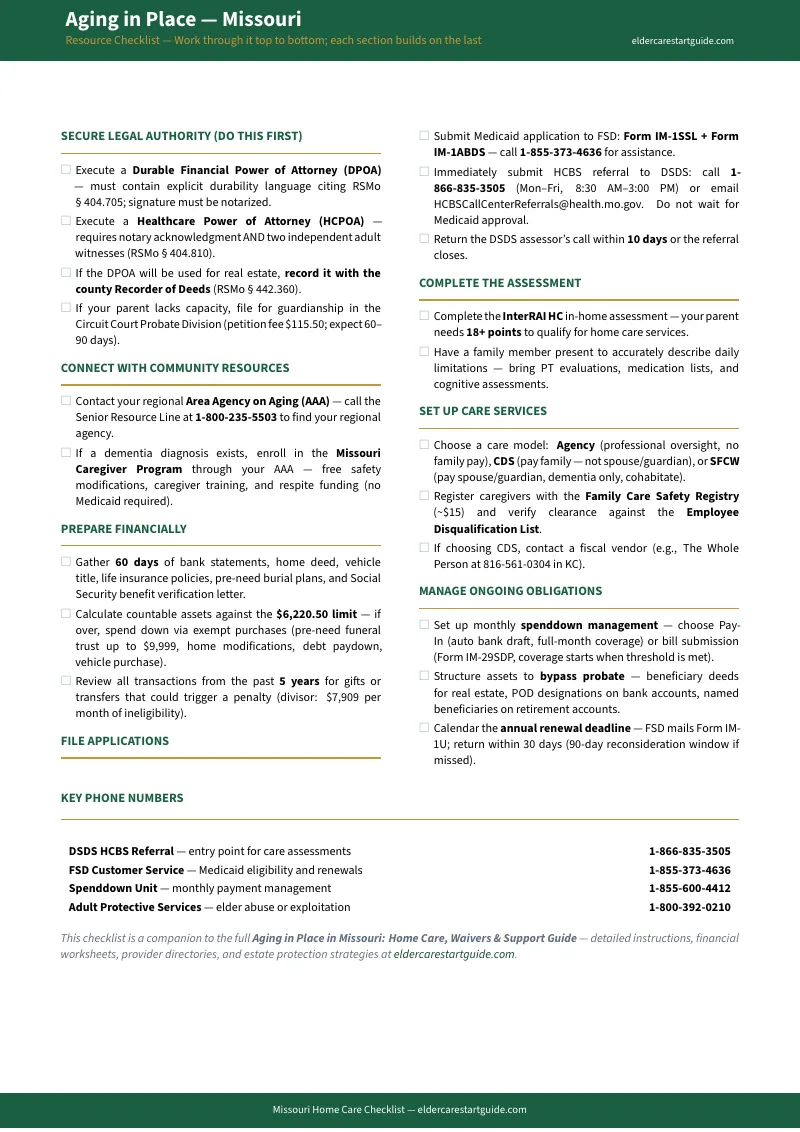
- Missouri Aging in Place Resource Checklist — A 17-item action list organized by timeline: legal authority (Week 1), financial preparation and applications (Weeks 2–4), assessment and care model selection (Weeks 4–8), and ongoing setup (Weeks 8–12), with every phone number and form reference.
- Medicaid Asset Worksheet — Tally every countable asset against the $6,220.50 limit, with exempt/countable status and spenddown strategy tracker.
- Spenddown Calculator Worksheet — Monthly spenddown math: income, deductions, excess calculation, and Pay-In vs. bill submission comparison.
- Care Model Comparison Chart — Agency vs. CDS vs. SFCW side by side: eligibility, caregiver rules, services, payroll, and which fiscal vendor to contact.
- Home Safety Assessment — Room-by-room checklist with Missouri modification funding sources.
- Estate Recovery Shield — Probate vs. non-probate structures, MERP exemptions checklist, and hardship waiver forms.
- Emergency Care Binder — Five-tab organizer template for medical, legal, financial, benefits, and care log records.
- Spousal Protections Worksheet — CSRA and MMMNA calculations, Snapshot Date timeline, and asset transfer tracker.
- Key Contacts Reference — All 10 AAA regions, state agency phone numbers, fiscal vendor contacts, and local resource fill-in fields. Print and keep on the fridge.
Who This Is For
- Adult children whose parent is being discharged from the hospital and someone needs to figure out how to pay for home care that costs over $75,000 a year
- Families who want to pay a relative through CDS but don't understand the caregiver restrictions, fiscal vendor requirements, or Family Care Safety Registry clearance process
- Spouses managing a dementia diagnosis who qualify for the Structured Family Caregiving Waiver but can't find anyone who explains the cohabitation mandate, the backup plan requirement, or the daily per diem structure
- Families confused by Missouri's spenddown system — they know their parent's income is "too high" for Medicaid but don't realize Missouri has no hard income cap and no Miller Trust requirement
- Anyone terrified that Missouri Medicaid will seize their parent's home after death — and who wants to understand what MERP actually reaches and what's protected
- Out-of-state siblings coordinating Missouri home care applications remotely with no idea which of the two state agencies to call first
Why Not Free Government Resources?
The DHSS publishes eligibility limits. FSD has an online portal. DSDS has an HCBS referral form.
Here is what none of them provide:
- A dual-agency walkthrough showing you how to push the DSDS clinical assessment and FSD financial eligibility simultaneously — not sequentially, which costs you weeks of uncompensated care
- An InterRAI assessment preparation strategy explaining how the scoring works and how to document your parent's limitations accurately enough to qualify — not just "call and wait for a visit"
- A spenddown calculation worksheet that shows the exact monthly math, deductions, and both payment methods — not a link to the mydss.mo.gov portal with no instructions
- A care model comparison so you can choose between agency care, CDS, and SFCW based on your family's actual situation — not three separate brochures that never mention each other
- An estate recovery analysis explaining which asset structures survive probate and which don't — not a "consult an attorney" note at the bottom of a government FAQ
Government sites publish regulations. This guide compiles fragmented state, federal, and county data into a single, sequential process you can follow from crisis to stable home care — without paying an elder law attorney to explain things you can learn yourself.
Your Parent's Safety Net
Every week you spend researching is a week your parent goes without the funded care they may already be entitled to. MO HealthNet coverage can be retroactive to the application date — but only if you file.
Get the guide. File the forms. Start the clock.
Get the Missouri Home Care Guide →
The free checklist gives you the 17-item action list to start immediately. The full guide gives you every chapter, every form reference, every spenddown calculation, and the complete dual-agency navigation framework.