Your Parent Has Dementia — Missouri's System Gives You 10 Days to Figure It Out
Your parent's hospital discharge planner just handed you a list of memory care facilities and told you to choose one by Friday. Or maybe you're watching a slow decline and wondering when "managing at home" crosses the line into something unsafe. Either way, you're about to navigate a system where one wrong decision — the wrong facility license, a missed appeal deadline, a generic Power of Attorney — can cost your family tens of thousands of dollars and months of lost care coverage.
Missouri's dementia care system is built on rules that most families discover too late. The most popular home care program requires your parent to pass a cognitive test that most people with dementia fail. The state's estate recovery program reaches further than almost any other state — standard probate-avoidance strategies that work elsewhere won't protect your parent's home here. And the assessment that determines whether your parent qualifies for any state-funded help can be derailed by a single "good day."
The Missouri Dementia Navigation System
This is the step-by-step workbook that walks your family through Missouri's dementia care system in the exact order the state's own administrative process requires — from securing legal authority while your parent can still sign documents, through the DSDS functional assessment that gates access to every state program, to the Medicaid financial restructuring that can preserve your family's home and savings.
It is not a textbook. It is not a collection of general advice you could find scattered across state agency websites. It is a clinical-grade navigational tool built around Missouri's specific regulatory framework — the InterRAI Home Care scoring instrument, the Consumer Directed Services self-direction evaluation, the Structured Family Caregiving Waiver's 300-slot cap, and the 60-month look-back period that determines whether your asset transfers survive Medicaid scrutiny.
What's Inside
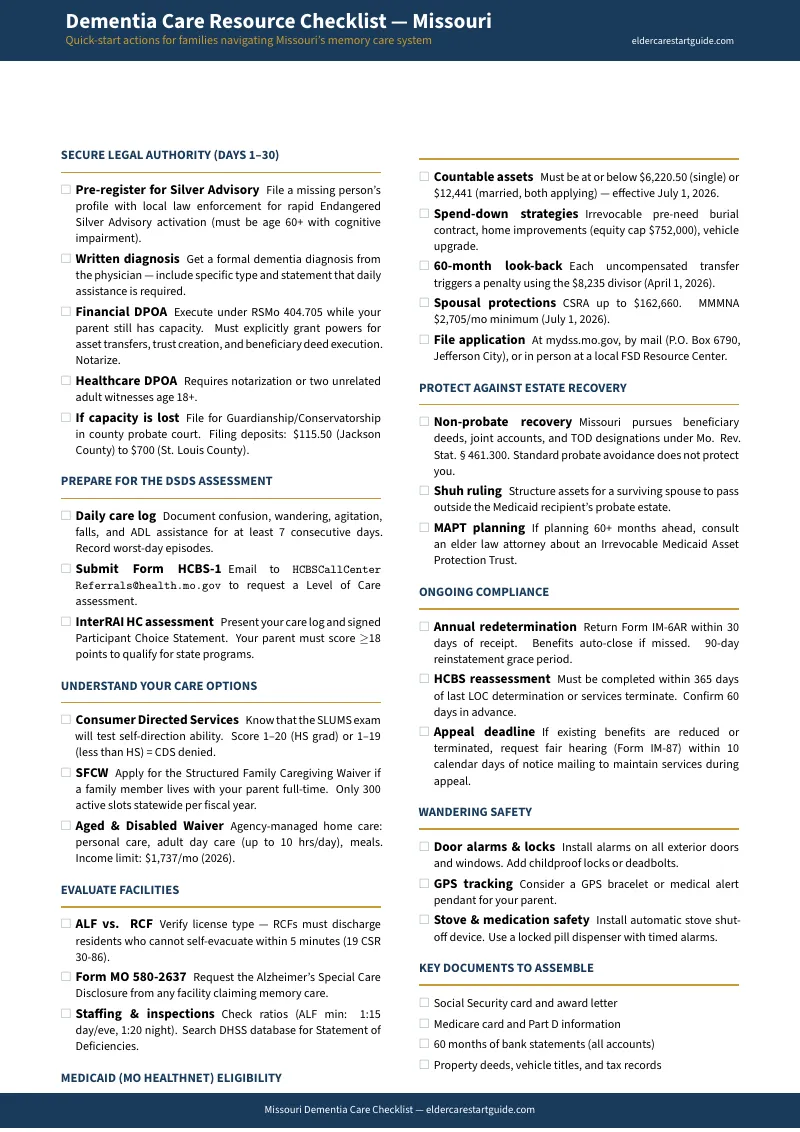
- DSDS Assessment Preparation Kit — The state's InterRAI Home Care assessment determines your parent's Level of Care score, which gates access to every Medicaid home- and community-based service. If your parent is having a "good cognitive day" when the assessor visits, you'll underreport and get denied. This kit includes a 7-day functional care log designed to capture the worst hours, so the assessor sees the full picture — not the best version.
- Consumer Directed Services vs. Structured Family Caregiving Roadmap — CDS lets you hire your own caregiver, but DSDS must verify your parent can "self-direct" using the SLUMS exam. Most people with moderate dementia fail. This roadmap shows you exactly what happens when self-direction is denied, how to pivot to the Structured Family Caregiving Waiver (capped at 300 slots statewide), and when the Aged and Disabled Waiver is the better path.
- MO HealthNet Financial Eligibility Worksheet (2026 Edition) — Missouri's $6,220.50 single-applicant asset limit, the Community Spouse Resource Allowance of up to $162,660, exempt asset conversions (home improvements, prepaid irrevocable funeral contracts, vehicle upgrades), and the monthly spend-down mechanism for excess income — all calculated step by step with current figures.
- Missouri Estate Recovery Protection Assessment — Unlike most states, Missouri's Cost Recovery Unit can pursue both probate and non-probate transfers. Beneficiary Deeds, Transfer on Death designations, and revocable living trusts do not protect the home. This section maps the specific federal exemptions that do work, the Caregiver Child Exemption documentation strategy, and the one-year recovery window after death.
- Memory Care Facility Evaluation Checklist — Side-by-side comparison for up to three facilities, built around Missouri's Alzheimer's Special Care Services Disclosure (Form MO 580-2637). Covers the critical ALF vs. RCF licensing distinction (RCFs can only admit residents who can self-evacuate within five minutes), verified staff-to-resident ratios against state-mandated minimums, and how to pull a facility's Statement of Deficiencies through the DHSS inspection database.
- Legal Authority Decision Tree — If your parent still has capacity: exact requirements for a Missouri Durable Power of Attorney with the explicit gifting, trust, and beneficiary-deed clauses that generic templates lack. If capacity is already gone: the full guardianship/conservatorship court process, county-by-county filing fees, GAL appointment, and surety bond requirements.
- Wandering Safety Protocol — Missouri uses the Endangered Silver Advisory instead of a traditional Silver Alert broadcast. This protocol covers pre-registration with local law enforcement, the MedicAlert/Safe Return enrollment process, home security modifications, and a rapid-response profile template with the exact information search teams need.
- Sibling Communication Planner — Meeting agenda, monthly cost-sharing worksheet, and agreements tracker designed to move sibling conversations from blame to documented care needs — because the biggest obstacle to your parent's care plan is often the family meeting, not the state bureaucracy.
Who This Is For
- Adult children in Missouri coordinating care for a parent with Alzheimer's disease, vascular dementia, Lewy body dementia, or frontotemporal dementia
- Families facing a hospital discharge or facility admission with a compressed decision window
- Caregivers trying to understand whether Consumer Directed Services, the Structured Family Caregiving Waiver, or agency-directed care is the right path
- Families who need to restructure assets before a Medicaid application — and who need to understand why Missouri's estate recovery rules change the playbook
- Primary caregivers burned out from providing daily hands-on care, looking for state-funded respite or caregiver compensation
Why Free Resources Won't Get You There
Missouri's Area Agencies on Aging — Aging Ahead, the St. Louis Area Agency on Aging, MARC — offer valuable services. But their staff are legally barred from giving strategic financial advice. They can tell you programs exist; they cannot help you structure your parent's assets to qualify. Their educational materials are scattered across dozens of unlinked PDFs written in bureaucratic language designed to protect the state from liability, not to help your family optimize its care plan.
The "free advisory" referral sites — A Place for Mom, Caring.com — operate as lead-generation brokers that earn commissions from private-pay facilities. They will never recommend a state-funded home care waiver because they only profit when your parent moves into expensive residential care. Their "personalized" recommendations are sales funnels, not care plans.
And elder law attorneys charge $300 to $600 per hour. They provide critical services for complex asset transfers and trust drafting. But spending those rates to learn basic terminology, organize documents, and understand the DSDS timeline is an expensive misallocation. This guide acts as your pre-attorney preparation — so when you do hire a specialist, you walk in knowing the vocabulary, the deadlines, and the exact questions to ask, cutting billable hours significantly.
The Guarantee
If the guide doesn't save you time and stress navigating Missouri's dementia care system, email us and we'll refund your purchase. No hoops, no time limit.
Get Started Now
Download the free Missouri Dementia Care Resource Checklist to see how the system is organized. When you're ready for the full step-by-step navigation system — the assessment prep tools, the Medicaid worksheets, the facility checklists, and the estate recovery analysis — get the complete guide for .