
Your Parent Needs Help. Mississippi Won't Let You Give It — Until You Have the Right Documents.
Your parent fell. Or the Division of Medicaid caseworker is ready to process the Elderly and Disabled Waiver application, but she cannot proceed without an authorized representative. Or the bank froze the checking account because your father's signature looked shaky, and now nobody can pay his electric bill or the nursing facility deposit.
You are the one driving to appointments, managing medications, fielding calls from siblings and social workers. But Mississippi law does not care that you show up every day. Without a legally executed power of attorney, banks will lock you out, hospitals will refuse to share test results, the Division of Medicaid will reject your application, and the Chancery Court becomes your only path — at $2,500 to $4,000 or more in attorney fees, with mandatory court oversight and annual accountings filed through the Mississippi Electronic Courts system for every dollar you spend on your parent's behalf.
The Mississippi Legal Authority Roadmap
This kit is not a stack of blank forms. It is the process around Mississippi's statutory framework — the part that $300/hour elder law attorneys explain in a one-hour consultation and that government websites leave out entirely.
It covers two paths: proactive planning (when your parent can still sign) and GAP Act court proceedings (when capacity is already gone). And it connects both paths to the Medicaid long-term care system you will almost certainly need to navigate — including the Qualified Income Trust (Miller Trust) that overcomes the strict $2,982 monthly income cap, the Elderly and Disabled Waiver that keeps your parent at home, and the homestead protections that prevent the state from recovering against the family residence.
What's Inside
The kit includes a 12-chapter guide, a printable quick-start checklist, and standalone printable tools — organized in the order you will actually need them:
- Capacity Assessment Framework — A plain-language framework for determining whether your parent can still legally sign. Mississippi law does not equate a dementia diagnosis with incapacity. What matters is whether your parent understands the nature and consequences of the document at the exact moment of signing. The kit explains the legal standard, guides you through "good day" documentation for fluctuating capacity, and tells you when the voluntary path has closed.
- Mississippi Durable Financial POA Walkthrough — The Uniform Durable Power of Attorney Act (Miss. Code Ann. § 87-3-101 et seq.) step by step. Why Mississippi POAs are not durable by default and must contain the explicit durability clause under § 87-3-105. Which powers to include for real estate management, Miller Trust creation, and tax authority. How to execute and notarize so the document is accepted at any Mississippi bank or Chancery Clerk's office.
- Advance Health-Care Directive — Mississippi's Uniform Health-Care Decisions Act (§ 41-41-201 et seq.) governs healthcare proxy designation, living will instructions, and psychiatric advance directives. Strict witness exclusion rules — no healthcare staff, heirs, or agents. How to combine the healthcare proxy and living will in a single document that emergency rooms accept on first presentation.
- Bank Acceptance Playbook — Mississippi banks routinely question POA documents. Under Miss. Code Ann. § 87-3-111, a third party who receives a properly notarized Agent's Affidavit of Validity is protected from liability when acting in good faith. The kit provides the affidavit framework, compliance officer communication templates, and a step-by-step escalation strategy that resolves most refusals without litigation.
- Miller Trust (Qualified Income Trust) Setup — Mississippi is a strict income-cap state. If your parent's gross monthly income exceeds $2,982, they cannot qualify for Medicaid long-term care or the E&D Waiver without a Qualified Income Trust. Complete setup blueprint: drafting the irrevocable trust document, opening the QIT bank account, routing monthly income, paying the approved Patient Liability, and satisfying the state payback requirement upon death.
- GAP Act Court Navigator — When capacity is gone and no POA exists, you must petition the Chancery Court under the Mississippi Guard and Protect Act. The kit covers petition preparation, the mandatory two-physician evaluation, service requirements, filing fees ($148–$161), the 90-day post-appointment inventory, emergency temporary orders limited to 60 days, and how to evaluate whether pro se filing is viable for your family's situation.
- Medicaid Eligibility Worksheet — A fillable worksheet to calculate your parent's countable assets, monthly income, and spousal protection allowances against Mississippi's 2026 thresholds: $4,000 individual asset limit, $162,660 Community Spouse Resource Allowance, $2,982 monthly income cap, and $752,000 homestead equity limit.
- Homestead Protection Guide — Under Estate of Darby v. Stinson, a primary residence passing to a surviving spouse, child, or grandchild is exempt from Medicaid Estate Recovery. The kit explains how to document the homestead exemption under Miss. Code Ann. § 85-3-21 and structure legal authority to preserve this protection.
- Decision Flowchart — A visual decision tree: can your parent still sign? → which document, which execution steps. Cannot sign? → emergency guardianship vs. full guardianship vs. alternatives. Bank refusing your POA? → escalation path. Print it and keep it on your desk.
- Forms Register & Contact Directory — Every Mississippi form referenced in the guide, plus Division of Medicaid regional offices, Planning and Development District intake numbers, and Chancery Clerk office locations — with space for your own professional contacts.
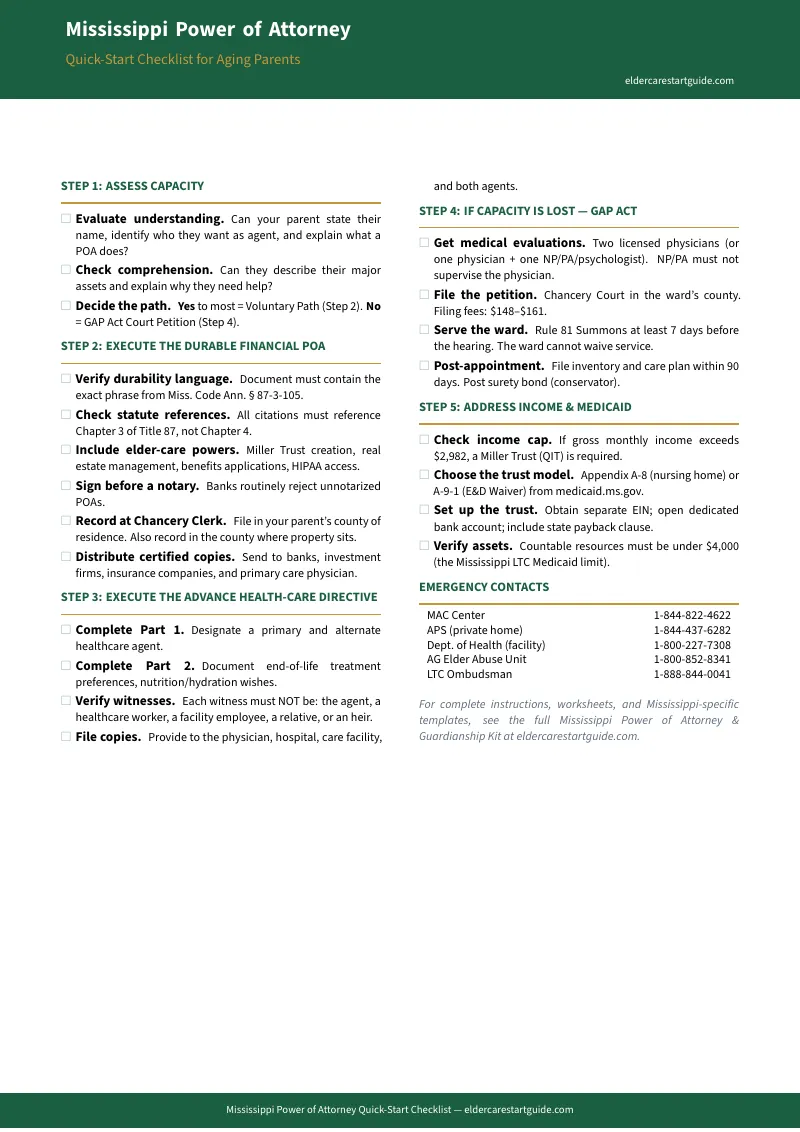
- Quick-Start Checklist — A printable, single-page action list for crisis mode. What to do today, this week, and this month — extracted from the full guide for the caregiver who needs to know what to do before calling the hospital back.
Who This Kit Is For
- Adult children who just learned they need "power of attorney" for an aging parent in Mississippi and do not know where to start
- Families facing a hospital discharge where the parent cannot go home alone and nobody has legal authority to sign admission or consent forms
- Caregivers whose parent has early-stage dementia and can still sign — but the window is closing
- Families trying to navigate Medicaid long-term care or the E&D Waiver and the Miller Trust process without paying thousands in attorney fees
- Siblings who need a clear, documented fiduciary process to avoid disputes about who controls what
- Anyone dealing with a bank or institution that will not honor an existing power of attorney document
Why Not Just Use Free Forms?
Mississippi publishes GAP Act templates through the Access to Justice Commission and DeSoto County. National sites like eForms and LawDepot offer downloadable POA forms. You can download blank forms right now.
Here is what those forms do not tell you:
- That Mississippi POAs are not durable by default — without the explicit durability clause required under § 87-3-105, your document dies the moment your parent becomes incapacitated, which is exactly when you need it most
- What to do when a bank teller refuses to honor the form you just had notarized — and how the § 87-3-111 Agent's Affidavit compels acceptance
- How to determine whether your parent can still legally sign, or whether the window has already closed and you are looking at a Chancery Court proceeding
- How to set up the Miller Trust that overcomes the $2,982 monthly income cap — without which the Division of Medicaid will deny your parent's application regardless of how perfectly the rest of the paperwork is completed
- Which Planning and Development District serves your county, how to schedule the mandatory LTSS pre-admission screening, and what clinical score threshold your parent needs to qualify for the E&D Waiver
The forms are step one of a twenty-step process. This kit covers all twenty.
Satisfaction Guarantee
If the kit does not give you a clearer path forward, email [email protected] and we will make it right.
— Less Than One Hour of a Mississippi Elder Law Attorney's Time
The average initial consultation with a Mississippi elder law attorney runs $200 to $500. A full GAP Act guardianship proceeding can cost $2,500 to $4,000 or more in court fees, bonding, and legal representation.
This kit will not replace an attorney for complex trust litigation or multi-property estate restructuring. But for the standard power of attorney execution, institutional acceptance, Miller Trust setup, and Medicaid navigation that most Mississippi families need, it covers the process at a fraction of the cost.
Start with the free checklist to see if the approach fits your situation. The full kit goes deeper with complete guides, decision flowcharts, and step-by-step institutional playbooks.