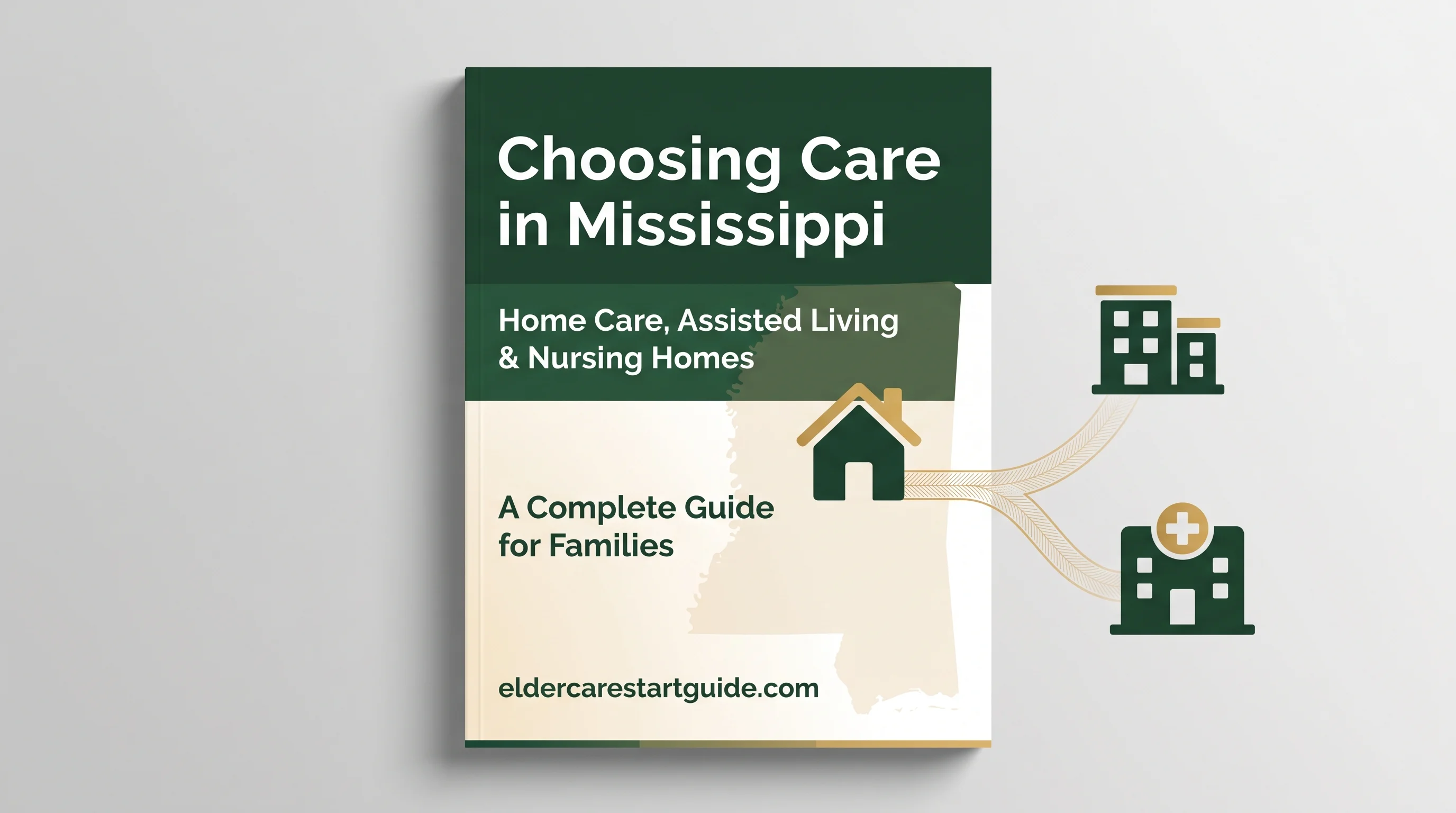

Your Parent Needs Care. Mississippi's System Has Three Paths — And the Wrong One Could Cost Your Family Everything.
Your parent fell last Tuesday. Or maybe it wasn't a fall — maybe you drove down for the holidays and noticed the refrigerator was empty, the bills were stacked unopened, and your mother couldn't remember which medications she'd taken. Either way, you're now making decisions about home care, assisted living, or a nursing home in a state where the rules are unlike anywhere else in the country.
You searched online. National websites told you Mississippi has "low care costs" and "Medicaid spend-down options." The first part is true — Mississippi has some of the lowest private-pay rates in the nation. The second part is dangerously wrong. Mississippi is a strict income-cap state. There is no medically needy spend-down for long-term care. If your parent's income exceeds $2,982 per month by a single dollar, they are disqualified from nursing home Medicaid unless they establish a Qualified Income Trust. No exceptions.
You called the Mississippi Access to Care Center. They mentioned "Personal Care Homes" (not assisted living — Mississippi uses different terminology), the Elderly and Disabled Waiver waitlist, and "Planning and Development Districts." You hung up with more questions than answers and no idea what to do first.
The Mississippi Care Transition System
This is not a pamphlet of eligibility limits. It is the decision-making system around those limits — a structured process for evaluating your parent's needs, comparing Mississippi's care settings against your family's finances, and navigating the state agencies that control access to services.
The guide covers every care option, every financial threshold, every legal instrument, and every state-specific wrinkle — organized in the order you will actually need them, from the first signs of decline through facility placement and Medicaid application.
What's Inside
- Clinical Self-Assessment Worksheets — Mississippi's clinical eligibility for waiver programs and nursing home Medicaid depends on scoring at or above a Nursing Facility Level of Care on the LTSS InterRAI assessment. The guide provides structured ADL and IADL assessment worksheets that mirror the state's evaluation tool, so you can objectively document your parent's functional status and present organized evidence to the state screener. This is the difference between "my parent needs help" and a documented case that qualifies for services.
- Mississippi Care Settings Decoded — PCH-RL, PCH-AL, and the Licensing Gap — Mississippi does not license facilities as "assisted living." The state calls them Personal Care Homes, split into two designations: Residential Living (PCH-RL) for basic oversight, and Assisted Living (PCH-AL) for medication administration and hands-on personal care. The guide explains what each designation covers, what it does not cover, and how to verify a facility's actual MSDH classification — because a facility marketing itself as "assisted living" may only hold a Residential Living license, which means they legally cannot manage your parent's medications.
- The Home Care Tipping-Point Calculator — Mississippi's in-home care rates average $24/hour, among the lowest in the country. But full-time home care crosses the cost of facility care at roughly 45 hours per week. The guide includes a cost-modeling worksheet that helps you calculate exactly when keeping your parent at home stops making financial sense and facility placement becomes the more sustainable option — factoring in Mississippi-specific rates for companion care, personal care, and skilled nursing visits.
- The $2,982 Income Cap and Miller Trust Administration — If your parent's gross monthly income exceeds $2,982, they must establish a Qualified Income Trust (QIT/Miller Trust) before they can qualify for long-term care Medicaid. The guide walks through the entire trust setup: opening the dedicated bank account, the monthly deposit-and-disbursement sequence ($44 personal needs allowance, then spousal maintenance, then cost-of-care share), naming the state as remainder beneficiary, and the administrative errors that invalidate the trust and trigger immediate Medicaid disqualification. Includes the disbursement waterfall template so the trustee knows exactly where every dollar goes each month.
- E&D Waiver and Assisted Living Waiver — Waitlists, Limits, and the Room-and-Board Gap — The Elderly and Disabled Waiver funds home services (personal care, adult day care, home-delivered meals) for seniors who meet nursing facility level of care. But it has capped enrollment and a waitlist, and the state selects your parent's providers — you cannot direct care. The Assisted Living Waiver covers care services in licensed PCH-AL facilities, but never covers room and board. Your family pays rent and meals out-of-pocket, creating a gap that surprises families who thought "Medicaid waiver" meant full coverage. The guide details eligibility, application through your regional Planning and Development District, and how to bridge costs while waiting for a slot.
- Facility Safety Vetting — MSDH Inspection Database and the Ombudsman — Before placing your parent anywhere, the guide walks you through searching the MSDH Health Facilities database for state survey results, reading citations for severity (Immediate Jeopardy, Substandard Quality of Care), and interpreting deficiency patterns. It includes an unannounced site-visit evaluation checklist with the specific questions to ask staff and the physical red flags to check in common areas, dining rooms, and resident rooms. Plus contact information for the State Long-Term Care Ombudsman — the independent resident advocate who handles complaints and can intervene in facility-initiated discharges.
- Estate Recovery and the Stinson Ruling — After a Medicaid recipient dies, Mississippi's Estate Recovery Program (MERP) files claims against the estate to recoup care costs — and the family home is almost always the primary target, even though it was exempt during your parent's lifetime. The guide explains the landmark Stinson v. Division of Medicaid ruling, where the Court of Appeals held that homestead property may pass free of Medicaid's recovery rights. This ruling is currently on appeal to the Mississippi Supreme Court. The guide covers what Stinson means for your family's planning, federal exemptions (surviving spouse, child under 21, disabled child), and steps to protect the home before and after your parent enters care.
- Legal Authority — POA, Healthcare Surrogacy, and the GAP Act — Default healthcare surrogacy under Mississippi Code § 41-41-211 only activates when a physician makes an official written determination of incapacity — not from a general dementia diagnosis in the chart. And surrogate authority covers healthcare decisions only, not financial contracts like nursing home admission agreements. The guide covers the Durable Power of Attorney provisions your parent needs, the Advance Health-Care Directive, and the full Guardianship/Conservatorship process under Mississippi's GAP Act when capacity is already gone, including Chancery Court filing requirements and costs.
Plus: Printable Worksheets and Templates
- ADL/IADL Self-Assessment — Structured functional evaluation matching Mississippi's LTSS screening categories
- Family Care Meeting Agenda — Pre-formatted discussion guide covering care preferences, finances, and legal authority
- Care Cost Comparison Worksheet — Side-by-side cost modeling for home care, PCH-AL, and nursing facility using Mississippi rates
- QIT Monthly Disbursement Template — Income waterfall showing every required payment in correct order
- Facility Evaluation Scorecard — Structured checklist for unannounced site visits with weighted safety indicators
- Medicaid Application Document Checklist — Every financial record needed for the 60-month lookback, organized by category
Plus: Printable Quick-Start Checklist
- Mississippi Care Decision Checklist — A one-page action list with the 20 most critical first steps: assess needs, secure legal authority, hold a family meeting, request a clinical assessment, compare care settings, check Medicaid eligibility, evaluate facilities. Every threshold, phone number, and deadline at a glance.
Who This Is For
- Adult children whose parent is being discharged from the hospital and someone needs to choose a care setting before the discharge planner's deadline
- Families watching a parent's slow decline — missed medications, empty refrigerator, minor accidents — who need an objective framework to decide when it's time
- Out-of-state children managing a Mississippi parent's care remotely, navigating a system that relies on in-person visits to regional PDD offices rather than a centralized state portal
- Families whose parent's income exceeds $2,982/month and needs a Qualified Income Trust set up correctly to qualify for Medicaid
- Spouses trying to understand their Community Spouse Resource Allowance and Monthly Maintenance Needs Allowance protections before their partner enters care
- Anyone comparing Personal Care Homes and nursing facilities who needs to understand the actual licensing distinction between PCH-RL and PCH-AL — not the marketing brochure version
Why Not Free Government Resources?
The Mississippi Division of Medicaid publishes eligibility limits. Your Area Agency on Aging offers options counseling. National sites like A Place for Mom and Caring.com have directory listings.
Here is what none of them provide:
- A clinical self-assessment structured to match the state's LTSS evaluation categories — so you arrive at the screener's visit with organized documentation instead of anecdotes
- The PCH-RL vs. PCH-AL licensing distinction explained in terms of what each designation can and cannot legally provide for your parent
- The cost-modeling worksheet that identifies the exact hour threshold where home care becomes more expensive than facility care in Mississippi
- The QIT disbursement waterfall template showing the trustee the correct payment order each month — not a generic "consult an attorney" note
- The Assisted Living Waiver's room-and-board gap explained as a real dollar figure your family must cover, not buried in a paragraph about "covered services"
- The Stinson ruling and its implications for estate recovery — which no government portal and no national publisher covers
Government sites publish rules. Lead-generation directories steer you toward facilities that pay them referral commissions. Elder law attorneys explain the nuances for $300 to $500 per hour. This guide bridges the gap — translating Mississippi's care system into a decision-making process you can work through in an evening.
Satisfaction Guarantee
If the guide doesn't give you a clearer path forward, email [email protected] and we'll make it right.
— Less Than One Hour of an Elder Law Attorney's Time
An initial consultation with a Mississippi elder law attorney runs $300 to $500. A full Medicaid planning engagement costs $3,000 to $5,000. A guardianship proceeding through Chancery Court adds thousands more.
This guide won't replace an attorney for complex trust litigation or contested guardianship. But for the care-level assessment, cost comparison, QIT setup guidance, facility vetting, and Medicaid eligibility mapping that most Mississippi families need, it covers the work of multiple billable hours at a fraction of the cost — and if you do need an attorney, you'll walk in with a fully organized file instead of a box of unsorted questions.
Start with the free checklist to see if the approach fits your situation. The full guide goes deeper — every care setting, every financial threshold, every legal instrument, every Mississippi-specific detail.