
The hospital says your parent is being discharged. You have until noon to stop it.
Your parent is in a Minnesota hospital bed. A case manager just told you the discharge is happening — maybe to a skilled nursing facility you have never visited, maybe straight home with no home health aide arranged. You have questions about observation status, rehab coverage, whether MnCHOICES can fund in-home care, and what happens if you sign that nursing home admission contract as the "responsible party." The case manager is already moving on.
The information you need exists. It is buried in Medicare.gov bulletins, Minnesota DHS policy manuals written for county assessors, Commence Health appeal instructions, and the fine print of your parent's MSHO or MSC+ managed care plan. Piecing it together yourself — under the pressure of a noon discharge deadline — is not a realistic option.
The Minnesota Discharge Navigation System
This is not a generic caregiving guide. It is a step-by-step administrative system built specifically for Minnesota families managing a parent's hospital discharge, skilled nursing transition, or long-term care eligibility process. Every script, template, and checklist is keyed to Minnesota statutes, DHS regulations, and the county-administered MnCHOICES framework that controls your parent's access to publicly funded care.
The guide walks you through the entire transition pipeline — from the moment your parent is admitted to the day you have a funded, compliant care plan in place — so you are never relying on a case manager's verbal assurances or a nursing home's financial pressure to make decisions.
What's Inside
- Discharge appeal scripts and timelines — the exact words to say and forms to file with Commence Health (the designated Region 5 BFCC-QIO) to legally freeze an unsafe discharge, including the automatic stay that prevents the hospital from billing your family while the clinical review is pending
- Observation status diagnostic — how to verify your parent's admission classification, understand the financial consequences of outpatient observation billing under the new MCSN rules effective February 2025, and challenge a reclassification that blocks skilled nursing coverage
- SNF transition roadmap — Medicare's three-midnight rule, coinsurance rates by day, the Jimmo v. Sebelius maintenance standard, and how to evaluate facilities during a compressed decision window
- Responsible party liability shield — how Minn. Stat. § 144.6501 protects you from personal financial liability when signing nursing home contracts, with a pre-drafted addendum template aligned to the Sholom Community Alliance v. Chadwell ruling
- MnCHOICES assessment preparation — a pre-written county intake request letter citing the 20-business-day statutory timeline, a walkthrough of what the certified assessor evaluates, and how to document your parent's care needs so the assessment captures nursing-facility level of care
- CFSS transition guide — how the new Community First Services and Supports program replaces PCA, the Agency vs. Budget model decision, how spouses and parents of minor children can be hired as paid support workers, and the critical transition deadlines (AC participants by March 2026, all others by September 2026)
- Medical Assistance spend-down worksheets — Minnesota's $3,000 individual asset limit, the $162,660 Community Spouse Resource Allowance, the $11,869 monthly SAPSNF penalty divisor for lookback transfers, and compliant strategies for the five-year lookback window
- Estate recovery protection matrix — which assets Minnesota's expanded recovery program under § 256B.15 can and cannot reach, including the sibling homestead exclusion and caregiver child homestead exclusion that permanently block claims
Who This Is For
This guide is for adult children in Minnesota who are managing a parent's hospital discharge and need to make financial, clinical, and administrative decisions they were never trained for. You may be facing an immediate discharge deadline, navigating a transition from hospital to skilled nursing facility, trying to bring your parent home with Elderly Waiver or CFSS-funded support, or working through a Medical Assistance application you do not understand. The guide meets you wherever you are in that process.
It is not for families dealing with simple, uncomplicated discharges where the patient goes home healthy. It is built for the situations where the system works against you — where observation status blocks rehab coverage, where the nursing home is pushing you to sign as a financial guarantor, where your parent's assets are at risk, and where nobody has explained what happens when the Medicare days run out.
Why Not Just Use Free Resources?
Minnesota publishes excellent free resources. The Senior LinkAge Line provides unbiased Medicare counseling. County human services offices administer MnCHOICES. The Office of Ombudsman for Long-Term Care advocates for residents' rights. The problem is not that the information is hidden — it is that free resources are designed to process paperwork, not to defend your family's interests.
A county assessor cannot advise you on how to legally shield your parent's home from estate recovery. The Senior LinkAge Line will not write a clinical argument to win a discharge appeal. Mid-Minnesota Legal Aid serves low-income seniors, but strict eligibility caps exclude most middle-class families. And official DHS policy manuals are written for caseworkers and compliance officers, not for a daughter who just found out her mother's three-day hospital stay was billed as observation.
Elder law attorneys can answer these questions — at $300 to $500 per hour. For straightforward transitions, this guide replaces those introductory consultations entirely. For complex estates, it ensures you walk into the attorney's office with an organized clinical and financial profile instead of paying for hours of discovery that this guide completes in an evening.
What You Get
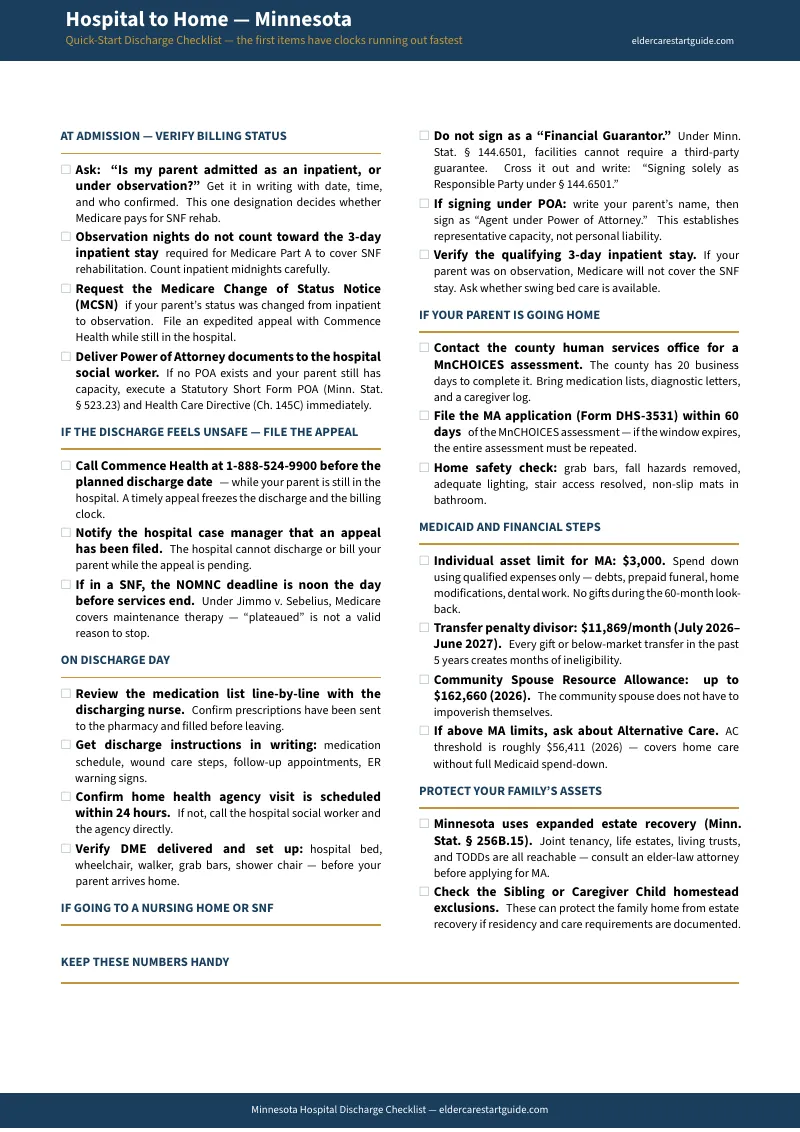
Your download includes the 54-page guide covering the full transition system: discharge rights, observation status, SNF transitions, the responsible party liability shield, MnCHOICES eligibility, CFSS home-care transition, Medical Assistance financial planning, and estate recovery protection. You also get the 24-item checklist and eight standalone printable worksheets — a discharge day readiness checklist, admission contract review worksheet, MnCHOICES assessment preparation form, Medical Assistance spend-down tracker, agency communication log, transfer penalty calculator, estate recovery protection matrix, and care integration decision tree. Everything you need to print and bring to the hospital, the nursing home, or the county office.
Every Minnesota-specific statute, regulation, and program referenced in the guide is current as of 2026. Asset limits, spousal allowances, penalty divisors, and CFSS transition deadlines reflect the latest published figures.
100% Satisfaction Guarantee
If the guide does not deliver the clarity and structure you expected, email us for a full refund. No forms, no time limit, no questions.
Start Protecting Your Parent Today
The hospital's discharge clock is already running. Every day without a plan is a day where decisions get made for your family instead of by your family.
Download the free Minnesota Hospital Discharge Checklist to see the sequential action steps. When you are ready for the full system — scripts, templates, worksheets, and the complete Minnesota-specific legal and financial framework — get the full guide and take control of this transition.
The price of a single lunch. The value of knowing exactly what to do, who to call, and what to say — before the discharge deadline hits.