
Minnesota Has Six Home Care Programs — And the One Your Parent Needs Depends on a Single Assessment You Can't Retake
Your parent needs help at home. Maybe it started with missed medications, a fall in the bathroom, or a call from a neighbor who noticed something off. Now you're trying to figure out what Minnesota actually offers — and the first thing you discover is that "home care" doesn't mean one thing here. The state runs six separate programs through 87 county-level agencies, each with different clinical thresholds, financial limits, and service delivery models. The Elderly Waiver covers a full range of home and community services but requires Nursing Facility Level of Care and Medical Assistance eligibility. Alternative Care serves families who earn too much for Medicaid but can't afford private nursing. CFSS lets family members get paid as caregivers. And the assessment that determines which programs your parent qualifies for — the MnCHOICES — is a 2-to-3-hour clinical interview conducted once, in your parent's home, by a county assessor who scores functional ability using a rules-based system most families don't understand until after it's over.
Meanwhile, the financial eligibility rules are unforgiving. A single applicant's countable assets must be at or below $3,000. If your parent owns a home, it's exempt during their lifetime — but after death, Minnesota's estate recovery program can seek repayment from the estate unless specific legal exemptions apply. Every government website you find explaining these programs is written in administrative language for county employees, not for an adult child trying to keep their parent safely at home.
The Minnesota Home Care Navigation System
This guide maps the complete pathway from the first phone call to Minnesota Aging Pathways through MnCHOICES assessment preparation, financial eligibility, waiver enrollment, and ongoing compliance. Every program name, asset limit, clinical threshold, and contact resource is specific to Minnesota's Department of Human Services, county lead agencies, and managed care enrollment process.
What separates this from state portals and referral directories: it connects the systems that Minnesota treats as separate administrative processes. Your parent's MnCHOICES assessment score, their Medical Assistance application, the managed care plan they enroll in (MSHO or MSC+), and the service delivery model they choose (agency, CFSS, or CDCS) all interact — and families routinely discover mid-process that a decision made in week two creates a bottleneck in week eight. The guide shows how these pieces fit together so you can sequence each step correctly.
What's Inside
- The Complete Guide (11 chapters) — covers every stage of the home care pathway: Minnesota's long-term care system overview, MnCHOICES assessment preparation with clinical scoring breakdown, MA-LTC financial eligibility with 2026 limits, the MA application process and timeline, managed care plan selection (MSHO vs. MSC+), CFSS paid family caregiver setup, Consumer Directed Community Supports budgeting, home modifications and environmental adaptations, legal instruments (POA and Healthcare Directive), estate recovery protections, and ongoing compliance with annual renewals and appeals
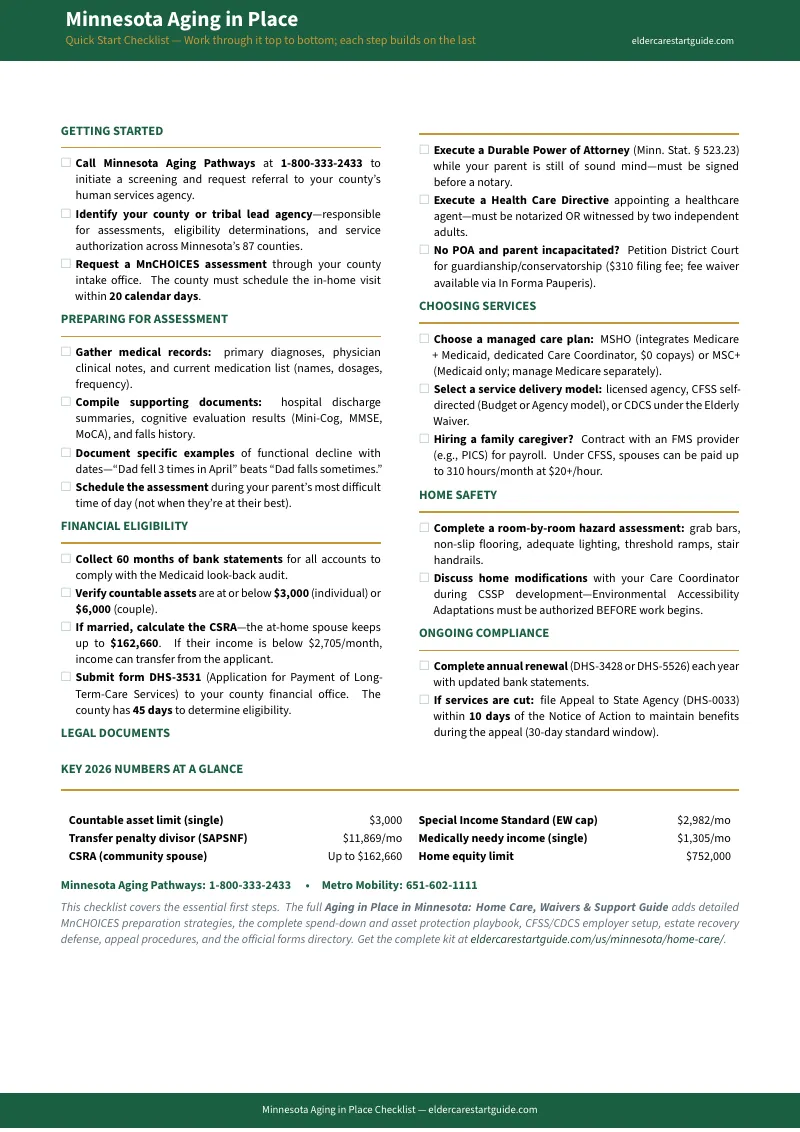
- Aging in Place Resource Checklist — a 20-item printable action list covering the key steps from initial contact through service enrollment and annual renewal
- MnCHOICES Assessment Prep Worksheet — clinical self-scoring across all five NF Level of Care categories plus a documentation checklist to complete before the assessor arrives
- Financial Eligibility Calculator — income and asset inventory with 2026 Minnesota thresholds, spousal impoverishment protections, and spend-down guidance
- CFSS Paid Caregiver Setup — step-by-step Budget Model onboarding for family members, FMS provider selection, and scope-of-care reference
- Estate Recovery Worksheet — exemption checklist, Caregiver Child documentation requirements, and hardship waiver assessment across all three qualifying categories
- Program Comparison Tables — side-by-side reference for Elderly Waiver, Alternative Care, ECS, CFSS, and CDCS with a decision flowchart
- Managed Care Plan Selector — MSHO vs. MSC+ comparison table and decision checklist to bring to your SHIP counselor
- Home Modification Funding Checklist — Environmental Accessibility Adaptations funding sources and the 6-step authorization process
- Annual Compliance Calendar — renewal forms, appeal deadlines, documents to gather, and ongoing eligibility maintenance rules
Who This Is For
- Adult children noticing a parent's slow decline — missed medications, difficulty with bathing or dressing, minor falls — who need to understand what Minnesota's county-based system actually offers before calling anyone
- Families preparing for a MnCHOICES assessment who want to know exactly how the assessor scores functional need, what the Nursing Facility Level of Care standard requires, and what documentation to have ready
- Anyone trying to determine whether their parent qualifies for the Elderly Waiver, Alternative Care, or CFSS — and what happens if they're over the $3,000 asset limit or the $2,982 monthly income threshold
- Family members who want to get paid as a caregiver through the CFSS Budget Model and need the full onboarding process, including FMS provider selection and the PCA-to-CFSS transition deadlines
- Families worried about estate recovery who need to understand the Caregiver Child Exemption, sibling equity rules, and hardship waiver process before applying for Medical Assistance
- Out-of-state adult children coordinating care remotely who need a single document that explains Minnesota's county-administered system without requiring them to cross-reference five different state websites
Why Free Resources Leave You Stuck
Minnesota's DHS and Minnesota Aging Pathways websites publish program descriptions, eligibility rules, and application forms. But these resources are written for county caseworkers and program administrators — the Community Based Services Manual is a policy reference, not a family care-planning guide. You can find the MnCHOICES assessment criteria buried in administrative bulletins, but you won't find a worksheet that lets you pre-score your parent's functional ability before the assessor arrives, or a timeline showing how the assessment connects to the MA application and managed care enrollment.
Elder law attorneys provide expert guidance on Medicaid planning and asset protection — at $300 to $500 per hour. For families with complex estates, professional counsel is essential. But you shouldn't be paying attorney rates to learn the difference between the Elderly Waiver and Alternative Care, or understand how the CFSS Budget Model works. Using this guide to organize your parent's records, pre-evaluate their clinical needs, and map out their financial situation before your first consultation can save hours of billable time.
Senior living referral services will match your parent with facilities for free — because those facilities pay them a referral commission. They have a structural incentive to recommend private-pay placement over state-funded home care programs, and they don't help families navigate the MnCHOICES assessment or the CFSS onboarding process.
Satisfaction Guarantee
If the guide doesn't help you identify at least one program, eligibility rule, or preparation step you weren't already aware of, email us for a full refund. No forms, no waiting period.
Start Navigating Minnesota Home Care with Confidence
Download the free checklist to get the aging-in-place resource overview — or get the full 10-PDF toolkit for and have the complete step-by-step system: MnCHOICES assessment prep worksheet, financial eligibility calculator, CFSS caregiver onboarding guide, estate recovery worksheet, program comparison tables, managed care selector, home modification checklist, compliance calendar, and the full 11-chapter guide to keep your parent safely at home in Minnesota.