
Your Parent Needs More Help. Minnesota's Care System Has Rules Nobody Told You.
Your parent fell last week. Or maybe it wasn't a fall — maybe it was the third time you found expired food filling the refrigerator, or the pharmacy called because a critical medication hadn't been refilled in six weeks. Something shifted, and now you're awake at 2 AM searching "assisted living in Minnesota" while trying to figure out how any of this works.
You called the Senior LinkAge Line. They told you to schedule something called a MnCHOICES assessment through your county lead agency. You looked up assisted living costs and discovered that the base rate doesn't include care tiers — the actual monthly cost depends on how much help your parent needs with bathing, dressing, and medication management, and the all-in figure can run thousands above the advertised price. You learned that the Elderly Waiver might help cover care costs, but it doesn't pay for room and board. And you found out that if your parent transferred any assets in the last five years — even a gift to a grandchild — a penalty period gets calculated by dividing that amount by $11,869, and the penalty clock doesn't start until your parent has already spent down to $3,000 and has nothing left to pay for care.
Meanwhile, the clock is ticking. Your parent's safety needs are real. The care decisions you make in the next few weeks will shape their quality of life and your family's finances for years.
The Minnesota Care Decision Navigation System
This is not a list of phone numbers you can find on the DHS website. It is the process around the system — the part that elder law attorneys explain for $300 to $500 an hour and that state agency portals bury across multiple websites run by DHS, the Department of Health, and the Board on Aging.
The guide walks you through every decision in the order it actually arrives: recognizing when your parent's needs have outgrown their current situation, understanding what each care level provides and costs under Minnesota law, evaluating facilities using the state's own inspection data and report cards, navigating Medical Assistance eligibility and the Elderly Waiver, protecting the family home from estate recovery, and securing the legal authority you need to act on your parent's behalf. Every threshold, every deadline, every contact is specific to Minnesota.
What's Inside
- How Minnesota's Eldercare System Actually Works — The three entities you need to know: your county lead agency for MnCHOICES assessments and care coordination, county financial workers for Medical Assistance eligibility, and the Minnesota Department of Health for facility licensing and complaints. Understanding this structure before you pick up the phone saves weeks of being transferred between offices that can't help you.
- Minnesota's Care Continuum Decoded — The legal and clinical differences between in-home care ($8,389/month at 44 hours/week), adult day services ($2,600/month), standard Assisted Living Facilities ($6,573/month median), ALFDC dementia care communities ($8,200/month), and skilled nursing facilities ($10,646/month semi-private). Each setting includes Chapter 144G licensing requirements, staffing mandates, and the specific ADL and cognitive thresholds that determine the right placement.
- The MnCHOICES Assessment Explained — What the county evaluator measures, how to request the assessment through your county or the Senior LinkAge Line, how to document your parent's functional limitations before the visit, and how the 365-day Initial Assessment Review validity window works so you don't lose your parent's clinical eligibility while waiting for financial approval.
- Facility Evaluation System — How to verify any facility's license type on the MDH Health Care Provider Database, how to request and compare the UDALSA (Uniform Disclosure of Assisted Living Services and Amenities) from every community you tour, how to read MDH inspection reports and correction orders, and the contract provisions to insist on before signing. Includes the Minnesota Nursing Home Report Card and Assisted Living Report Card for side-by-side quality comparisons.
- Medical Assistance Eligibility — Every Threshold, Every Rule — The 2026 limits: $3,000 single-applicant countable asset cap, $162,660 maximum Community Spouse Asset Allowance, $752,000 homestead equity exclusion, $2,705 minimum monthly spousal income allowance, and the $11,869 statewide average skilled nursing rate used to calculate lookback penalties. Plus the complete Elderly Waiver, Alternative Care, Essential Community Supports, and MSHO program comparison — which one covers what, who qualifies, and how to apply through your county.
- The 60-Month Lookback — Worked Examples — How Minnesota calculates asset transfer penalties, with dollar-for-dollar worked examples showing the penalty period calculation. The penalty starts only after your parent is otherwise eligible and has spent down to $3,000 — creating a gap where no funding covers care. The guide shows which transfers trigger penalties, which are exempt, and the specific approved spend-down strategies (debt payoff, irrevocable burial plans, home modifications, vehicle replacement) that reduce countable assets without creating penalties.
- Estate Recovery — What Happens After Death — Minnesota's expanded estate definition allows the state to pursue recovery against joint tenancies, life estates, transfer-on-death deeds, and revocable living trusts — not just probate assets. The guide explains the specific exemptions (surviving spouse, disabled child, caretaker child), the narrow marital homestead joint tenancy protection, and the hardship waiver process.
- Legal Authority — POA and Guardianship — If your parent still has capacity: the Statutory Short Form Power of Attorney (Minn. Stat. § 523.23) and Health Care Directive (Minn. Stat. Ch. 145C) they need to sign now. If capacity is already gone: the full guardianship and conservatorship petition process, including filing fees ($322–$325 plus background study and fingerprint check), publication requirements, and the ongoing reporting obligations that make guardianship a permanent administrative commitment.
- When Things Go Wrong — Complaints, Discharges, and the Ombudsman — How to file complaints with MDH's Office of Health Facility Complaints (1-800-369-7994), when to contact the Office of Ombudsman for Long-Term Care (1-800-657-3591), how to report suspected abuse or neglect to the Minnesota Adult Abuse Reporting Center (1-844-880-1574), and the anti-retaliation protections that keep your parent safe after you report.
- Hospital Discharge Under Pressure — Your parent's right to appeal a discharge, what to demand from the hospital social worker before your parent leaves, and how to bridge the gap when home care services or facility placement are not immediately available. The guide covers this because most families face their biggest care decision during the worst possible moment — a 48-hour hospital discharge window with no plan in place.
Who This Is For
- Adult children whose aging parent is declining and who need to determine the right care level — home care, assisted living, memory care, or skilled nursing — under Minnesota's specific system
- Families trying to qualify a parent for Medical Assistance long-term care but confused by the $3,000 asset limit, spousal impoverishment rules, and the county-administered application process
- Caregivers who need to evaluate assisted living or memory care facilities and want to verify Chapter 144G licensing (ALF vs. ALFDC), read inspection reports, and ask the right questions on tours
- Families facing a hospital discharge and needing to make placement decisions under pressure — with no existing care plan
- Anyone who needs legal authority to manage a parent's care and finances but isn't sure whether a Power of Attorney is still possible or if guardianship is the only option
- Families concerned about Minnesota's aggressive estate recovery program and looking to understand what protections exist for the family home
Why Not Free Government Resources?
The Senior LinkAge Line provides options counseling. DHS publishes program descriptions. The MDH database lists licensed facilities. County social services handles intake.
Here is what none of them provide:
- A decision sequence that tells you what to evaluate first, what to apply for second, and what documents to have ready at each step — not a directory of agencies arranged alphabetically
- The 60-month lookback explained with worked dollar examples showing exactly how the penalty period is calculated — instead of a single paragraph on the DHS website that says "consult an attorney"
- The Chapter 144G licensing system explained so you understand that an ALF cannot legally operate a secured dementia unit — and what happens if the facility marketing "memory care" doesn't hold the ALFDC license
- The estate recovery exposure analysis that shows exactly how Minnesota's expanded estate definition reaches joint tenancies, life estates, and transfer-on-death deeds — and what that means for the family home
- A self-assessment framework that uses the same ADL and IADL categories as the MnCHOICES evaluator, so you can document your parent's needs accurately before the official assessment
State agencies administer programs. Elder law attorneys explain them at $300 to $500 per hour. This guide bridges the gap — translating Minnesota Statutes, DHS administrative rules, and MDH licensing requirements into a sequence you can work through in an evening.
Satisfaction Guarantee
If the guide doesn't give you a clearer path forward for your parent's care in Minnesota, email [email protected] and we'll make it right.
— Less Than One Hour of an Elder Law Attorney's Time
An initial consultation with a Minnesota elder law attorney runs $300 to $500. A Medicaid planning engagement can exceed $10,000. A guardianship proceeding adds thousands more in filing fees, background studies, publication costs, and attorney fees.
This guide won't replace an attorney for complex trust litigation or contested guardianship proceedings. But for the care-level assessment, facility vetting, Medical Assistance eligibility analysis, and application process that most Minnesota families need, it covers the full navigation at a fraction of the professional cost — and if you do need an attorney, you'll walk in with organized records and the right questions instead of starting from zero.
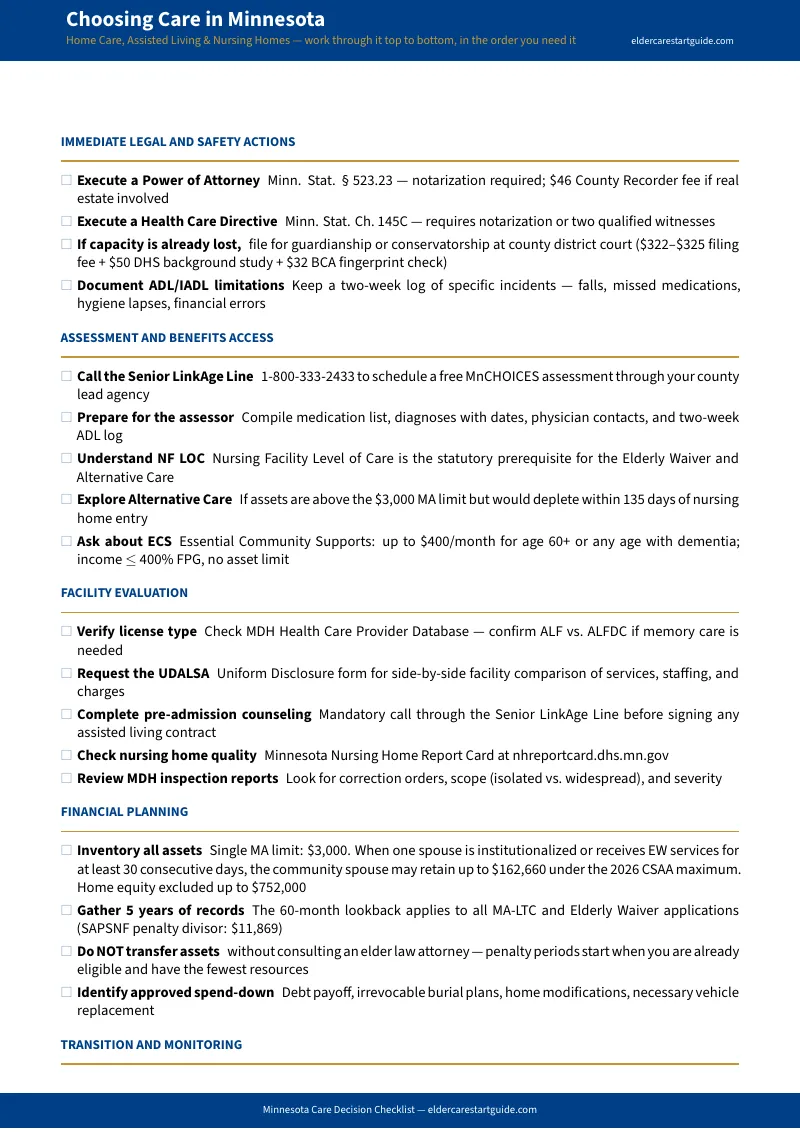
Start with the free checklist to see if the approach fits your situation. The full guide goes deeper — every threshold, every contact, every strategy, every deadline.