Your Parent Needs Help. Michigan Says You Can't Touch Their Bank Account.
Your mom fell. Or your dad's memory is slipping. Or the hospital discharge planner just handed you a bill and said "someone needs to sign this."
You reach for the checkbook — and the bank says no. You call the doctor — and they say they can't share information. You try to pay the mortgage, manage the insurance claim, argue with the billing department — and every door is locked.
You're the one doing the caregiving, but Michigan doesn't care. Without the right legal documents, you have zero authority over your own parent's finances, healthcare, or housing.
The Legal Authority Navigation System
This isn't a stack of blank forms. The State of Michigan already gives those away for free on Michigan Legal Help and through SCAO.
This is the execution methodology that makes those forms actually work — the step-by-step instructions, witness screening checklists, bank enforcement letters, and court filing walkthroughs that turn a blank template into a legally binding document that hospitals, banks, and care facilities must accept.
Michigan updated its entire Power of Attorney framework in July 2024 with the Uniform Power of Attorney Act (UPOAA). Most free resources online — and many attorney websites — still reference the old rules. This kit is built on the current law, including the new automatic durability provisions, agent acceptance requirements, and strict bank-acceptance timelines under MCL 556.220.
What's Inside
Durable Financial Power of Attorney Package
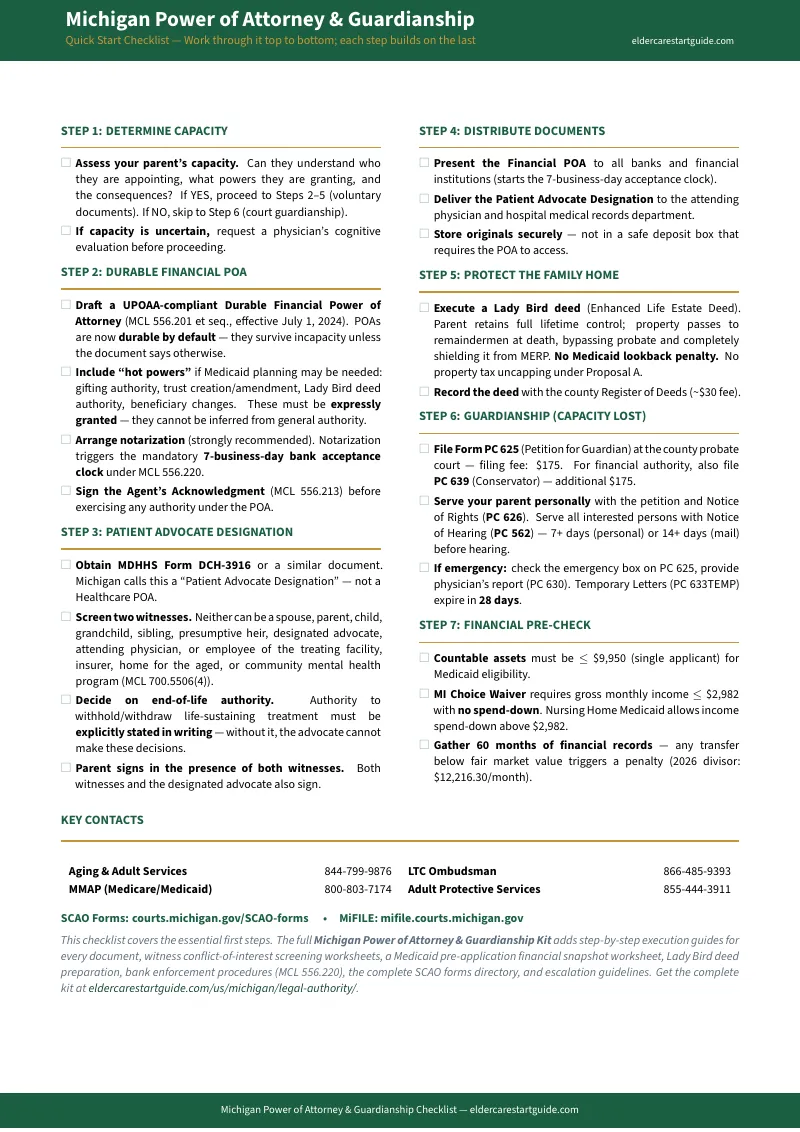
A complete walkthrough of Michigan's Statutory Form POA under the 2024 UPOAA — including when to notarize vs. use witnesses, how to structure special instructions for Medicaid spend-downs and gifting, and the mandatory agent acceptance form your designated person must sign before they can act on your parent's behalf.
Patient Advocate Designation (Healthcare POA)
Michigan doesn't have a "healthcare power of attorney" — it has a Patient Advocate Designation under MCL 700.5506, with witness rules that disqualify hospital employees, presumptive heirs, and insurance providers. One ineligible witness makes the entire document void. Our witness screening checklist catches these disqualifications before the signing, not during the ER admission.
Bank Enforcement Letter
Under the 2024 UPOAA, banks have exactly 7 business days to accept a properly executed POA or request certification. After receiving certification, they get 5 more business days — then they face a court order and mandatory liability for your attorney fees. The kit includes a pre-drafted statutory demand letter citing MCL 556.220 that you can hand to the branch manager.
Lady Bird Deed Guide
Michigan is one of a handful of states that recognizes Lady Bird Deeds (Enhanced Life Estate Deeds) — a way to transfer the family home outside of probate and beyond the reach of the Michigan Medicaid Estate Recovery Program (MERP). This isn't a Medicaid penalty because the parent retains full control during their lifetime. Our guide explains the recording process and how to verify the deed protects against MERP recovery.
SCAO Court Guardianship & Conservatorship Filing Manual
When a parent has already lost capacity and no POA exists, probate court is the only path. The kit walks you through every SCAO form — PC 625 (guardianship petition), PC 639 (conservatorship petition), PC 571 (acceptance of appointment), MC 97 (protected personal information), PC 674 (estate inventory due within 56 days), and the annual accounting on PC 583. Includes filing fees, electronic filing instructions for Wayne, Oakland, Kent, and Macomb counties via MiFILE, and service-by-publication procedures for missing heirs.
MI Choice Waiver Pre-Screening Worksheet
Michigan's MI Choice Waiver funds home and community-based services for nursing-home-eligible adults — but eligibility runs through two separate offices (the regional AAA for clinical assessment and the local MDHHS for financial assessment). The pre-screening worksheet helps you estimate whether your parent meets the 2026 resource limits ($2,982 monthly income, $9,950 countable assets) and clinical criteria before you contact the Area Agency on Aging.
Dementia & Lucid Interval Signing Protocol
A dementia diagnosis does not automatically void legal capacity. Michigan law allows document execution during lucid intervals — but only if properly documented. The protocol covers how to obtain a contemporaneous physician's letter of competency, select independent witnesses, and create an evidence trail that protects the signing from future challenges by siblings or institutions.
Supported Decision-Making Guide
Not every situation requires a guardianship. Michigan probate courts already recognize informal Supported Decision-Making agreements as valid grounds to deny a guardianship petition — even though the formal SDM statutes are still pending in the Legislature. This section covers how to structure an SDM agreement, when it's appropriate, and when you genuinely do need court-appointed authority.
Who This Is For
- Your parent still has capacity — you want to get POA and healthcare documents in place before a crisis forces you into probate court
- Your parent's capacity is borderline — you need to execute documents during a lucid interval with proper safeguards
- Your parent has already lost capacity — you need to file for guardianship and conservatorship and don't know which forms to use or where to start
- A bank or hospital is blocking you — you have a POA but the institution won't accept it, and you need to enforce compliance under the new UPOAA
- You're worried about Medicaid and the family home — you need to understand Lady Bird Deeds, MERP, and the 60-month look-back before it's too late
Why Not Just Use Free Forms?
Michigan Legal Help offers free SCAO-approved forms. The State Bar publishes pamphlets. Every elder law firm in Grand Rapids has a blog post.
None of them give you a sequential execution plan.
They hand you a blank Patient Advocate Designation but don't tell you that your daughter-in-law who works at the nursing home is a disqualified witness under MCL 700.5506. They give you a financial POA template but don't mention that your agent needs to sign a formal acceptance of duties before taking any action under the 2024 UPOAA. They explain what a Lady Bird Deed is but don't walk you through recording it at the county Register of Deeds office.
The free forms assume you already know Michigan elder law. This kit assumes you don't — and gives you the execution methodology to get it right the first time.
What About Hiring an Attorney?
Michigan elder law attorneys charge $200–$500 per hour. An uncontested guardianship retainer starts around $2,000. A full estate plan runs $3,000–$10,000 depending on complexity.
For straightforward estates — one or two parents, a family home, standard bank accounts, no active litigation or blended-family trust disputes — you can prepare and execute valid documents yourself using Michigan's statutory templates. The UPOAA was explicitly designed to make this possible.
This kit helps you handle the standard planning. If your situation involves irrevocable trusts, contested wills, disabled heirs, or active litigation, we'll tell you that too — and recommend when hiring an attorney is worth the investment.
100% Satisfaction Guarantee
If the kit doesn't give you a clear path to securing legal authority for your parent, email us for a full refund. No time limit, no questions.
— Less Than One Hour of Attorney Time
Michigan elder law attorneys bill $200–$500 per hour. A single initial consultation often costs more than this entire kit. Get the same legal knowledge in a format you can use at your kitchen table, on your schedule, without a retainer or billable-hour clock running.
Start with the free checklist to see if your parent's current documents are compliant with the 2024 UPOAA. If they're not — or if no documents exist at all — the full kit gives you everything you need to fix it.