
Your Parent Needs Help at Home. Michigan Has Programs to Pay for It — but Nobody Explains How They Actually Work.
Your parent fell last month. Or maybe the decline has been slower — missed medications, expired food in the fridge, a utility bill that went unpaid for the third time. Either way, you are past the point of hoping things will be fine.
You searched "home health care Michigan" and got a wall of agency ads. You called the Area Agency on Aging and reached a voicemail. You looked into Medicaid and discovered that Michigan has a $9,950 asset limit, a 60-month look-back period, and an estate recovery program that can claim the family home after your parent dies — and nobody at the hospital or the doctor's office mentioned any of this.
Meanwhile, private home care runs $25 to $45 per hour. At 40 hours a week, that is $4,000 to $7,200 per month draining your parent's savings. And every month you pay out of pocket is a month closer to spending down assets you could have protected — if someone had explained the rules before the clock started.
The Michigan Home Care Navigation System
This is not a directory of phone numbers you can find on michigan.gov. It is the process around the system — the part that elder law attorneys explain for $150 to $250 an hour and that state agency websites never sequence for you.
The guide maps Michigan's three publicly funded home care pathways — the Home Help Program (which pays family members $17.13/hour to provide personal care), the MI Choice Waiver (comprehensive home and community-based services for nursing-home-eligible adults), and PACE (all-inclusive coordinated care) — and walks you through the eligibility math, the application process, the asset protection strategies, and the legal documents you need to execute before your parent loses capacity.
What's Inside
- Three Home Care Pathways — Side by Side — The Home Help Program, the MI Choice Waiver, and PACE serve different needs and have different eligibility gates. The guide compares all three: who qualifies, what each one covers, how to apply, and when to use one as a bridge to another. Most families do not learn about all three options from a single source — the agencies administering each program rarely mention the others.
- Financial Eligibility — the Full Calculation — The $9,950 asset limit, the $2,982 monthly income cap, the medically needy spend-down pathway (Michigan does not require a Miller Trust), the Community Spouse Resource Allowance ($32,532 to $162,660), and the Protected Income Level by county ($341 to $408/month). Every number is 2026-current, with the formulas you need to run the math for your parent's specific situation.
- Lady Bird Deeds and Estate Recovery Protection — Michigan's Medicaid Estate Recovery Program (MERP) can only reach assets that pass through probate. A Lady Bird deed transfers the home to heirs at death without probate — shielding it from state recovery claims without triggering the 60-month look-back penalty. The guide explains when to use one, how to record it, and the strategies that are legal versus the transfers that will trigger a penalty of one month's Medicaid ineligibility for every $12,216.30 gifted.
- Getting Paid as a Family Caregiver — Through the Home Help Program, Michigan pays family members and friends to provide personal care at $17.13/hour. Through the MI Choice Self-Determination option, even a spouse can be hired. The guide covers how to apply, the MDHHS-5534 home assessment, Electronic Visit Verification requirements, and how to structure a formal caregiver agreement to protect both the caregiver's income and the parent's Medicaid eligibility.
- Legal Planning Before Capacity Is Lost — The Patient Advocate Designation (Michigan's healthcare POA), the Durable Financial Power of Attorney, and the MI-POST form. If your parent can still sign legal documents, these cost a few hundred dollars. If they cannot, you face a probate court guardianship proceeding that costs thousands and takes months. The guide includes a legal planning decision tree and explains exactly when to escalate to an elder law attorney.
- Home Modifications and Environmental Adaptations — The MI Choice Waiver covers Environmental Accessibility Adaptations (EAA): grab bars, ramps, widened doorways, bathroom modifications. The guide covers ADA specifications, which modifications are covered under the waiver, and how to request them through your person-centered plan of service.
- The 48-Hour Hospital Discharge Problem — When your parent is medically cleared, the hospital pushes for a skilled nursing facility transfer because the SNF system is set up to receive admissions immediately. They rarely explain that home care waiver options exist. Medicare covers up to 100 days in a SNF after a qualifying stay — with $217/day copays from day 21. The guide covers your rights during discharge, how to challenge an unsafe discharge, and how to coordinate a direct-to-home transition.
- Appeals and Fair Hearings — When services are denied, reduced, or terminated, you have the right to appeal. The guide covers the managed care internal grievance process, MDHHS administrative hearings, aid-paid-pending (keeping current services while you appeal), and the timelines that matter — because missing a 10-day window can mean losing months of coverage.
Plus: Printable Standalone Tools
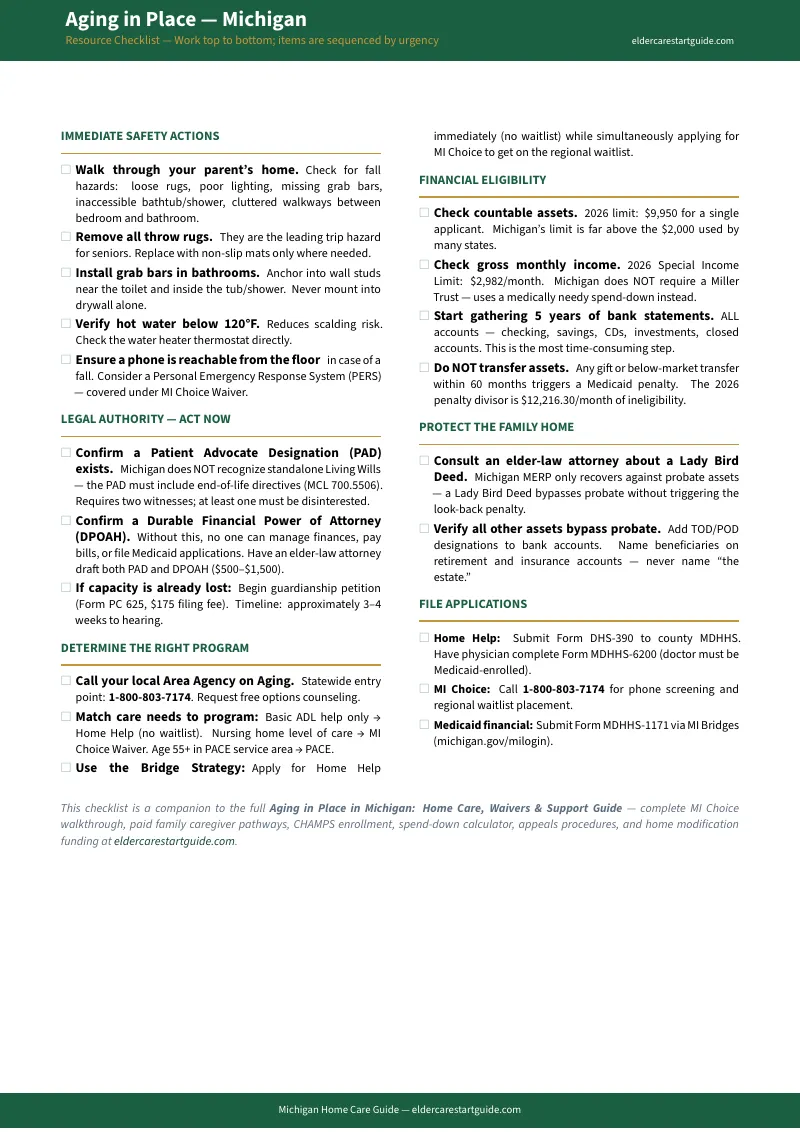
- Quick-Start Checklist — One-page 20-item action list with every threshold, phone number, and deadline
- Program Comparison Worksheet — Home Help vs. MI Choice vs. PACE: eligibility, coverage, and application steps
- Financial Eligibility Worksheet — Asset inventory, income calculation, spend-down math, and CSRA protections
- Lady Bird Deed Decision Guide — When it works, when it does not, and how to record one
- Home Safety Assessment Form — Room-by-room evaluation for fall risks, accessibility, and modification needs
- Professional Advisory Team Directory — When to call an elder law attorney, a geriatric care manager, MMAP, or the ombudsman
Who This Is For
- Adult children whose parent needs daily help at home — after a fall, a hospital stay, or a gradual decline that has passed the point of hoping things will be fine
- Families navigating the MI Choice Waiver application through their regional Area Agency on Aging and needing to understand the Level of Care Determination process
- Caregivers who want to get paid through the Home Help Program but cannot find clear instructions on how the MDHHS-5534 assessment and enrollment process works
- Families worried about losing the family home to Michigan's Medicaid Estate Recovery Program and wanting to understand Lady Bird deeds before spending $6,500 to $9,500 on an elder law engagement
- Out-of-state children managing a Michigan parent's care from a distance, who need a single sequenced roadmap instead of 16 different agency websites
- Anyone whose parent's income exceeds $2,982/month and needs to understand Michigan's medically needy spend-down pathway
Why Not Free Government Resources?
The Area Agencies on Aging provide intake screenings. MDHHS publishes eligibility limits on michigan.gov. Michigan Legal Help offers free POA forms.
Here is what none of them provide:
- A step-by-step sequence that tells you what to do first, second, and third — not a directory of 16 regional agencies to call in no particular order
- The asset protection strategies that are legal under Michigan law, with the specific timing and exemption rules that distinguish a Medicaid-approved spend-down from a penalized transfer
- The Lady Bird deed mechanics explained in plain language — why it works for MERP avoidance, when to use it, and what a $200 recording fee protects compared to a $6,500 elder law engagement
- A comparison of all three publicly funded pathways in one place — because the Home Help Program office does not explain MI Choice, the waiver agency does not mention Home Help, and neither office brings up PACE
- The family caregiver pay enrollment process, which most families never hear about until they have already spent months providing unpaid care
State agencies administer programs. Elder law attorneys explain them at $150 to $250 per hour. This guide bridges the gap — translating hundreds of pages of Michigan statutes, MDHHS policies, and agency procedures into a sequence you can work through in an evening.
Satisfaction Guarantee
If the guide doesn't give you a clearer path forward for your parent's care, email [email protected] and we'll make it right.
— Less Than One Hour of a Geriatric Care Manager's Time
An initial assessment with a Michigan Geriatric Care Manager costs $800 to $2,000. Ongoing care coordination runs $150 to $250 per hour. A full Medicaid planning engagement with an elder law attorney starts at $6,500.
This guide won't replace an attorney for complex trust litigation or multi-million dollar estate planning. But for the MI Choice enrollment, Home Help application, asset mapping, Lady Bird deed analysis, and care transition planning that most Michigan families need, it covers the process at a fraction of the cost — and if you do need an attorney, you'll walk in with organized records and the right questions instead of starting from scratch.
Start with the free checklist to see if the approach fits your situation. The full guide goes deeper — every threshold, every strategy, every form, every phone number.