
Your Parent Has Dementia. Michigan's System Has Answers — Buried Under 16 Agencies and Thousands of Pages.
The diagnosis hit hard enough. Now you're supposed to figure out memory care placement, Medicaid qualification, legal authority, and asset protection — all at once — while your parent's capacity to sign critical documents fades by the month.
You call the Area Agency on Aging. They explain clinical assessments. You call MDHHS. They explain financial eligibility. You call LARA to check a facility's license. Nobody connects the dots between what you learn at each stop.
Meanwhile, every week without a Durable Power of Attorney is another week closer to a $5,000–$10,000 probate guardianship. Every month without a Medicaid application is another month of private-pay rates that can run $10,000 to $15,000. And one misunderstood rule about the $9,950 asset limit can trigger a denial that sets your family back months.
The Michigan Dementia Care Navigation System
This guide does what no single Michigan agency will: it lays out the entire dementia care journey — from legal authority to facility placement to post-death estate recovery — as one sequential roadmap.
Not generic national advice. Not a sales pitch for an assisted living chain that pays commission. Not a $300/hour legal consultation where you spend the first hour explaining your situation.
A step-by-step system built exclusively for Michigan families, using 2026 financial thresholds, current LARA licensing rules, and the exact forms you'll need at every stage.
What's Inside the Guide
- Legal Authority Toolkit (DPOA + Patient Advocate) — the Michigan Uniform Power of Attorney Act requires specific execution steps that most DIY forms miss. This chapter walks you through capacity assessment, notary and witness requirements, and the agent duties acknowledgment — plus what to do if your parent has already lost capacity and you're facing probate court (forms PC 625, PC 631, PC 630)
- LARA Facility Evaluation System — Michigan doesn't license "memory care" or "assisted living" as legal categories. Facilities are either Adult Foster Care (Act 218, typically 1–20 residents) or Homes for the Aged (Act 368, 21+ residents). This chapter explains why the distinction matters — AFC homes cannot retain residents who need continuous nursing, which can trigger a sudden discharge — and gives you a site-tour checklist with the questions LARA inspectors ask
- 2026 Medicaid Qualification Roadmap — the exact financial limits ($2,982 monthly income cap, $9,950 countable asset limit), the difference between countable and exempt assets, spousal impoverishment protections (up to $162,660 in protected assets), and the spend-down paradox that blocks MI Choice Waiver applicants with income slightly above the limit
- MI Choice Waiver Application Planner — the waiver can pay for personal care, nursing, adult day health, and supports coordination in home, AFC, or HFA settings. But it never pays room and board, it's not an entitlement (roughly 20,543 slots statewide), and waitlists can run months to over a year. This chapter maps the 6-stage application process from initial phone screening through service plan creation, including what to say on the intake call to your regional AAA
- Home Help Program Setup — how to get paid $17.13/hour (2026 rate) for up to 180 hours/month as your parent's caregiver. Covers CHAMPS registration, the prohibition on paying legal spouses, and how Home Help differs from MI Choice self-determination
- Estate Recovery Shield — Michigan uses probate-only estate recovery, which means a Lady Bird deed can legally bypass state claims on the family home after death. This chapter explains the caregiver-child transfer exemption, the 60-month look-back period, the 2026 penalty divisor ($12,216.30/month), and how to handle the MDHHS Estate Recovery Questionnaire
- Silver Alert + Safe Return Registration — how Michigan's new statewide Silver Alert system (Senate Bill 456, July 2026) works, plus MedicAlert + Alzheimer's Association Safe Return enrollment for 24/7 wandering response
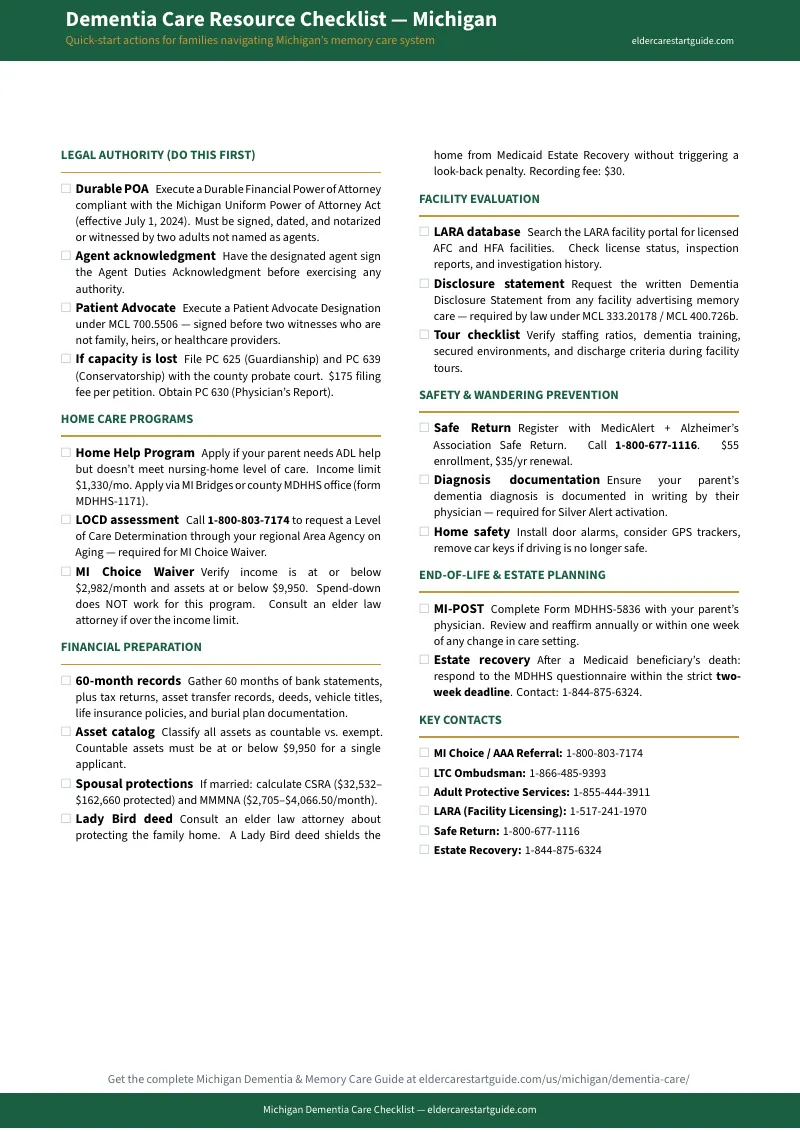
- Resource Checklist — one-page companion with all 16 Area Agency on Aging contacts, LARA lookup instructions, key MDHHS phone numbers, and a clinical assessment preparation worksheet
8 Printable Standalone Worksheets
Every major decision point in the guide has a standalone PDF you can print and bring to the meeting, the tour, or the attorney's office:
- DPOA Capacity Assessment Checklist — determine whether your parent can still sign legal documents, with UPOAA execution requirements
- Medicaid Asset Tracker — countable vs exempt asset worksheet with 2026 thresholds and spend-down gap calculator
- Memory Care Facility Tour Checklist — staffing, environment, care planning, and financial questions to ask at every facility visit
- MI Choice Waiver Application Roadmap — 6-stage application tracker with intake call script
- Estate Recovery Response Guide — what to do when MDHHS sends the recovery questionnaire, with Lady Bird deed protection and hardship waiver checklist
- Forms & Contacts Reference — every essential phone number, portal, state form, and professional referral on one sheet
- Spend-Down Strategies Worksheet — legitimate methods to reduce assets below $9,950 with tracking and attorney consultation prep
- Wandering Safety & Silver Alert Plan — Silver Alert preparation, Safe Return enrollment, and in-home wandering prevention
Who This Guide Is For
- Adult children who just got a parent's diagnosis and need to lock down legal authority while there's still time
- Families facing a hospital discharge crisis — the discharge planner wants a placement decision in 48 hours and you don't know where to start
- In-home caregivers hitting the wall — sundowning, wandering, aggression — and you need to know the AFC vs. HFA vs. nursing home decision before it's made for you
- Anyone approaching the $9,950 asset limit and trying to qualify for Medicaid without triggering a 60-month penalty
- Families who've lost a parent and received the MDHHS Estate Recovery Questionnaire
Why Not Just Use Free Resources?
Michigan publishes its Medicaid rules across thousands of pages of disconnected administrative manuals — the Bridges Eligibility Manual, LARA's facility database, MDHHS application portals, SCAO probate court forms. Each agency handles one piece. None of them hand you a sequence.
Free placement services like A Place for Mom operate on commission. They're paid by large corporate assisted living communities to fill beds, which means they have a structural incentive to steer your family away from smaller AFC homes and state-supported options like the MI Choice Waiver — because those facilities don't pay referral fees.
Elder law attorneys provide excellent guidance, but initial consultations run $300–$500/hour. Showing up without understanding Michigan's specific asset limits, exemptions, and program rules means you spend billable time on intake questions instead of strategy.
This guide is independent — no facility commissions, no legal retainer. It gives you the complete Michigan-specific sequence in one place, so you either handle the straightforward steps yourself or walk into a professional consultation already fluent in the rules that matter.
Satisfaction Guarantee
If the guide doesn't save you time and reduce the confusion of navigating Michigan's dementia care system, email us for a full refund. No questions, no hassle.
— Less Than One Hour of an Elder Law Attorney's Time
For a fraction of what a single legal consultation costs, you get the complete Michigan dementia care roadmap — legal authority, facility evaluation, Medicaid qualification, estate protection, and every form and phone number you'll need along the way.
Start with the free checklist to see if this guide fits your family's situation. If it does, the full guide picks up exactly where the checklist leaves off.