
Your parent needs a different level of care. Michigan's system isn't going to walk you through it.
The hospital says your parent can't go home. Or maybe it's slower than that — missed medications, weight loss, a fall that wasn't quite an emergency but made it clear something has changed. Either way, you're now the person who has to figure out what comes next.
And "what comes next" in Michigan is scattered across three separate state agencies, 16 Area Agencies on Aging with different intake processes, and licensing categories that don't match the marketing names facilities use. The state doesn't issue a license for "assisted living" — that term means nothing in Michigan regulatory law. What actually exists is Adult Foster Care homes, Homes for the Aged, and skilled nursing facilities, each governed by different statutes with different staffing requirements and different cost structures.
Meanwhile, you're trying to figure out whether your parent qualifies for the MI Choice Waiver, whether their assets will survive a Medicaid application, and whether the power of attorney sitting in a filing cabinet is actually valid under Michigan's current requirements.
The Michigan Care Transition System
This toolkit converts Michigan's fragmented care landscape into a single, sequential path. It's built around the actual regulatory framework — LARA licensing acts, MDHHS eligibility manuals, and the Estates and Protected Individuals Code — so every step connects to the real system your family will be navigating.
It's not a directory of facilities. It's not a lead-generation funnel disguised as a guide. It's a 15-chapter process map with 10 print-and-bring worksheets — legal audit, LARA decoder, cost comparison, waiver tracker, Medicaid asset log, facility vetting, move-in sheet, and more — so you can make the transition without paying an attorney hundreds of dollars an hour to explain concepts you could learn in an afternoon.
What's Inside
- Legal Authority Audit — a fillable review of your parent's Patient Advocate Designation and Durable Power of Attorney against MCL 700.5506 witness rules, plus the probate path (PC 625 / PC 639, $175 filing fee) if capacity is already gone.
- LARA Licensing Decoder — a landscape sheet to record the actual license (AFC Family, Small, Large, HFA, or skilled nursing) for three facilities you tour, including inspection history and overnight staffing — not the marketing name.
- Cost Comparison Worksheet — quote home care, AFC, HFA, and nursing home, then calculate months of private-pay runway. West Michigan ranges in the guide: $25–$35/hour home care; $5,000–$8,000 AFC/HFA; $12,000–$14,000 nursing home.
- MI Choice Waiver Tracker — 2026 eligibility screen ($2,982 income / $9,950 assets), AAA contact, LOCD date, and waitlist notes. The waiver funds care services, not room and board.
- Medicaid Asset Worksheet — countable-asset inventory, CSRA math (floor $32,532 / ceiling $162,660), and a 60-month gift log using Michigan's $12,216.30 penalty divisor.
- Facility Vetting Checklist — print one per tour. Desk research on LARA/CMS first, then write-in answers on staffing ratios, discharge policy, extras, and responsible-party clauses.
- Move-In Coordination — medication table, personal-effects inventory, and a first-30-days log. Nursing-home complaint line 1-800-882-6006; AFC/HFA 1-866-856-0126.
Who This Is For
This toolkit is built for adult children in Michigan who are coordinating care for an aging parent. That includes families managing a gradual decline who have time to plan, families responding to a hospital discharge with 48 hours to find a placement, and families trying to preserve assets before Medicaid's look-back window closes.
If you've been Googling "assisted living in Michigan" and getting lead-generation sites that want your phone number instead of actual information, this is the alternative. No sales calls. No referral commissions. Just the regulatory framework and process steps your family needs.
Why Not Free Resources?
Michigan publishes thousands of pages of regulatory rules, but they're scattered across LARA, MDHHS, and county-level agencies that don't coordinate their information. The licensing rules are in one place. The Medicaid eligibility criteria are in another. The waiver program intake process lives somewhere else entirely. And none of them tell you what order to do things in or how to connect one step to the next.
Free placement services like A Place for Mom are compensated by the facilities they recommend — they have no incentive to mention the MI Choice Waiver, the Home Help Program, or non-profit care homes that don't pay referral fees. Their business model is leads, not guidance.
Elder-law attorneys are valuable for complex trust and deed work. But paying hundreds of dollars an hour for someone to explain basic Medicaid thresholds or help you organize medical records is an avoidable expense. This toolkit handles the preparation work, so when you do consult an attorney, you spend that time on strategy instead of orientation.
What You Get
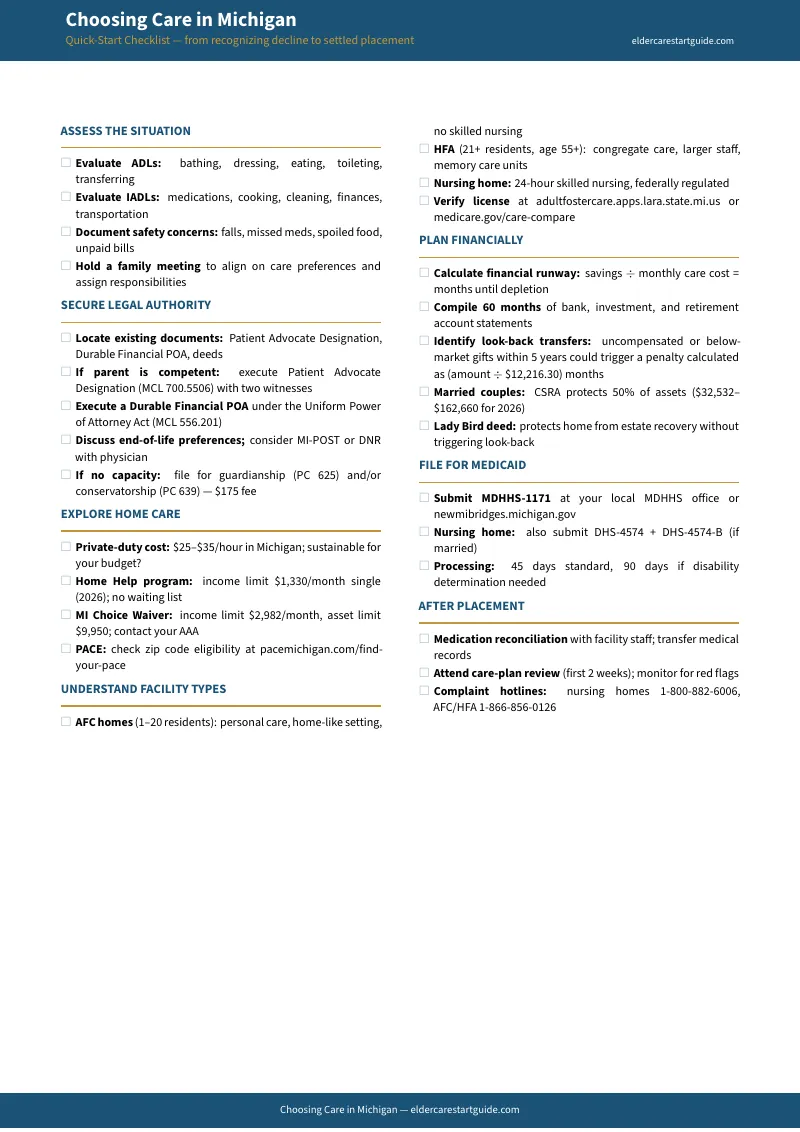
The full toolkit is 12 PDFs: the 15-chapter guide, the 28-item care transition checklist, and 10 fillable worksheets (legal audit, LARA decoder, cost comparison, MI Choice tracker, Medicaid asset log, facility vetting, move-in, warning-signs assessment, key contacts, and the dated timeline).
A free version of the checklist is available — it covers the action sequence without the worksheets or the chapter-level explanations in the paid kit.
Get the Michigan Care Transition Toolkit →
Your family is navigating one of the hardest transitions there is. This toolkit won't make the emotions easier, but it will make the process clear — and that clarity is worth more than most people realize until they're standing in a hospital hallway trying to figure out what happens next.