
Your Parent Is Paying Thousands for Medicare Costs That Could Be Eliminated
Every month, $202.90 vanishes from your parent's Social Security check before they see a cent — that's the standard Part B premium. Then a hospitalization lands: $1,736 for the Part A deductible. Then the outpatient bills arrive: 20% coinsurance with no annual cap under Original Medicare. Then the pharmacy counter, where drug costs force a monthly choice between prescriptions, groceries, and heat.
Programs exist to eliminate most or all of these costs. QMB alone can save over $8,000 a year. The Part D Low-Income Subsidy (Extra Help) is worth an average of $5,700 annually, capping prescription copays at $5.10 for generics and $12.65 for brand-name drugs.
But finding out whether your parent qualifies — and actually getting them enrolled — means navigating a system split across two federal agencies and 50 state Medicaid offices, each with its own income thresholds, asset rules, and application quirks. Thirteen states and the District of Columbia have no asset test at all. California reinstated its limit at $130,000 on January 1, 2026, after two years of no cap. The standard federal floor sits at $9,950. What counts as "income" depends on which agency you're talking to and which program you're asking about.
A SHIP counselor can answer one question at a time — if you can get an appointment. An elder-law attorney will charge $300–$600 per hour to walk you through the basics. Neither will hand you an organized, start-to-finish filing plan you can execute on your own.
The Medicare Costs Elimination Workbook
This is not a policy explainer. The Medicare Costs Elimination Workbook is a structured filing system — the exact sequence of screenings, calculations, applications, renewals, and appeals that gets your parent enrolled in the right programs without oversharing financial information, without accidentally triggering Medicaid estate recovery on the family home, and without paying a professional fee to fill out forms you can complete yourself.
It organizes the chaos that government portals leave scattered: Medicare.gov explains federal benefits. Your state Medicaid site explains state rules. This guide shows you exactly where the two systems collide — and what to file, in what order, to make them work together instead of against each other.
What You Get — 10 Printable PDFs
- 13-Chapter Process Guide (47 pages) — Covers the entire lifecycle: what Medicare actually costs, how the four MSP tiers work, Extra Help qualification, state-by-state asset rules, the application process, the post-repeal Social Security Fairness Act landscape, QMB balance billing protections, estate recovery exemptions, federal representation forms, annual redetermination, appeals, and worksheets.
- MSP Eligibility Screening Worksheet — Walk through the exact math: gross income, the $20 unearned income disregard, countable vs. exempt assets, and the state-specific thresholds for QMB ($1,350/month single), SLMB ($1,616), and QI ($1,816). Fill in your parent's numbers and see which programs apply.
- Document Checklist and Organizer — Every document required for MSP and Extra Help applications, with checkboxes for tracking what you've gathered and where it's stored.
- Application Tracker — Record submission dates, confirmation numbers, caseworker contacts, and decision outcomes for both your MSP and Extra Help applications in one place.
- Agency Communication Log — Log every call to Medicare, Social Security, and the state Medicaid office with dates, reference numbers, and outcomes. This log becomes evidence if you need to appeal.
- QMB Balance Billing Dispute Letter — A copy-and-paste dispute letter citing Section 1902(n) of the Social Security Act and CMS MLN Matters SE1128, with escalation steps and a dispute tracker. If your parent has QMB, providers are federally prohibited from billing them for deductibles, coinsurance, or copays — this letter enforces that protection.
- Retroactive Payment Spend-Down Planner — Track the 9-month resource exclusion window for Social Security Fairness Act retroactive payments, with a timeline and compliant spend-down options to prevent loss of MSP eligibility.
- Annual Renewal Preparation Checklist — A month-by-month timeline for assembling redetermination documents, starting 90 days before the expected renewal notice, so a missed signature or undocumented income change doesn't cost your parent their benefits.
- Estate Recovery Protection Worksheet — Document which family members reside in the home and their relationship to your parent, establishing the factual basis for MERP exemptions before they're needed.
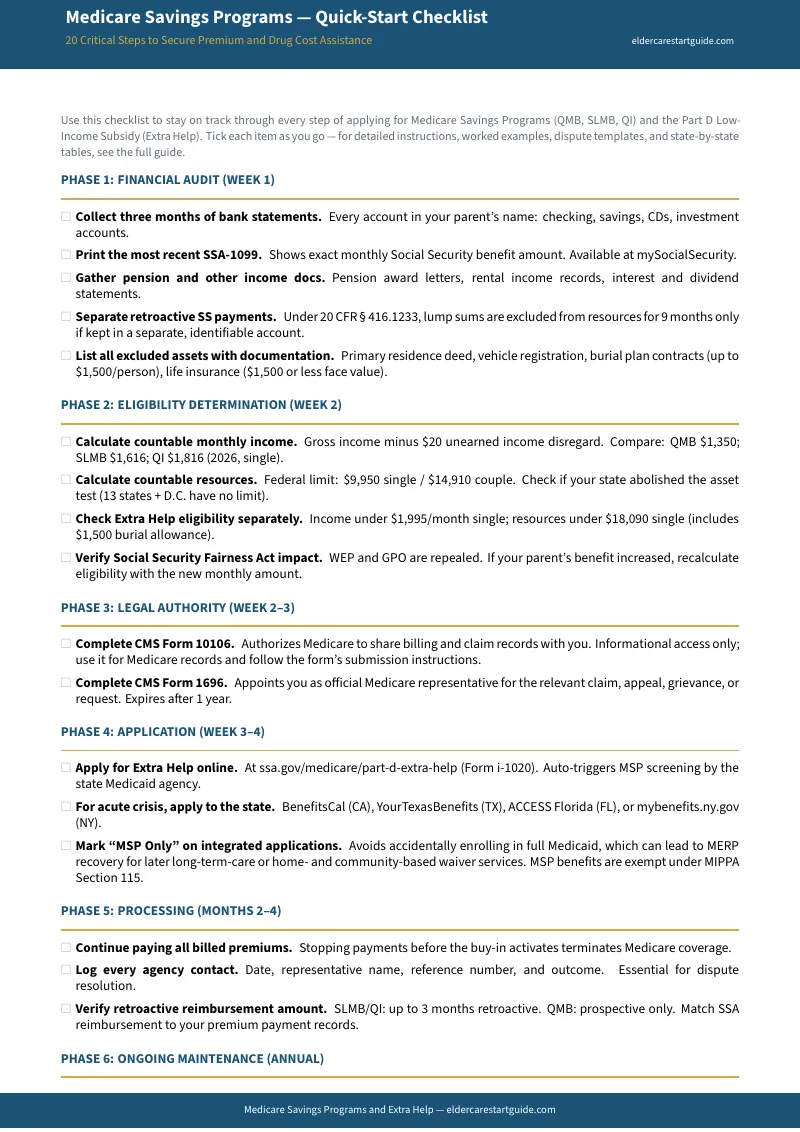
- Quick-Start Checklist (Free Download) — 20 actionable items across 6 phases. A printable starting point that tells you what to gather, who to call, and what to file first — available as a free download before you decide on the full guide.
Who This Workbook Is For
- Adult children who just discovered that Medicare premiums, deductibles, and coinsurance are consuming a significant portion of their parent's Social Security income
- Caregivers managing a parent's finances after a hospitalization — especially when the first bill arrives and the numbers don't add up
- Families trying to determine whether a parent qualifies for QMB, SLMB, QI, or Extra Help — and which agency to contact first
- Anyone who has taken over a parent's affairs under a power of attorney and needs Medicare to recognize them as an authorized representative before they can file anything
- Caregivers who received a Medicaid redetermination packet and need to respond correctly to avoid their parent losing premium assistance
Why the Free Information Isn't Enough
Medicare.gov explains the MSP programs. The Social Security Administration explains Extra Help. Your state Medicaid portal lists its own income and asset limits. But none of these sites show you how the programs interact — or what happens when you file the wrong application and accidentally subject your parent's home to estate recovery.
SHIP counselors are prohibited from advising on asset protection strategies or legal authority. Online articles from insurance companies are designed to funnel you into Medicare Advantage enrollment — they don't cover MSP applications, balance billing disputes, or appeal procedures because those topics don't generate plan commissions.
Elder-law attorneys and Medicaid planners charge $300–$600 per hour. For a straightforward MSP application — which is an administrative filing, not a legal proceeding — paying professional fees to assemble bank statements and complete government forms is an expense most low- and moderate-income families cannot absorb. This guide ensures that if you do hire a professional for a complex situation (Chapter 13 tells you exactly when that makes sense), your first billable hour is productive, not educational.
Satisfaction Guarantee
If this workbook doesn't give you a clear, actionable path to reducing your parent's Medicare costs, email [email protected]. We read every message.
— Less Than 10 Minutes of an Elder-Law Attorney's Time
Elder-law attorneys charge $300–$600 per hour. Certified Medicaid planners charge $3,000–$8,000 as a flat fee. For most families, the MSP and Extra Help applications are administrative filings that don't require legal expertise — they require organized information and the right sequence of steps.
This workbook is the organized information. It turns weeks of scattered research into a structured afternoon project — and for families with complex asset situations, it makes every dollar of professional consultation count.
Download the free Quick-Start Checklist to see the 20 most urgent action items. When you're ready for the complete filing system, the full workbook is here.