A monthly surcharge that can last for years
Your parent's Social Security deposit dropped, and the explanation letter says a drug-plan late-enrollment penalty has been deducted — permanently. The penalty adds 1% of the national base beneficiary premium for every month Medicare thinks they went without creditable prescription drug coverage. Thirty-six uncovered months means roughly $14 extra every month in 2026. The amount can change each year as the base premium changes. At roughly $14 a month, a constant penalty would add up to more than $1,000 over a decade for a coverage gap that may never have existed.
The plan sent a notice asking for proof of prior drug coverage. Maybe your parent missed it. Maybe they called the plan and thought the conversation settled it. Maybe they mailed a letter but never heard back. It doesn't matter — once the penalty is officially assessed, an informal phone call or a late attestation won't stop the 60-day deadline. To request an independent review, file a written reconsideration with the independent review entity.
The Coverage Proof Filing System
This guide exists because proving your parent had creditable coverage should be straightforward — but nothing about the process is. The plan that assessed the penalty may correct its own record, but C2C Innovative Solutions is the independent review entity for a reconsideration. The Social Security Administration, which may withhold the surcharge from a monthly deposit, doesn't adjudicate Part D appeals. C2C reviews supporting evidence; the signed reconsideration request is due within 60 calendar days from the penalty notice, with five additional mailing days allowed unless evidence shows earlier receipt.
The Coverage Proof Filing System converts that tangled process into a chronological sequence of actions. It's the same filing workflow a fee-only Medicare consultant would walk a family through, built for adult children and retirees who'd rather handle it themselves.
What's inside
- Penalty notice decoder — a section-by-section walkthrough of the plan's LEP letter: what each paragraph means, how to verify the gap months they're counting against you, and how to calculate the actual dollar cost using the 1% formula and the current national base beneficiary premium
- 60-day filing timeline — when the deadline starts, C2C's five-day mailing allowance, how to count the days correctly, certified-mail and fax protocols that create proof of timely filing, and what qualifies as good cause after that window
- Creditable coverage evidence matrix — the specific documents that prove prior drug coverage from each source (employer group plan, VA, TRICARE, FEHB/PSHB, union, retiree plan), organized by what the independent review entity expects to see
- Closed-employer evidence protocol — alternative proof paths when the HR department no longer exists: plan handbooks, premium deduction records from pay stubs, insurance cards with effective dates, and coverage confirmation letters from the insurer that administered the plan
- C2C reconsideration form walkthrough — section-by-section instructions for the form you file with C2C Innovative Solutions, including which checkboxes apply to your situation and how to describe your coverage history clearly
- Family helper authorization — Form CMS-1696 guidance for appointing an adult child as the appeal representative, plus CMS-10106 guidance for authorizing 1-800-MEDICARE to share personal health information
- Extra Help escape route — how the Low-Income Subsidy excludes uncovered months while the beneficiary receives it, without erasing an LEP for earlier months, plus income and asset thresholds and the SSA application steps
- Decision tracker and next steps — monitor the review timeline (generally 90 calendar days, with a possible 14-calendar-day extension), what a favorable decision means for refunds of overpaid penalty amounts, and how to request reopening if the initial decision doesn't go your way
- 8 printable worksheets and reference cards — coverage timeline worksheet, penalty calculation audit sheet, evidence tracker, filing package checklist, IRE submission and decision tracker, helper delegation checklist, evidence matrix reference, and surcharge diagnosis card — fillable tools you print and use at every step of the process
Who this is for
If you're an adult child racing the 60-day deadline — you found out about the penalty when your parent mentioned their check shrank. You need to gather evidence of coverage that ended years ago, possibly from an employer that no longer exists, and file it with an entity you've never heard of. This guide gives you the evidence checklist, the form walkthrough, and the authority forms to act on your parent's behalf.
If you're a retiree with continuous employer or union coverage — your drug plan says you have a gap, but you know you were covered the entire time. The problem is proving it in the format the review entity requires. This guide maps every type of creditable coverage to the documents that prove it.
If you're a veteran or military retiree — VA prescription coverage and TRICARE are creditable, but plans sometimes fail to recognize them. This guide shows you exactly which VA or TRICARE documents to submit and how to package them for C2C.
If you missed the initial attestation window — the plan asked for coverage proof, the letter went unseen, and now the penalty is assessed. An informal call won't preserve the 60-day filing deadline. The guide walks you through the formal reconsideration path.
If you're preparing for a SHIP appointment — SHIP counselors provide free, unbiased guidance, but they can't gather your evidence for you. This guide organizes your documents before the appointment so the counselor can focus on reviewing your case, not sorting your paperwork.
Why free resources aren't enough
Medicare.gov explains that the penalty exists and that you can request reconsideration. It does not hand you a step-by-step checklist for gathering evidence when your former employer has closed, when you need to prove VA coverage the plan didn't recognize, or when the 60-day deadline is twelve days away and you haven't started.
SHIP counselors are free and invaluable. They'll explain your appeal rights and review your submission. But they can't contact your former employer's HR department, retrieve your plan handbooks, or build your evidence package for you. That work falls on you or your family.
Insurance brokers publish helpful educational articles about penalties — to capture your contact information and sell you a new drug plan. They have no incentive to help you challenge a penalty from your current plan.
This guide is the execution layer between "I understand I can appeal" and "I've filed the right form with the right evidence to the right entity before the deadline." It converts a confusing multi-agency process into a single filing sequence.
Satisfaction guarantee
If the guide doesn't help you navigate your Part D penalty reconsideration, email us and we'll issue a full refund, no time limit.
Get the free checklist or the full guide
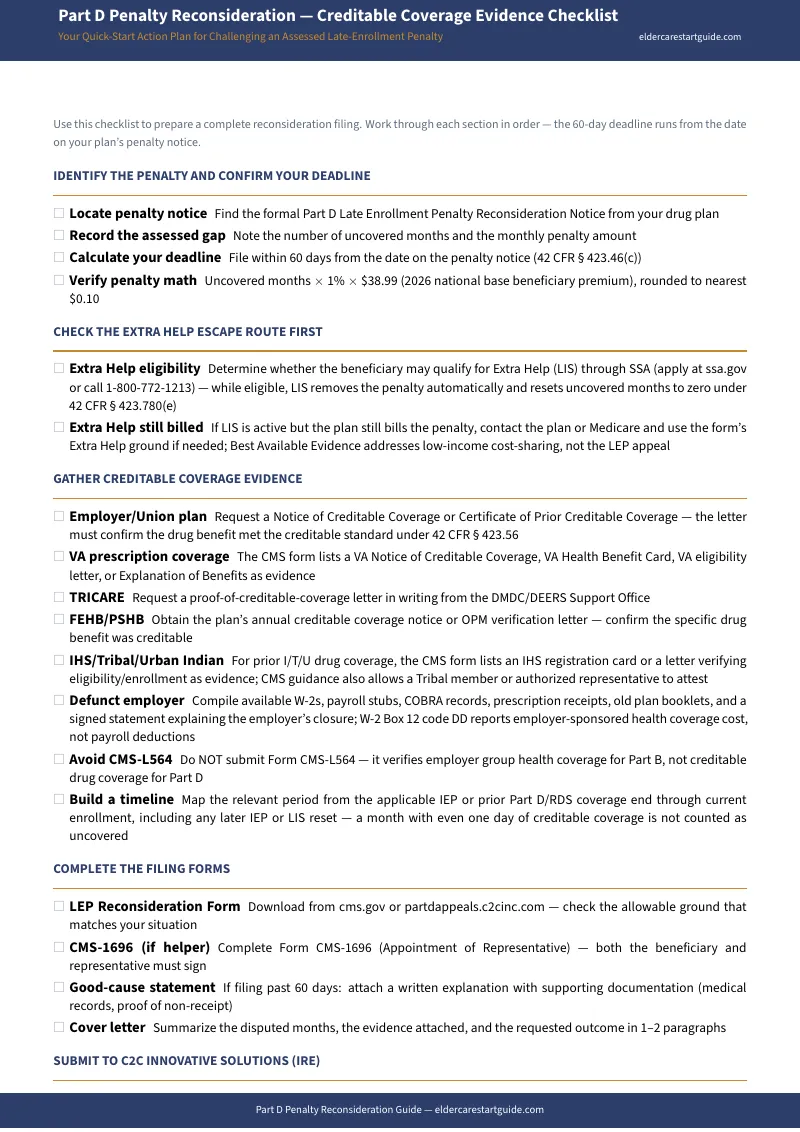
The free Creditable Coverage Evidence Checklist gives you the filing deadline, the key evidence categories, and links to the official CMS and C2C forms — enough to understand what you're facing and whether you need to act.
The full guide adds the section-by-section form walkthrough, the closed-employer evidence protocol, the family helper authorization forms, the Extra Help escape route, and the decision tracker — everything you need to build and file the reconsideration package from start to finish.
Frequently Asked Questions
What if the rules change after I buy?
We update the guide when the rules change. Email us any time, even years later, and we'll send you the current edition free.