Your Parent's Drug Plan Is Costing Them More Than It Should
Every October, Medicare mails a small packet called the Annual Notice of Change. Inside is a list of everything your parent's drug plan changed for next year — dropped medications, higher copays, new pharmacy restrictions. Most families never open it. The ones who do can't make sense of it. And the deadline to switch plans closes December 7, whether anyone was paying attention or not.
The result is predictable: a parent locked into a plan that no longer covers a critical medication, hit with a surprise prior authorization at the pharmacy counter, or paying hundreds more per year than they need to because nobody ran the numbers on a preferred pharmacy network.
This isn't a knowledge problem. Medicare.gov has all the raw data. The problem is that the data is scattered across five different tools, written in regulatory language, and designed for insurance professionals — not for the adult child who's trying to figure this out between work meetings and school pickups.
The Part D Caregiver Decision System
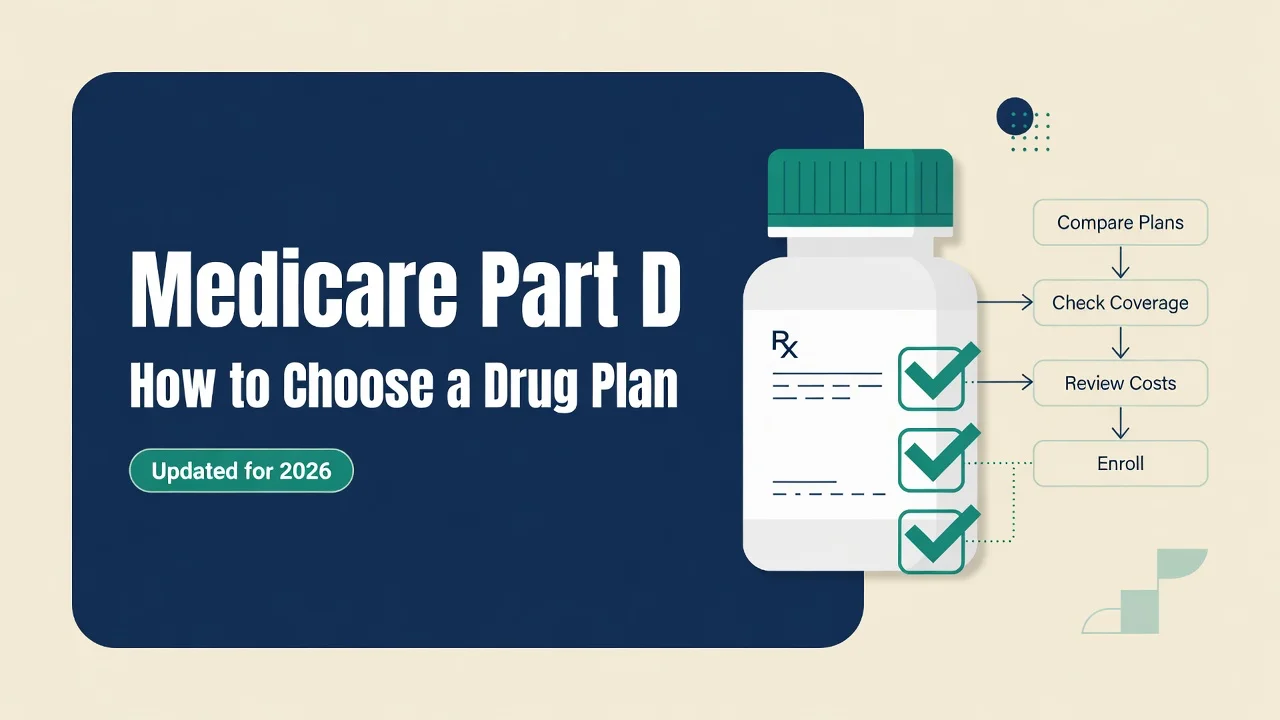
This guide replaces scattered research with a single sequenced workflow — every step in order, every form included, every deadline marked.
It starts where most resources skip entirely: securing the legal authority to act on your parent's behalf. A standard Power of Attorney doesn't work with federal agencies. Medicare requires Form CMS-1696. Social Security requires SSA-1696. Without these, you'll be blocked from accessing plan details, filing appeals, or even confirming enrollment — and no broker or government website tells you this until you're already stuck.
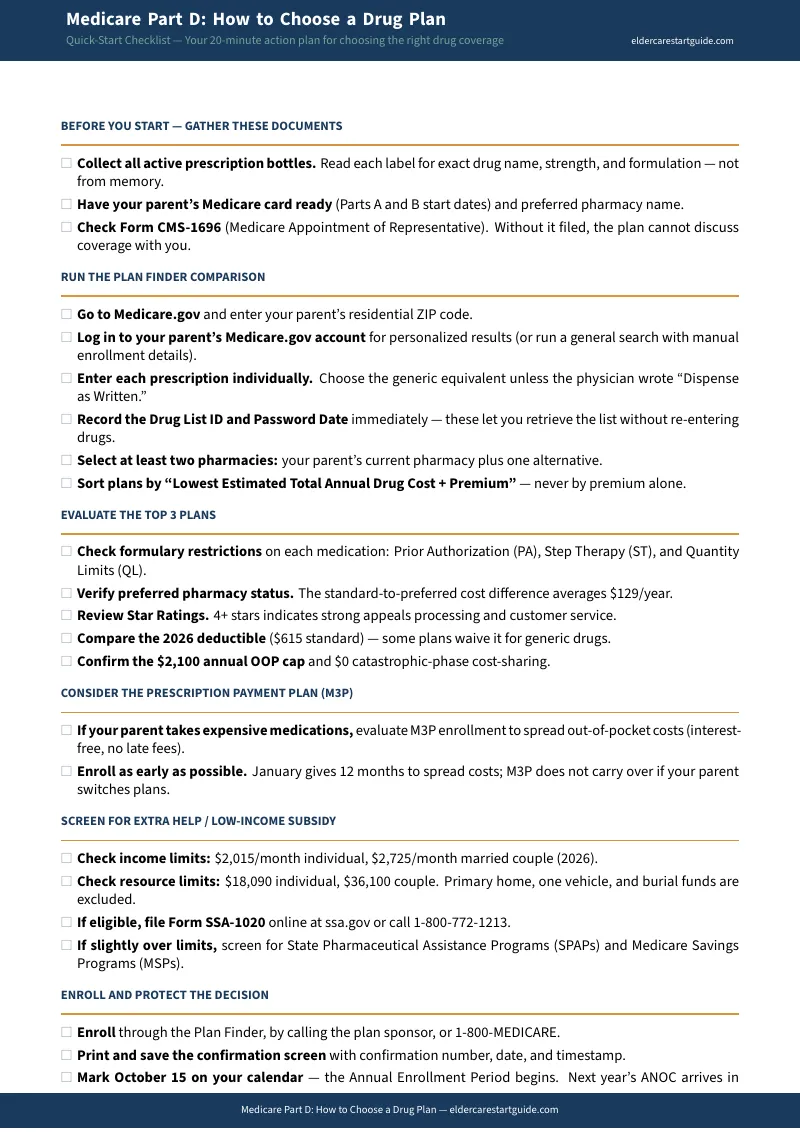
From there, the system walks you through auditing your parent's current coverage against the 2026 benefit structure (the $2,100 out-of-pocket cap, the eliminated donut hole, the new $615 deductible), running a disciplined plan comparison using the Medicare Plan Finder, and checking every prescription against the target plan's formulary — tier by tier, restriction by restriction.
When a drug isn't covered, the guide doesn't stop at "call your doctor." It gives you the appeals playbook: five levels of appeal, the exact timeline for each, draft letters of medical necessity for the prescribing physician, and the critical difference between a standard 72-hour determination and an expedited 24-hour request for urgent medications.
What You Get
- The Plan Selection Workflow — A step-by-step walkthrough of the Medicare Plan Finder that cuts through the data overload. You'll know exactly which filters matter, how to compare total annual costs (not just premiums), and how to verify preferred pharmacy networks before you commit.
- The Formulary Restriction Playbook — Prior authorizations, step therapy requirements, quantity limits, and tiering exceptions — what each one means, when your parent will hit them, and the exact process to request an exception before it blocks a refill.
- The Five-Level Appeals Toolkit — Draft letters, submission timelines, and decision benchmarks for every level from plan redetermination through federal court review. Most families give up after the first denial. The data shows that 75% of first-level appeals succeed.
- The M3P Payment Plan Calculator — The Medicare Prescription Payment Plan lets your parent spread out-of-pocket drug costs across the year instead of paying them all upfront in January. The guide walks you through enrollment, the monthly billing formula, and what happens if a payment is missed.
- The Extra Help Eligibility Screener — A worksheet that maps your parent's income and assets against 2026 federal limits. If they qualify, the program eliminates premiums and deductibles and caps copays at $5.10 for generics. If they're slightly over, the guide shows you which state programs (MSPs, SPAPs) can still help.
- The Legal Authority Packet — Pre-filled samples of CMS-1696 and SSA-1696 with line-by-line instructions. Plus the Social Security Fairness Act action guide — how to verify retroactive WEP/GPO adjustments for existing beneficiaries, and how to file a new claim if your parent never applied because the old rules would have zeroed their benefit.
- The Annual Review Checklist — A seven-step October-to-December audit process that catches formulary drops, premium increases, and pharmacy network changes before the enrollment window closes.
Who This Is For
- First-time enrollees — Your parent is turning 65 or leaving employer coverage and needs to choose a stand-alone Part D plan or a Medicare Advantage plan with drug coverage. The Initial Enrollment Period has a hard deadline, and late-enrollment penalties compound for life.
- Annual reviewers — Your parent has coverage but hasn't checked it against this year's Annual Notice of Change. Plans shift formularies, copay tiers, and pharmacy networks every year.
- Post-hospitalization families — Your parent was discharged with new, expensive medications. The plan may require prior authorization before the pharmacy will fill them, and you have days — not weeks — to sort it out.
- Low-income households — Your parent may qualify for Extra Help, which eliminates premiums and deductibles and caps copays. The income and asset tests are strict but the program is underutilized — more than 2 million eligible beneficiaries aren't enrolled.
- Public-sector retiree families — If your parent has a government pension, the Social Security Fairness Act repealed the provisions that used to reduce or eliminate their spousal and survivor benefits. The guide shows you exactly how to verify the adjustment or file a new claim.
Why Not Just Use Free Resources?
Medicare.gov gives you the raw data — plan listings, premium comparisons, formulary lookups. What it doesn't give you is a sequence. It can't tell you which legal forms to file first, how to read a formulary restriction, when to request an expedited determination instead of waiting 72 hours, or how to screen for Extra Help before choosing a plan (because qualifying for Extra Help changes which plans are optimal).
Brokers will walk you through plan selection for free, but they're paid by the carriers — so they can only show plans from companies that pay them commissions. They can't help with Extra Help applications, formulary exceptions, appeals, or the federal authorization forms you need to manage a parent's account.
SHIP counselors are genuinely helpful and free, but they're overbooked during enrollment season. If your parent's enrollment window closes December 7 and the nearest SHIP appointment is in January, you need a system you can work through on your own.
This guide is the neutral layer. It gives you the sequenced process, the forms, the templates, and the decision framework — then lets you verify any broker's recommendation or government tool's output against it.
Satisfaction Guarantee
If the guide doesn't give you a clearer path through your parent's Part D decision than any free resource you've tried, email us for a full refund. No time limit, no hoops.
Get Started
Download the free Quick-Start Checklist to see the decision sequence. When you're ready for the full system — the Plan Finder walkthrough, the appeals toolkit, the Extra Help screener, and every form you need — get the complete guide for .