Your parent's Medicare choice is a one-way door. This guide makes sure you walk through the right one.
Your parent is turning 65 — or they already have Medicare and something feels wrong. The premiums are climbing. The network just dropped their cardiologist. A prior authorization denial delayed their rehab by three weeks. You've been Googling at midnight, and every article contradicts the last one.
Here's what nobody tells you upfront: Medicare is not one program. It's two completely different coverage architectures — Medicare Advantage (a private managed-care plan) and Original Medicare with a Medigap supplement — and choosing the wrong one can lock your parent into a coverage structure that's nearly impossible to escape.
The Coverage Decision System
This is not another "Medigap vs. Medicare Advantage comparison chart." This is a Coverage Decision System — a 61-page guide with eight ready-to-use worksheets that walks your family through the exact sequence of calculations, verifications, and legal steps required to choose the right Medicare path and protect your parent's access to care.
Free comparison charts tell you what the differences are. This guide tells you what to do about them — with the specific forms, scripts, timelines, and cost calculations you need to act.
What's Inside
The Two-Path Analysis
A side-by-side breakdown of how Medicare Advantage and Original Medicare + Medigap actually work in practice — not the marketing version, but the real cost-sharing math. You'll see exactly how copays, coinsurance, and out-of-pocket maximums accumulate during a serious health event under each path, so you can model your parent's specific scenario before committing.
The Prior Authorization Reality Check
Medicare Advantage plans deny 12% of initial prior authorization requests for skilled nursing admissions, with certain for-profit plans denying up to 23%. But 95% of those denials are overturned on appeal — and only 18% of families ever appeal. The guide includes the exact clinical terminology, appeal workflow, and documentation requirements to challenge a denial and win.
The Observation Status Trap Protocol
If your parent spends three nights in a hospital bed but two of those nights are coded as "observation," Medicare Part A will deny skilled nursing coverage entirely — leaving your family responsible for rehab costs that routinely exceed $10,000. You'll get the verbal script and written letter template to request a formal inpatient admission review before discharge.
The State-by-State Switching Rights Tracker
After the initial Medigap open enrollment window closes, most states allow insurers to deny applications based on health history. But sixteen states offer annual birthday-rule guaranteed-issue windows, and five more (Connecticut, Massachusetts, Maine, New York, Vermont) have continuous protections. The guide maps every state's rules so you know exactly when and how your parent can move between coverage paths without medical underwriting.
The Cost Comparison Calculator
A structured worksheet that calculates your parent's total annual cost under both Medicare architectures — factoring in premiums, the Part B deductible, expected specialist visits, prescription costs under Part D, and the out-of-pocket maximum exposure. You fill in the numbers; the framework shows you which path costs less for your parent's specific health profile.
The Legal Authority Checklist
You cannot manage your parent's Medicare enrollment, appeal a claim denial, or even discuss their coverage with an insurer without the right legal documents in place. The guide covers exactly which authorization forms you need — Healthcare Power of Attorney, Durable Financial Power of Attorney, HIPAA Authorization, Form CMS-10106, and Representative Payee status — with a document-mapping template to verify you have everything before a crisis hits.
The Medicaid Asset Protection Reference
When long-term care costs exceed your parent's savings, Medicaid estate recovery can claim the family home. The guide details the federally protected exemptions — the sibling exemption, the caregiver child exemption, and spousal protections — with the specific residency, documentation, and timing requirements to qualify before your parent enters a facility.
The Family Meeting Agenda
A structured discussion guide for getting siblings aligned on care choices, financial responsibilities, and coverage decisions — so the conversation happens around data, not emotions.
Who This Is For
- Adult children managing Medicare decisions for an aging parent — whether your parent is approaching 65 or already enrolled and facing problems with their current plan
- Families navigating a health crisis — a hospitalization, a rehab denial, a sudden need for skilled nursing care — who need to understand their options immediately
- Caregivers considering a switch from Medicare Advantage back to Original Medicare and unsure whether their parent can get a Medigap plan without medical underwriting
- Anyone coordinating care across siblings who need a neutral framework to evaluate trade-offs without the conversation becoming adversarial
Why Not Just Use Free Resources?
Medicare.gov gives you the rules — but not the strategy. It won't tell you how to fight a prior authorization denial, how to force a hospital to review your parent's observation status, or how to time a Medigap application around your state's guaranteed-issue window.
Free Medicare brokers compare plans and handle enrollment — but they're paid by the carriers. In 2026, an initial Medicare Advantage sale pays brokers up to $694 nationally (up to $864 in high-cost states), while Medigap commissions are substantially lower. That commission asymmetry can subtly shape which path they recommend.
Elder-law attorneys provide bespoke planning — at $300 to $600 per hour. If you need complex trust work, you need an attorney. But if you need to understand enrollment deadlines, compare coverage architectures, and organize your parent's documents before that first appointment, this guide covers that groundwork — so you arrive prepared and spend fewer billable hours catching up on basics.
This guide has no carrier affiliations, no commission incentives, and no hourly billing. It covers both Medicare paths with equal depth, gives you the worksheets to run the numbers yourself, and includes the forms and scripts to take action — for a fraction of what one professional consultation would cost.
What You'll Walk Away With
A clear understanding of which Medicare path minimizes your family's financial and medical risk. A folder of completed worksheets — cost calculations done, provider networks verified, legal authority documents mapped, enrollment deadlines marked. And a set of scripts and templates ready to deploy if your parent faces a denial, a billing dispute, or a sudden change in coverage.
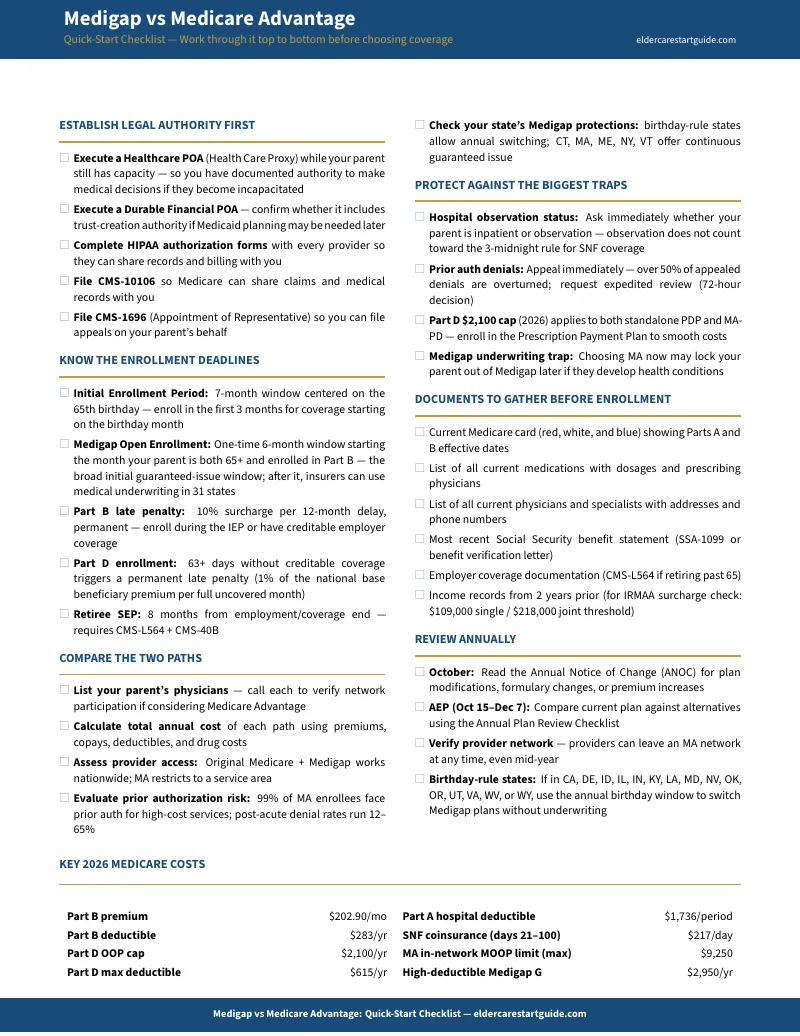
The Coverage Decision System includes the full 61-page guide, a 2-page quick-start checklist, and eight standalone worksheets — .
Your purchase includes free updates whenever Medicare rules change. The 2026 Part D redesign, annual MOOP adjustments, and any new switching-rule changes are reflected in updated downloads at no additional cost.
Satisfaction Guarantee
If the guide doesn't give you a clearer picture of which Medicare path is right for your parent, email [email protected] for a full refund. No forms, no hoops.