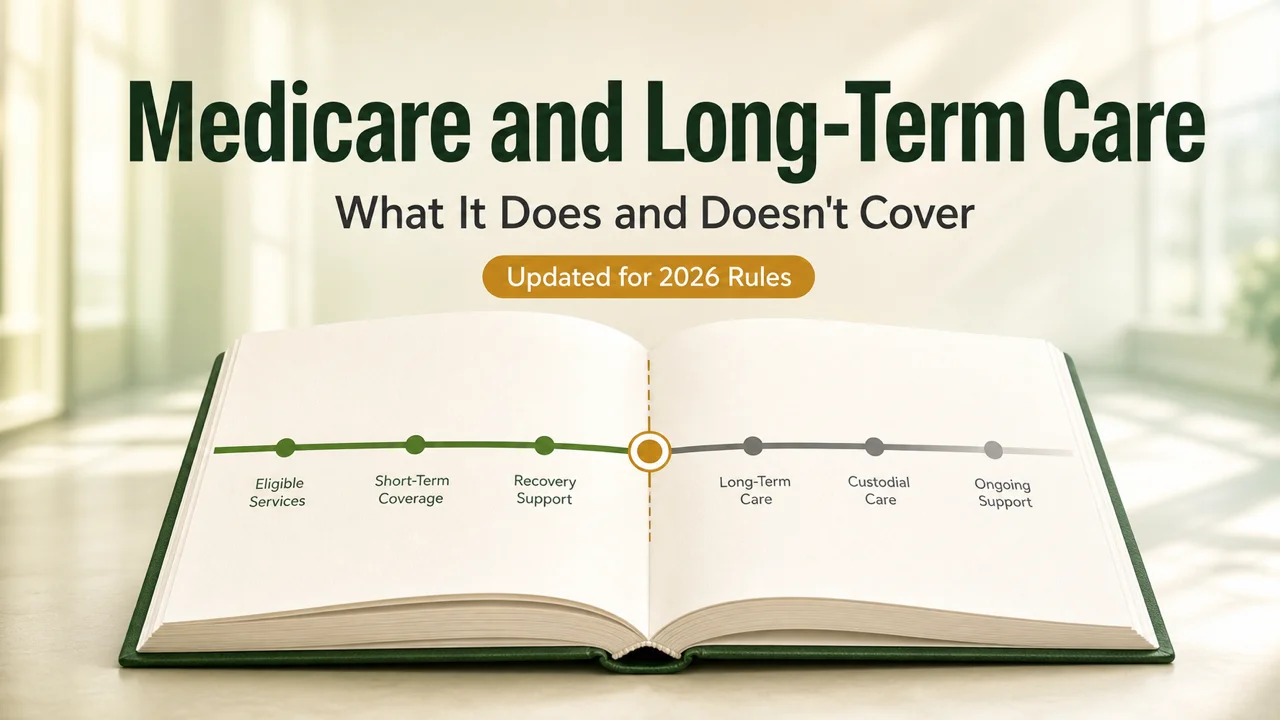
Medicare Will Pay for Your Parent's Rehab. It Was Never Going to Pay for the Nursing Home.
The shock arrives the same way almost every time: a hospital social worker mentions "discharge planning," you call a nursing home to ask about rates, and someone tells you the bed costs $10,800 a month — and Medicare doesn't cover it. Not after 100 days. Not ever, for the kind of care your parent actually needs.
Because here's what nobody explained while your parent was healthy: Medicare covers short-term skilled rehab after a qualifying hospital stay. It does not cover custodial care — the daily help with bathing, dressing, eating, and moving safely that most aging parents actually need. That gap between what families assume and what Medicare pays is where retirements get liquidated.
And the coverage you do have is leakier than you think. Three nights in a hospital bed can count as zero days if the hospital coded your parent as "observation." A Medicare Advantage plan can cut off rehab at Day 14 with an algorithm-driven denial. A premature readmission can burn through the 100-day pool before your parent is strong enough to leave.
The Coverage Boundary System
This guide doesn't explain Medicare in the abstract. It maps the exact line where Medicare stops and family money starts — then gives you the playbook for every decision on both sides of that line.
Three coordinated layers, in the order a real crisis unfolds:
- Protect the coverage you have — the three-day rule, the observation status trap, the Jimmo standard that makes "not improving" an illegal reason to end therapy, and the 48-hour appeal that overturns most Medicare Advantage denials
- Know the real math before the bill arrives — the day-by-day cost of the 100-day benefit ($217/day coinsurance from Day 21 in 2026), the benefit period clock, and exactly what Day 101 costs
- Execute the Medicare-to-Medicaid handoff — the application timeline that starts 30–45 days before coverage ends, the five-year lookback, compliant spend-down, and the spousal protections that keep the healthy partner from impoverishment
No statutory prose. No "consult your attorney." Every chapter ends in an action.
What You Get — 10 PDFs
- 15-chapter step-by-step guide (guide.pdf) — from the hospital admission through the Day 101 funding transition: coverage rules, traps, appeals, Medicaid eligibility, spousal protection, estate recovery, VA benefits, and the professional directory
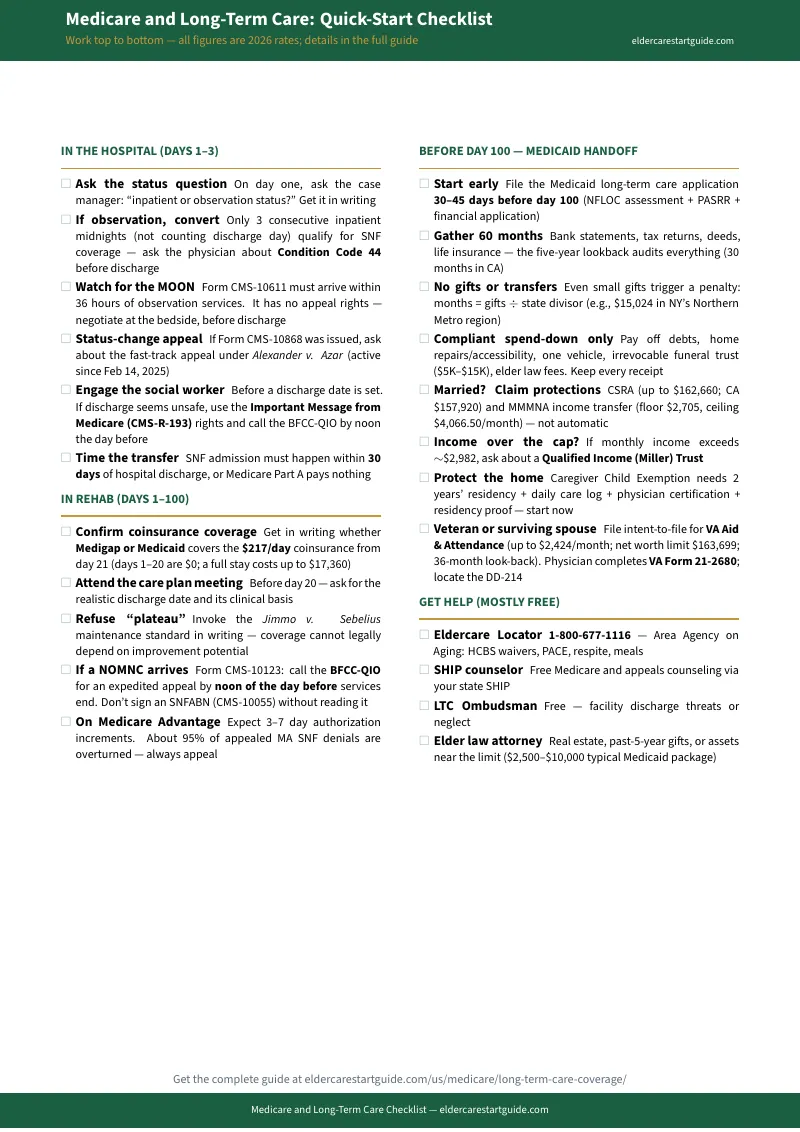
- Quick-start checklist (checklist.pdf) — the printable crisis sequence: what to do in the hospital (Days 1–3), in rehab (Days 1–100), before Day 100, and who to call for free help
- 100-day cost calculator (snf-cost-calculator.pdf) — plug in your parent's admission date and see the exact coinsurance exposure at Day 21, Day 60, and Day 100
- Hospital status playbook (hospital-status-playbook.pdf) — the observation status script, the MOON notice, Condition Code 44, and the fast appeal form (CMS-10868) in one bedside reference
- Medicare Advantage appeal kit (ma-appeal-kit.pdf) — the notices to recognize, the 48-hour expedited appeal sequence, and the escalation thresholds for 2026
- Medicaid handoff checklist (medicaid-handoff.pdf) — the day-by-day transition starting 30–45 days before Day 100: NFLOC assessment, PASRR screening, Qualified Income Trust setup
- Spend-down registry (spend-down-registry.pdf) — the valid, penalty-free ways to reduce countable assets under the five-year lookback, with a documentation tracker
- Spousal protection worksheet (spousal-protection.pdf) — CSRA and MMMNA calculations so the healthy spouse keeps the maximum the law allows in 2026
- Home protection reference (estate-recovery-exemptions.pdf) — estate recovery explained, plus the caregiver child exemption and the other exemptions that can save the family home
- Professional directory (who-to-call.pdf) — SHIP counselors, elder law attorneys, Medicaid planners, and the state agencies, with what each one costs and when to use them
Who This Is For
- Your parent is in the hospital or rehab right now and a discharge deadline is on the calendar
- You assumed Medicare pays for nursing homes and just found out it doesn't — and you need the real map tonight, not after a consultation
- You're the healthy spouse trying to protect the house and retirement savings while your partner needs custodial care
- Your parent's Medicare Advantage plan just denied continued rehab and you have 48 hours to appeal
- You're planning ahead — a parent is declining and you want the funding path mapped before the crisis forces the decision
Why Not Just Use Medicare.gov or a Free Counselor?
Medicare.gov is authoritative and free — and written for regulators. It will tell you the skilled nursing benefit exists. It will not tell you that the hospital coded your parent as observation at 2 a.m., that "no improvement" is an illegal denial reason under Jimmo, or that the Medicaid application needs to start 45 days before Day 100 or you'll have a gap in care.
Free SHIP counselors are genuinely excellent — and overwhelmed. During a discharge crisis, "we can book you in two weeks" doesn't help when the appeal deadline is 48 hours.
An elder law attorney will handle everything — at $195 to $500 an hour, with Medicaid planning packages running $3,000 to $15,000. For families who need one, this guide still pays for itself: it organizes the documents, the timeline, and the right questions so you buy fewer billable hours.
This guide sits in the gap: the step-by-step protocol for the 90% of the Medicare-to-Medicaid transition that doesn't require an attorney, available the night you need it.
Satisfaction Guarantee
If the guide doesn't help you navigate your parent's care transition more clearly, email [email protected] and we'll make it right.
Start with the Free Checklist
Download the Quick-Start Checklist — the printable crisis sequence from hospital admission through the Day 101 funding transition. If the checklist alone wins you one phone call with the discharge planner, the full guide wins you the whole transition.
Get the Full Guide
For , you get 10 PDFs — the complete 15-chapter guide, quick-start checklist, 100-day cost calculator, hospital status playbook, Medicare Advantage appeal kit, Medicaid handoff checklist, spend-down registry, spousal protection worksheet, home protection reference, and professional directory. Less than one hour of an elder law attorney's time — for the system that tells you whether you need one at all.