
Your Parent Had a Stroke. The Hospital Wants to Know Who Has Health Care Proxy. The Bank Will Not Let You Pay Their Bills. MassHealth Is Asking for an Authorized Representative — and You Do Not Know Which Section to Check.
Your parent's cognitive decline was gradual until it was not. Maybe the hospital called. Maybe you found a stack of unopened bills, or a sibling started making financial decisions you never agreed to. Now you need legal authority — the right to manage bank accounts, make medical decisions, apply for MassHealth benefits — and nobody is explaining how Massachusetts law actually works.
Massachusetts gives you two tracks: voluntary documents (durable power of attorney and health care proxy, when your parent can still sign) and court-supervised guardianship or conservatorship under M.G.L. c. 190B (when capacity is already gone). Most families do not know which track applies. Most do not know that a standard guardianship does not authorize antipsychotic medications — that requires a separate Rogers petition. And most do not discover MassHealth estate recovery rules until after the probate court is already involved.
The Massachusetts Power of Attorney & Guardianship Kit is a Legal Authority Navigation System — a step-by-step roadmap that walks you from capacity assessment through document execution, court filings, MassHealth enrollment, Frail Elder Waiver access, estate recovery protection, and sibling dispute resolution. Not a national overview that treats Massachusetts as a footnote. Not a blog post designed to sell you an elder law retainer. A Massachusetts-specific manual built on M.G.L. c. 190B, MassHealth regulations (130 CMR), and the ASAP network — covering every form, every statutory requirement, and every financial trap in the order Massachusetts families actually encounter them.
What's Inside the Legal Authority Navigation System
An 18-chapter guide, a 20-item quick-start checklist, and 9 standalone printable worksheets — covering every legal pathway for acting on behalf of an aging parent in Massachusetts:
Understanding the Two-Track System — Voluntary Documents vs. Court Supervision
Massachusetts law draws a hard line at mental capacity. If your parent can understand what a power of attorney does and who they are granting authority to, they can sign voluntary documents — a durable power of attorney for financial matters and a health care proxy for medical decisions. If capacity is already gone, those documents are void and you are on the court track. The guide starts with this assessment because everything else depends on it: which forms to use, which court to file in, how much it costs, and how long it takes.
The Durable Power of Attorney — Financial Authority Under M.G.L. c. 190B
Massachusetts adopted the Uniform Power of Attorney Act, which means the statutory form requires specific authority grants for high-risk actions — real estate transactions, gift-making, trust modifications, retirement account access, and MassHealth applications. A generic power of attorney downloaded from a legal forms site may lack these grants, and banks routinely reject documents that do not match the statutory language. The guide explains every authority category, when to include each one, how to handle notarization and witness requirements, and what to do when a financial institution refuses to honor your document.
The Health Care Proxy — Medical Decision Authority and MOLST
A health care proxy gives you the right to make medical decisions when your parent cannot communicate. But Massachusetts also uses MOLST (Medical Orders for Life-Sustaining Treatment) — a physician-signed order set that governs CPR, intubation, IV fluids, and hospital transfer. The health care proxy decides who makes the call. The MOLST records what the call is. Families who have one without the other face gaps that surface at the worst possible moment. The guide covers both instruments, their interaction, and the specific situations where you need the MOLST form completed before a hospital admission.
Guardianship and Conservatorship — When the Voluntary Path Is Closed
Filing a guardianship or conservatorship petition in Massachusetts Probate and Family Court requires a Medical Certificate, a clinical capacity evaluation, notice to all interested parties, and (usually) an attorney for the respondent appointed by the court. Guardianship covers personal and medical decisions. Conservatorship covers finances. You may need one or both. The guide explains the full petition process — MPC 120 for guardianship, MPC 130 for conservatorship — including the Medical Certificate requirements, the court hearing, bond posting, and the annual reporting obligations that begin the moment you are appointed.
Rogers Guardianship — The Authority Standard Guardianship Does Not Include
If your parent has severe behavioral symptoms of dementia and a physician recommends antipsychotic medication, a standard guardianship does not give you the authority to consent. Massachusetts requires a separate Rogers petition (MPC 825/826) based on the legal doctrine of substituted judgment — the court must determine what your parent would choose if they were competent. The guide covers when a Rogers petition is needed, the clinical documentation package, the treatment plan requirements, and what to expect at the hearing. Families who do not know this requirement face weeks of delay while their parent's behavioral symptoms go untreated.
MassHealth Eligibility, Estate Recovery, and Asset Protection
MassHealth estate recovery (MERP) goes further than most states — it seeks reimbursement for all medical services paid after age 55, not just nursing home care. But recovery is limited to probate assets. The guide explains how irrevocable trusts, life estates, and enhanced life estate deeds (Lady Bird deeds) can remove the family home from the probate estate — along with the five-year look-back period, mandatory deferrals for surviving spouses and disabled children, hardship waiver eligibility, and the specific POA authority grants you need before any of these strategies can be executed.
The Frail Elder Waiver and ASAP Network — In-Home Care Before Nursing Home Placement
Massachusetts funds in-home care through the Frail Elder Waiver (FEW), administered by regional Aging Services Access Points (ASAPs). Eligibility requires meeting a nursing-facility level of care clinically, with income up to 300% of SSI and individual assets under $2,000. The guide covers the full intake process — calling MassOptions, the RN assessment, ASAP case management, Senior Care Options (SCO) plans — and the specific POA authority needed to complete the MassHealth Authorized Representative Designation (ARD) form on your parent's behalf.
Who This Guide Is For
- The adult child whose parent can still sign — who needs to execute a durable power of attorney and health care proxy correctly before capacity declines further, and who wants to understand which authority grants to include before a bank or MassHealth office rejects the document
- The family facing a crisis — whose parent has already lost capacity and needs to understand the guardianship and conservatorship petition process, the Medical Certificate requirements, and the timeline from filing to appointment
- The caregiver dealing with severe behavioral symptoms — who needs Rogers guardianship authority for antipsychotic medications and does not know the petition exists or what clinical documentation it requires
- The family applying for MassHealth long-term care — who needs to protect the family home from estate recovery, understand the look-back period, and complete the Authorized Representative Designation correctly
- The sibling trying to stop financial exploitation — who has discovered unauthorized transfers or a misused power of attorney and needs to understand petitions for accounting, protective orders, and guardian replacement under M.G.L. c. 190B
Why Free Resources Will Not Get You Through This
Massachusetts legal authority information exists. It is scattered across mass.gov, MassHealth.gov, the Trial Court website, elder law firm blogs, and ASAP agency pages. Here is what you encounter when you try to navigate legal authority using free sources:
- Mass.gov publishes accurate statutory forms without process guidance. You can download a health care proxy form or a power of attorney form. Nobody explains which authority categories to initial, how to handle notarization, what to do when a bank rejects the document, or how the form interacts with MassHealth enrollment requirements.
- Elder law attorney blogs are accurate and designed to sell retainers. Every article about guardianship or estate recovery ends with "contact our office for a consultation." The content explains how complex and dangerous these processes are — and they are complex — but it rarely tells you that walking into the consultation with your capacity documentation, financial inventory, and authority requirements already organized saves hours of billable time.
- National platforms like AARP and Nolo publish general guides that lack Massachusetts statutory depth. They will not explain the Rogers petition, the MassHealth ARD form sections, the ASAP referral pathway, MERP's broader-than-federal recovery scope, or the specific court forms (MPC 120, MPC 130, MPC 825) you need to file in Probate and Family Court.
- ASAP agencies provide referrals but cannot give legal advice. Your local Aging Services Access Point can connect you with services. They cannot tell you which power of attorney authority grants to include, when you need conservatorship in addition to guardianship, or how to structure asset transfers to survive the look-back period.
Free resources give you forms from one agency and warnings from another. The Legal Authority Navigation System puts every Massachusetts-specific statute, form, deadline, and process into one document, in the order you actually encounter them.
— Less Than One Hour With an Elder Law Attorney
An initial consultation with a Massachusetts elder law attorney runs $250–$500. A full guardianship filing with attorney representation costs $3,000–$8,000. This guide costs less than one hour of professional time and gives you the complete Massachusetts legal authority roadmap — every statutory form, every court petition, every MassHealth requirement, every estate recovery protection strategy, and the step-by-step sequence that connects them.
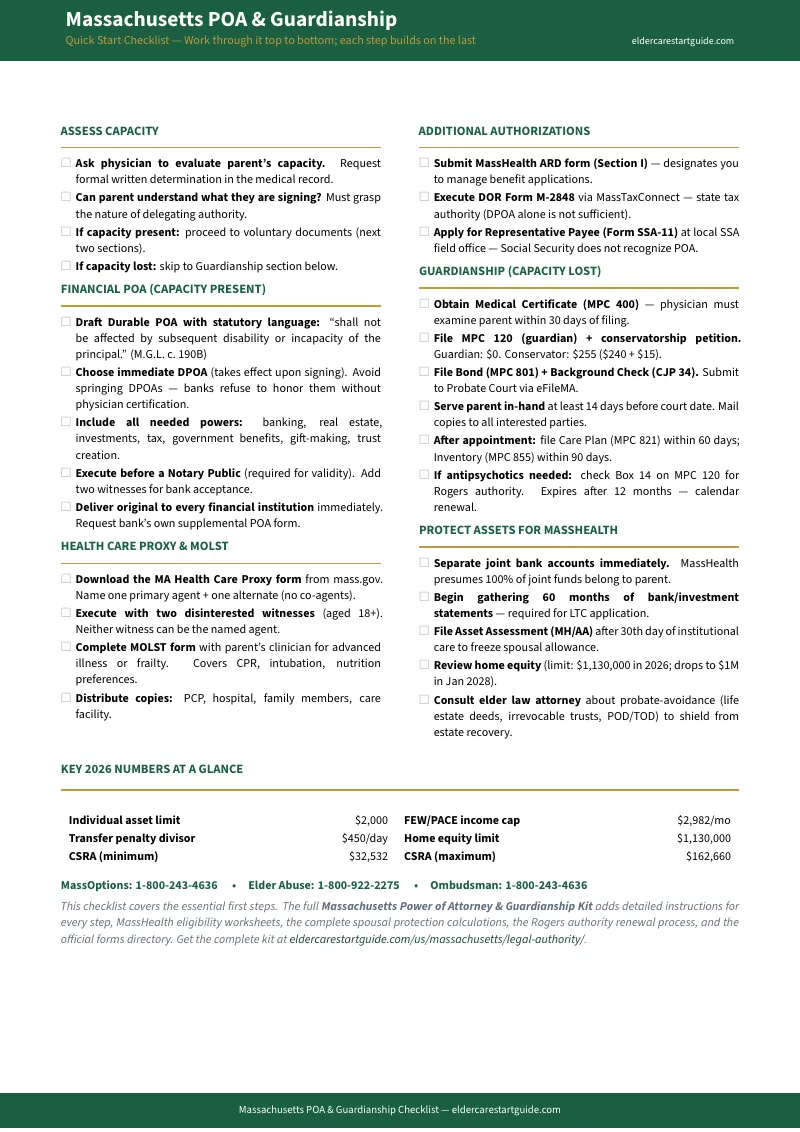
Your download includes the 18-chapter guide, the 20-item quick-start checklist, and 9 standalone printable worksheets — a capacity assessment protocol, POA authority grant worksheet, guardianship filing checklist, Rogers petition checklist, MassHealth eligibility worksheet, estate recovery protection worksheet, fiduciary transparency ledger, forms directory and contact sheet, and a 72-hour crisis action plan.
30-day money-back guarantee. If the guide does not give you clarity on which legal authority path applies to your family, how to execute the documents or file the petitions, and how to protect your parent's assets from MassHealth estate recovery — email us for a full refund. No questions asked.
Not ready for the full guide? Download the free Massachusetts Power of Attorney Quick-Start Checklist — a step-by-step action plan covering capacity assessment, voluntary document execution, guardianship filing, post-appointment compliance, and asset protection basics. Enough to understand which track you are on and what comes next.
You did not ask for this responsibility. But your parent needs someone who understands Massachusetts law — and the system is not going to explain itself. This guide does.