
Your Parent Needs Help at Home. Massachusetts Has Programs That Pay for It — If You Can Figure Out How to Apply.
Your parent fell last Tuesday. Or maybe it wasn't a fall — they just stopped cooking, stopped bathing, started forgetting their medications. Either way, you're now the person figuring out what comes next.
You called the local Aging Services Access Point. They said someone would call back in three to four weeks. You searched "Massachusetts home care Medicaid" and found the Frail Elder Waiver, the state Home Care Program, and the Personal Care Attendant program — three separate programs with three sets of eligibility rules, none of which are explained in a way that tells you what to actually do.
Meanwhile, you priced out private home care. In Massachusetts, that runs $30 to $50 per hour — $5,600 to $7,400 a month for full-time coverage. Your parent's savings won't survive a year at that rate.
The MassHealth Home Care Navigation System
This is not a list of eligibility limits you can find on Mass.gov. It is the process around the limits — the part that $400/hour elder law attorneys explain in billable consultations and that the MassOptions helpline never covers.
The guide walks you through every step from the first ASAP intake call through clinical qualification, financial eligibility, program enrollment, legal authority, home modifications, and estate recovery protection — organized in the order you will actually need them.
Massachusetts runs three distinct home care funding tracks, and most families qualify for at least one. But each has different income thresholds, asset limits, clinical requirements, and application processes. One mistake — depositing a check into the wrong account, giving a $500 gift during the 60-month lookback, missing a recertification deadline — can trigger a penalty period or an outright denial.
What's Inside
- ASAP Intake & Crisis Response — Your parent is being discharged and someone said "arrange care." This chapter tells you exactly who to call (MassOptions: 1-800-243-4636), what to request from the hospital social worker, how to find your regional ASAP by town, and how to fast-track a clinical assessment before your parent leaves the hospital room.
- Clinical Eligibility — The CDS Assessment — The registered nurse is coming to evaluate your parent. This chapter explains every domain the Comprehensive Data Set measures — ADLs, IADLs, cognitive function, behavioral symptoms, wandering risk — and how to document your parent's worst days so the assessment reflects their actual needs, not their best-behavior performance during a 90-minute visit.
- The State Home Care Program — No Asset Limit — If your parent has income but too many assets for MassHealth, the state Home Care Program has no asset test. The guide includes the complete 2026 sliding-scale copay table ($10/month for individuals earning under $16,291 up through 70% cost-sharing above $48,579), the services covered (homemaker, personal care, laundry, meals, companion, adult day health), and the Enhanced Community Options Program (ECOP) for higher-acuity needs.
- The Frail Elder Waiver — MassHealth's Alternative to Nursing Home Placement — Nursing-facility level of care, income under $2,982/month (300% SSI), assets under $2,000. Zero copays. The guide covers the clinical documentation required, the spousal asset allowance ($162,660), the Medically Needy spend-down pathway for over-income applicants, and the monthly service minimum that keeps enrollment active.
- The PCA Program — Hiring Your Own Caregiver — Your parent needs hands-on help with at least two ADLs. The guide covers the consumer-directed model (your parent is the employer), who can be hired (friends and adult children — yes; spouses, legal guardians, and surrogates — no), the enhanced income deduction, and the fiscal intermediary setup for payroll and tax compliance.
- Financial Eligibility, Spend-Downs & Asset Protection — The 60-month lookback rule, the Medically Needy pathway, spousal impoverishment protections, the home equity exemption ($1,071,000 in 2026), exempt assets (primary residence, one vehicle, prepaid burial contracts), and compliant spend-down strategies that reduce countable assets without triggering penalties.
- Legal Authority Chapter — The Massachusetts Durable Power of Attorney (M.G.L. c. 190B), the Health Care Proxy (M.G.L. c. 201D), MOLST orders, and the full guardianship process for families who waited too long — emergency temporary guardianship, permanent guardianship, bonds, Rogers authority for antipsychotic medications, and annual court reporting requirements.
- Home Modification Loan Program (HMLP) — 0% interest, deferred-payment loans from $1,000 to $50,000 for ramps, grab bars, walk-in showers, stairlifts, and widened doorways. No monthly payments — repayment due only on home sale or transfer. The guide includes the 2026 income guidelines by household size, the application process, and which modifications are covered.
- Care Settings — When Home Is No Longer Enough — Certified Assisted Living Residences, skilled nursing facilities, Group Adult Foster Care (GAFC), the break-even calculation between home care and residential placement, and the Patient-Paid Amount formula that determines how much of your parent's income goes to the facility.
- Estate Recovery — Protecting Your Family's Assets — The 2024 Long-Term Care Act (Chapter 197) dramatically narrowed MassHealth estate recovery. The guide covers exactly what changed: PCA and CommonHealth costs are now exempt, recovery is limited to probate assets only, the three hardship waiver categories (residence, care-provided, and income-based up to $50,000 per heir), the 60-day response deadline, the three-year statute of repose from Kendall v. MassHealth, and the irrevocable trust protections established by Daley v. MassHealth.
- Step-by-Step Action Plan — Nine steps from crisis to compliance: initiate clinical intake, complete assessment, secure legal authority, audit financials, execute spend-down, submit MassHealth application, apply for home modifications, approve care plan, complete annual recertifications. Each step includes the forms, deadlines, and phone numbers you need.
- When to Call the Experts — Decision matrix for elder law attorneys, geriatric care managers, Medicaid planners, SHINE counselors, hospital social workers, long-term care ombudsmen, and probate court clerks. Know exactly when you need professional help — and when the guide covers the ground.
Plus: 10 Printable Standalone Tools
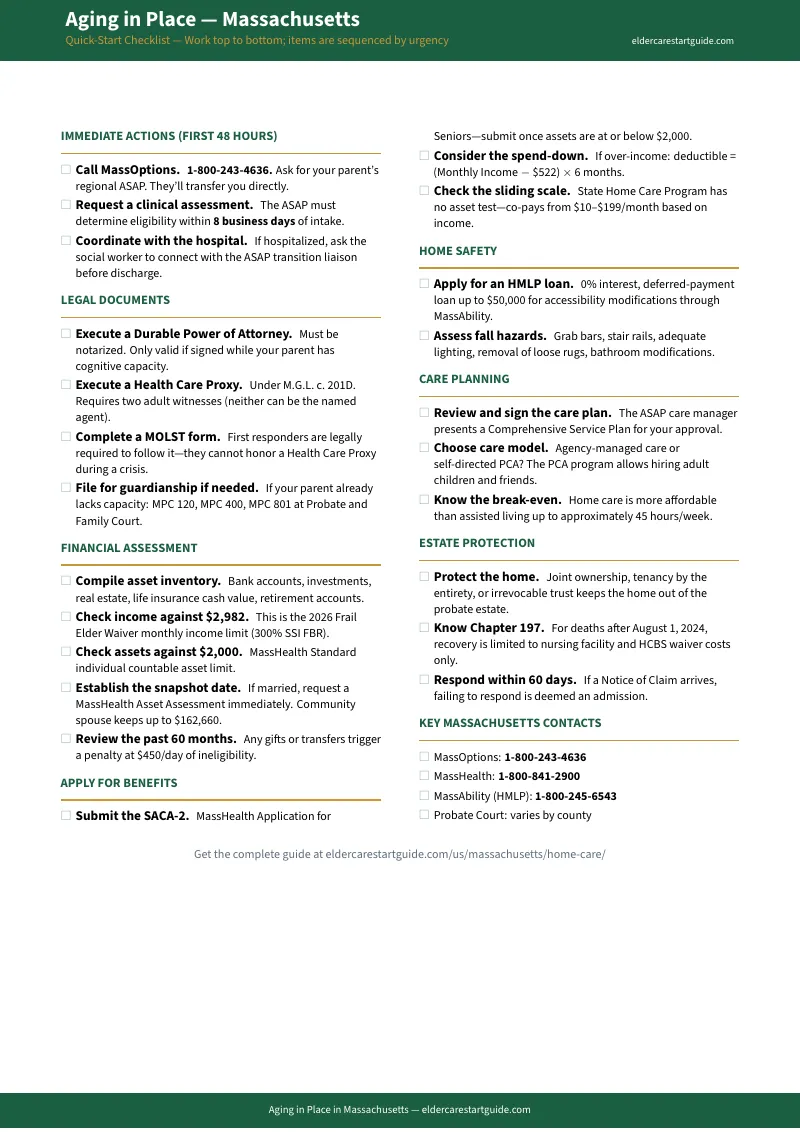
- Massachusetts Aging in Place Checklist — One-page action list with the 20 most critical items, thresholds, and phone numbers
- Three-Track Program Comparison Chart — Home Care Program vs. Frail Elder Waiver vs. PCA side by side: eligibility, services, copays, and care model
- MassHealth Asset Worksheet — Fillable inventory of liquid assets, retirement accounts, real property, and vehicles with 2026 limits and compliant spend-down strategies
- Spousal Protections Worksheet — Calculate the Community Spouse Resource Allowance, income transfer, and the 90-day retitling deadline
- Estate Recovery Protection Sheet — The 2024 Long-Term Care Act reforms, probate-only rule, three hardship waivers, and the SJC decisions that protect trusts
- CDS Assessment Prep Guide — What the ASAP nurse evaluates, how FIL/NFLOC scores determine program eligibility, and a preparation checklist to print before the visit
- 9-Step Action Plan Roadmap — The crisis-to-compliance sequence with contacts, forms, and decision points at each step
- PCA Hiring Guide — Who can be hired, fiscal intermediary setup, the enhanced income deduction, and the 5-step process
- Home Modification Loan Program Reference — HMLP terms, eligible modifications, 2026 income guidelines, and application steps
- Key Contacts Reference Sheet — Every phone number and website on one fridge-ready page
- Official Forms Directory — SACA-2, MPC forms, MOLST, and HMLP application with when-you-need-each-one guidance
Who This Is For
- Adult children whose parent is being discharged from the hospital and someone needs to figure out how to pay for home care that costs $5,600 to $7,400 a month
- Families trying to decide between the Frail Elder Waiver, the state Home Care Program, and the PCA program — three separate tracks with different rules, and no one explaining which applies to their parent's situation
- Caregivers who want to get paid through the PCA program but don't know how to set up the consumer-directed model or whether adult children are eligible to serve as attendants
- Families whose parent's income is over $2,982/month and they need to understand the Medically Needy spend-down — not a generic "consult an attorney" instruction
- Anyone terrified that MassHealth will seize the family home after a parent's death — and who needs to understand what the 2024 Long-Term Care Act actually changed about estate recovery
- Out-of-state siblings coordinating Massachusetts home care applications remotely with no idea where to start or which ASAP covers their parent's town
Why Not Free Government Resources?
Mass.gov publishes eligibility limits. MassOptions offers a helpline. Your regional ASAP provides options counseling after a three-to-four-week wait.
Here is what none of them provide:
- A side-by-side comparison of the three home care funding tracks — Frail Elder Waiver, state Home Care Program, PCA — with the exact clinical, financial, and residency requirements for each, so you know which to apply for before you call
- The CDS assessment preparation strategy — what the registered nurse is looking for, how to document cognitive decline and behavioral symptoms, and why your parent's "best behavior" during the visit can disqualify them from the FEW
- A compliant spend-down roadmap that shows which asset transfers are safe during the 60-month lookback and which trigger penalty periods — not a "talk to a lawyer" note
- The estate recovery rules broken down by the 2024 reforms, with the specific SJC decisions (Daley, Kendall, Mason) that protect irrevocable trusts, impose a three-year deadline, and void TEFRA liens at death
Government sites administer rules. Elder law firms explain them for $400 per hour. This guide bridges the gap — translating hundreds of pages of Massachusetts policy into a sequence you can execute in a weekend.
Satisfaction Guarantee
If the guide doesn't give you a clearer path forward, email [email protected] and we'll make it right.
— Less Than One Hour of a Massachusetts Elder Law Attorney's Time
An initial consultation with a Massachusetts elder law attorney runs $400 per hour. A full Medicaid planning engagement costs $3,000 to $15,000. A guardianship proceeding adds $3,000 to $10,000 in court and legal fees.
This guide won't replace an attorney for contested guardianships or complex irrevocable trust drafting. But for the program comparison, clinical assessment preparation, financial eligibility analysis, spend-down strategy, and estate recovery protection that most Massachusetts families need, it covers the ground at a fraction of the cost — and if you do need an attorney, you'll walk in with an organized file instead of a pile of unsorted bank statements.
Start with the free checklist to see if the approach fits your situation. The full guide goes deeper — every threshold, every strategy, every form, every phone number.