
Your Parent Needs a Care Plan — and Massachusetts Has 24 Regional Access Points, Three Separate Waiver Programs, a Dual-Certification System for Assisted Living, and Estate Recovery Rules That Put the Family Home at Risk
Your mother fell and fractured her hip. Or your father's dementia has progressed to the point where someone needs to be in the house at all times. The hospital discharge planner needs a placement decision by Thursday. The social worker mentioned something about ASAPs, ALR certifications, and MassHealth estate recovery — and you realized you do not understand any of it.
You start researching. You discover that Massachusetts does not license assisted living the way other states do — it certifies Assisted Living Residences through the Executive Office of Aging & Independence, while skilled nursing facilities are regulated by an entirely different agency. You learn that the state Home Care Program charges sliding-scale copayments starting at $10/month, but the Frail Elder Waiver has a separate clinical threshold. You learn that MassHealth can pursue your parent's probate estate for all medical services received after age 55 — not just nursing home costs. And you learn that the placement service that called you "free" earns a commission from every facility it recommends.
The Massachusetts Elder Care Decision Guide is a Care-Setting Navigation System — a step-by-step roadmap that walks you from recognizing the first signs of decline through care-setting comparison, state program eligibility screening, facility quality verification, MassHealth financial planning, and estate recovery protection. Not a national overview that mentions Massachusetts in a sidebar. Not a blog post designed to sell you a $6,000 legal retainer. A Massachusetts-specific manual built on M.G.L. c. 19D, 651 CMR 12.00, and the 2026 MassHealth financial rules — covering every agency, every program threshold, every deadline, and every financial limit in the order you actually encounter them.
What's Inside the Care-Setting Navigation System
A 12-chapter guide, a 28-item decision checklist, and 7 standalone worksheets — covering every phase of the elder care decision in Massachusetts from the first signs of decline through facility enrollment, MassHealth activation, and estate recovery planning:
Recognizing When a Parent Needs Help — and How to Document It
The care-decision process starts before any phone call or facility tour. You need to document specific ADL and IADL difficulties — bathing, dressing, medication management, financial competence, driving safety — with dates and specific incidents. This documentation is not just for family discussions. It becomes the clinical evidence your regional ASAP evaluates during the state's functional assessment. Families who walk into that assessment with vague concerns get lower priority than families who present a dated log of specific incidents. The guide shows you exactly what to observe and how to record it so the state evaluation reflects your parent's actual condition.
Massachusetts Care Settings Compared — Costs, Rules, and Clinical Boundaries
Massachusetts offers a spectrum from nonmedical home companions ($38–$40/hour) through the state-funded Home Care Program, adult day health programs, certified Assisted Living Residences ($9,475/month statewide median), Special Care dementia units ($12,000+/month), Rest Homes (the overlooked middle tier), and skilled nursing facilities ($13,000–$16,000/month). Each setting has different regulatory oversight, different program funding eligibility, and different clinical boundaries — including the rule that ALR staff cannot provide direct skilled nursing care except through outside agencies limited to 90 days per year. The guide maps every setting with cost benchmarks and a 45-hour-per-week break-even calculation that shows you exactly where home care stops being affordable and facility care becomes the rational choice.
The ASAP Network and the Home Care Program — Before You Spend on Private Care
Massachusetts has 24 regional Aging Services Access Points that administer state-funded programs and provide free options counseling. Most families never contact their ASAP before making care decisions — and end up paying privately for services the state would have subsidized. The Home Care Program covers personal care, homemaker services, and case management with sliding-scale copayments as low as $10/month. The guide identifies exactly which ASAP serves your parent's municipality and walks you through the intake process, the functional assessment, and the copayment schedule so you can access state-funded services before committing to private home care contracts.
Frail Elder Waiver, PACE, and Enhanced Community Options — Keeping a Parent Home When the Need Is Severe
When a parent's needs go beyond what the regular Home Care Program provides, Massachusetts has three pathways for keeping them at home even when they clinically qualify for a nursing facility. The Frail Elder Waiver covers services including Alzheimer's coaching, home-based wandering response, and expanded aide hours — but requires a Nursing Facility Level of Care determination and has a $2,000 asset limit. The Enhanced Community Options Program serves applicants who are over-income for the waiver. PACE integrates all medical and long-term care under one team. The guide explains the clinical and financial thresholds for each pathway, including the restriction that FEW participants cannot reside in certified ALRs.
MassHealth Financial Eligibility — Asset Limits, Income Rules, and Spousal Protections
MassHealth long-term care rules diverge sharply from other states. The individual asset limit is $2,000, but the way Massachusetts treats retirement accounts, the primary residence, and spousal assets creates planning opportunities that most families miss. The Community Spouse Resource Allowance protects up to $162,660 for the at-home spouse. The Minimum Monthly Maintenance Needs Allowance ensures the at-home spouse keeps enough income to live. And the Medically Needy spend-down pathway provides a route for applicants whose income exceeds the standard limit. The guide includes a Financial Snapshot Worksheet that maps your parent's specific assets against MassHealth's countable-versus-exempt categories.
The Five-Year Look-Back, Penalty Periods, and the Caregiver Child Exemption
The 60-month look-back catches transfers that families made years ago without understanding the consequences. A $50,000 gift to a grandchild three years ago creates a penalty period of roughly three to four months during which MassHealth will not pay for nursing home care — and your parent is responsible for the full private-pay rate. The guide walks you through the penalty calculation, identifies the exempt transfers that do not trigger penalties (the Caregiver Child Exemption, transfers to a disabled child, home equity within the $1,130,000 limit), and explains when families must consult an elder law attorney because the look-back exposure is too large for self-guided planning.
Estate Recovery — Protecting the Family Home After Death
This is where Massachusetts diverges most dangerously from other states. MassHealth recovers from the probate estate for all medical services after age 55 — not just long-term care. If the family home passes through probate, it is exposed to recovery claims. The guide explains the legal structures that move the home outside probate: life estate deeds, irrevocable trusts, joint tenancy, and the Caregiver Child Exemption. It covers the Kendall rule — the 2014 SJC decision that limits estate recovery when no estate is opened within three years of death — and the circumstances under which a hardship waiver can reduce or eliminate the recovery claim.
Facility Quality Verification — Using the Databases the Placement Agencies Will Not Show You
Placement agencies earn a commission from the facilities they recommend. They are not going to point you to the DPH Nursing Home Survey Performance Tool scoring facilities across 132 indicators, the AGE biennial compliance review records for ALRs, or the Long-Term Care Ombudsman complaint patterns. The guide walks you through each database step by step: how to read DPH inspection reports, what an immediate jeopardy citation means, how to spot repeat citations for pressure ulcers or medication errors, how to verify ALR certification status, and how to ask the right questions during facility tours using the included Facility Tour Scoring Sheet.
Who This Guide Is For
- The adult child who just got the call from the hospital — who has 72 hours to produce a discharge plan and does not know the difference between an ALR certified by AGE and a nursing home licensed by DPH, or why that distinction determines which databases to check for safety violations
- The family watching a parent decline gradually — who sees the missed medications, the stove left on, the refrigerator full of expired food, and knows something needs to change but does not know which care setting matches their parent's clinical needs or what it costs in Massachusetts
- The caregiver who is burning out — who needs to understand the Home Care Program copayment schedule, respite options through the Family Caregiver Support Program, and the point at which the 45-hour break-even makes facility care more rational than round-the-clock home aides
- The family trying to protect assets before MassHealth depletes everything — who needs to understand the $2,000 asset limit, the Community Spouse Resource Allowance up to $162,660, the five-year look-back penalty math, and the estate recovery rules that put the family home at risk even after death
- The out-of-state child managing a parent's care in Massachusetts remotely — who needs every agency contact, every DPH database, every ASAP directory, and every deadline in one document instead of calling MassOptions repeatedly and getting different referrals each time
Why Free Resources Will Not Get You Through This
Massachusetts elder care information exists. It is scattered across 24 regional ASAPs, the MassOptions portal, Mass.gov subpages for AGE, DPH, and MassHealth, and dozens of elder law firm blogs. Here is what you actually encounter when you try to navigate the care decision using free sources:
- State portals give you accurate information in bureaucratic fragments. Mass.gov explains the Frail Elder Waiver on one page, MassHealth eligibility on another, and ALR certification on a third. None of them sequence the information into a decision pathway. None of them tell you which step to take first or how one program's eligibility affects another.
- MassOptions is a directory, not a decision guide. It connects you to services and programs — but it requires you to already know what you are looking for. If you cannot distinguish between the Home Care Program, the Frail Elder Waiver, and Enhanced Community Options, MassOptions cannot sequence that decision for you.
- Placement agencies are referral brokers with a financial conflict. A Place for Mom and similar services earn commissions from partner facilities. Their advisors may not recommend state-funded Home Care Program services, the Frail Elder Waiver, or Group Adult Foster Care — programs that could eliminate or dramatically reduce your family's out-of-pocket costs.
- Elder law attorney blogs are accurate and designed to sell retainers. Every MassHealth planning article ends with "call our office." Massachusetts elder law attorneys charge $300–$500/hour and $6,000–$15,000 for Medicaid planning packages. Their content shows you how complex the system is — but it does not tell you that a structured preparation kit could save you thousands in billable hours by walking into the consultation with your financial inventory organized and your program eligibility already screened.
- National platforms like AARP publish general guides that lack Massachusetts regulatory depth. They will not explain the ALR certification regime under AGE, the Home Care Program copayment schedule, the FEW restriction against residing in ALRs, the estate recovery scope that goes beyond long-term care to all post-55 medical services, or the Kendall rule for avoiding estate recovery claims.
Free resources give you pieces from a dozen agencies that do not talk to each other. The Care-Setting Navigation System puts every Massachusetts-specific rule, program threshold, form, deadline, and cost range into one document, in the order you actually encounter them.
— Less Than One Hour With an Elder Law Attorney
An initial consultation with a Massachusetts elder law attorney runs $300–$500. A full MassHealth planning package costs $6,000–$15,000. National care-matching platforms collect your personal data and sell it to referral networks. This guide costs less than one hour of professional time and gives you the complete Massachusetts care-decision roadmap — every licensing rule, every cost benchmark, every program tier, every MassHealth threshold, every facility audit step, and the worksheets that organize everything your family needs to act.
Your download includes 9 printable PDFs — the 12-chapter guide, a 28-item decision checklist, and 7 standalone worksheets you can print and bring to facility tours, family meetings, attorney consultations, and MassHealth appointments: the ADL Self-Assessment, Financial Snapshot, Document-Gathering Checklist, Facility Tour Scoring Sheet, Agency Communication Log, Caregiver Child Documentation Checklist, and Estate Recovery Risk Audit.
30-day money-back guarantee. If the guide does not give you clarity on which care setting fits your parent, how to verify a facility's quality, and how to navigate MassHealth eligibility and estate recovery — email us for a full refund. No questions asked.
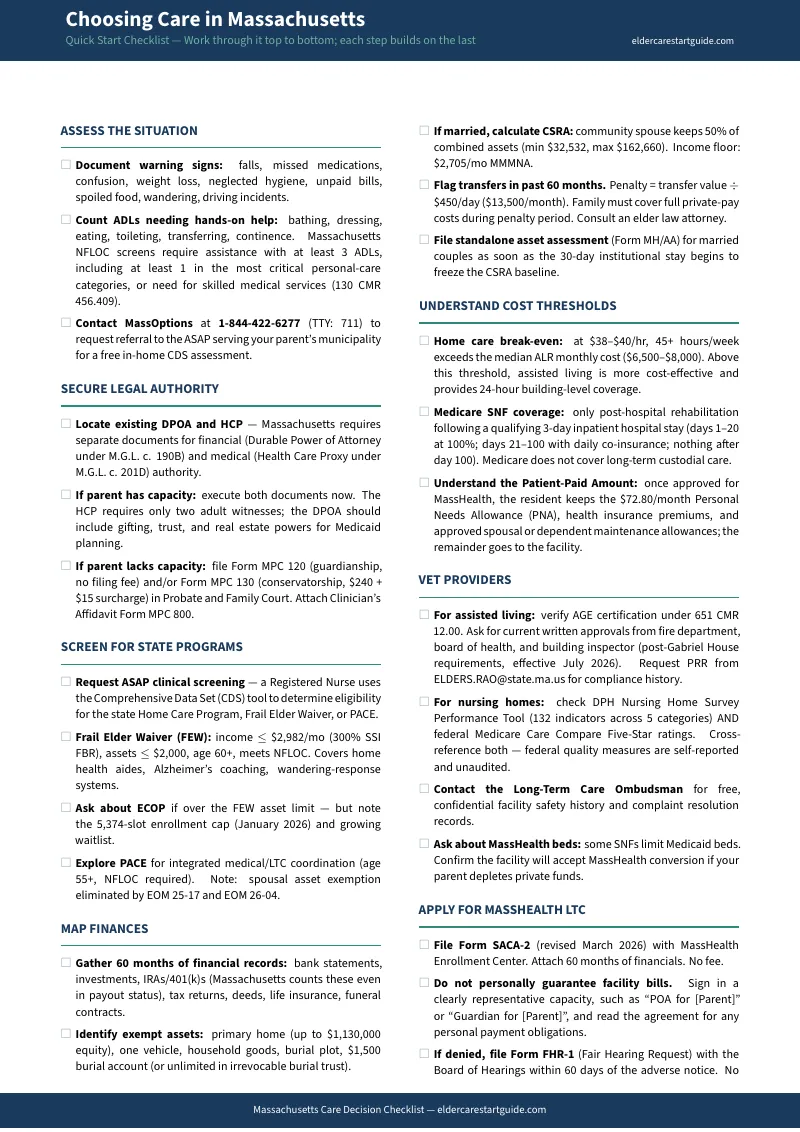
Not ready for the full guide? Download the free Massachusetts — Choosing Care Decision Checklist — a quick-start action plan that walks you through the immediate steps: safety assessment, legal document audit, ASAP contact, and program screening. Enough to start the clinical on-ramp and understand what comes next.
You did not sign up for this. But your parent needs someone who understands Massachusetts's system — and the system is not going to explain itself. This guide does.