Medicare just ended. The bills are $12,927 a month. Now what?
Your parent was discharged from a Maryland hospital to a skilled nursing facility. Medicare covered the rehabilitation stay — 20, maybe 40 days — and then stopped. The facility has shifted your parent to private-pay custodial care, and the billing department is asking you to sign financial responsibility forms.
You're Googling "Maryland Medicaid nursing home" at midnight, trying to figure out whether your parent qualifies, what assets count, and whether the state can take the house. You're reading conflicting advice from attorney blogs that want a $5,000 retainer and state agency pages written in regulatory prose that answers nothing.
You need a clear sequence of steps — and you need it before the next bill arrives.
The Medicaid Readiness System: A Complete Process Map for Maryland Families
This isn't a glossary of Medicaid terms. It's a decision-by-decision process guide built around the order things actually happen when a Maryland parent needs long-term care — from the first 72 hours after hospitalization to the day the Medicaid application is approved.
Most free resources explain what Medicaid is. This guide covers what to do, in what order, and what to avoid signing along the way. Every chapter includes the worksheets and templates you need to act on what you've just learned, so you're never left knowing the theory without having the tools.
What's Inside
- The 72-Hour Crisis Protocol — exactly what to sign (and what never to sign) when a nursing facility presents admission agreements. One wrong signature can make you personally liable for unpaid balances.
- Maryland's Three Long-Term Care Pathways — nursing home Medicaid, the Community Options Waiver, and Community First Choice, mapped out with eligibility rules, wait times, and the strategic bypasses that most families never learn about (including the 30-day nursing facility transition that skips the 24,000-person waiver waitlist).
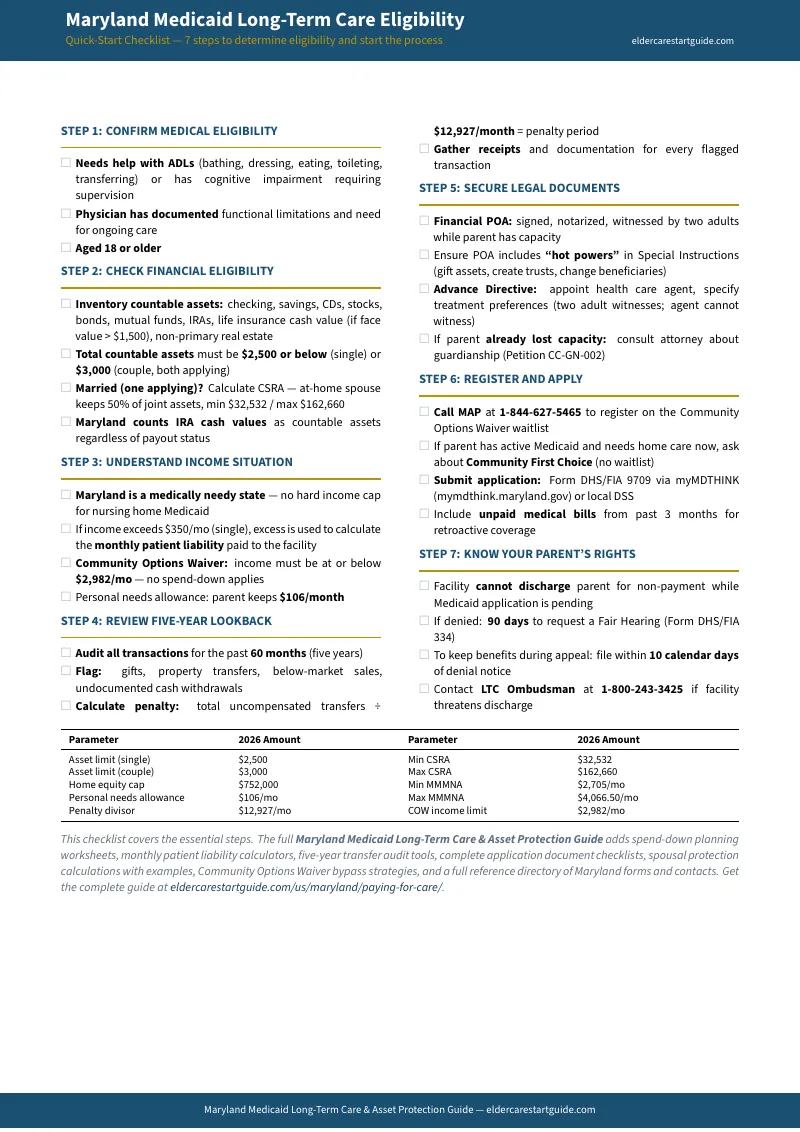
- The Spend-Down Calculator — Maryland is a "medically needy" state with no income cap and no Miller Trust requirement. The guide includes a planner that walks you through the math: your parent's income, the $350 medically needy threshold, the monthly patient liability, and compliant spend-down strategies (prepaid burial contracts, home modifications, debt payoff).
- Five-Year Lookback Audit Worksheet — state examiners will review 60 months of bank statements, retirement accounts, and property transfers. Undocumented cash withdrawals get treated as gifts. This worksheet helps you flag every transaction that could trigger a penalty before you submit the application.
- Spousal Protection Calculator — if your parent is married, the at-home spouse is entitled to keep between $32,532 and $162,660 of joint assets (the Community Spouse Resource Allowance) plus a monthly income floor. The calculator walks through the joint-asset snapshot, the CSRA calculation, and income transfers from the applicant spouse.
- The "Medicaid Pending" Crisis Kit — templates to establish pending status with the nursing home billing department, a patient liability estimator, and a reference sheet of federal protections that prevent facilities from discharging residents for non-payment while an application is processing.
- Personal Care Agreement Template — if a family member provides caregiving, undocumented payments get flagged as gifts during the lookback. This COMAR-compliant agreement template documents fair-market-value compensation so it doesn't trigger a transfer penalty.
- 10-Day Appeal Packet — if your parent is denied, you have 90 days to request a Fair Hearing. But to keep existing benefits running during the appeal, you must file within 10 calendar days. The guide includes a template appeal letter and a step-by-step filing walkthrough.
- Estate Recovery Roadmap — Maryland's MERP program recovers costs from probate assets after a beneficiary's death. The guide covers exemptions, life estate deeds, the caregiver child exception, and how to structure ownership so the family home passes outside probate.
Who This Is For
You're the adult child — probably between 45 and 65 — handling a parent's care transition while balancing your own family and career. Your parent has modest savings, somewhere between $30,000 and $150,000, and spending $5,000 to $10,000 on an elder law attorney retainer feels like it would defeat the purpose of protecting those savings.
This guide is a preparation tool, not a replacement for legal counsel. It helps you organize five years of financial records, understand which assets count and which are exempt, and walk into an attorney's office with a completed intake instead of a box of unsorted bank statements. Families who do this groundwork typically save significant billable hours.
Why Not Just Google It?
You can find most of this information scattered across Maryland government sites, elder law attorney blogs, and national directories. Here's the problem:
- State agency pages explain policy in regulatory prose (COMAR citations, eligibility categories, bureaucratic terminology) without ever telling you what to do.
- Attorney blogs explain just enough complexity to make you feel you need a retainer — which is exactly the point. They don't provide templates, calculators, or step-by-step filing instructions.
- National directories (Paying for Senior Care, A Place for Mom) generalize across 50 states. They miss Maryland-specific details like the medically needy spend-down pathway, the Community First Choice waitlist bypass, and the state's probate-only estate recovery rule.
The cost isn't the information. It's the 40 hours of searching, cross-referencing, and hoping you haven't missed the one rule that creates a penalty period or delays approval by months.
What You Get
The full package includes the comprehensive guide (13 chapters plus appendix worksheets), a standalone spend-down planner, the five-year lookback audit worksheet, the spousal protection calculator, the Medicaid Pending crisis kit, the personal care agreement template, the appeal packet, and the quick-start eligibility checklist.
Everything is formatted as downloadable PDFs — fill in the worksheets on screen or print them out. The 2026 financial figures (asset limits, CSRA thresholds, penalty divisors, personal needs allowances) are current as of the guide's publication date.
Satisfaction Guarantee
If the guide doesn't help you move forward with your parent's care plan, email us for a full refund. No hoops, no time limit.
The free checklist gives you the eligibility overview — enough to see if your parent is likely to qualify. The full guide gives you the system to act on it: the worksheets, the calculators, the templates, and the chapter-by-chapter roadmap to get from "Medicare just ended" to "Medicaid approved."
Download the free checklist or get the full Medicaid Readiness System — and stop making care decisions under pressure.