The Discharge Planner Just Said Your Parent Is "Medically Stable." Your Parent Can't Walk to the Bathroom.
You're standing in a hospital corridor in Maryland, and someone in scrubs just told you your parent needs to leave. Maybe tomorrow. Maybe today. They handed you a printed list of rehab facilities — names you've never heard of, no ratings, no explanation of which ones specialize in stroke recovery versus hip replacement versus dementia care.
Meanwhile, your parent's chart says "observation status." You don't know what that means yet. But it means this: if your parent needs skilled nursing facility rehab after discharge, Medicare won't cover it. The three-day inpatient rule wasn't met. Nobody told you. The bill — $10,000 to $15,000 per month — lands on your family.
And somewhere in the stack of intake paperwork, a nursing home is about to slide a financial guarantee clause across the table for you to sign.
The Maryland Discharge Navigation System
This isn't a pamphlet of general advice about hospital discharges. The Maryland Discharge Navigation System maps the exact sequence of decisions, appeals, applications, and protections your family needs — from the hour you learn about the discharge through long-term Medicaid planning — so you don't lose coverage, miss deadlines, or sign documents that make you personally liable for bills that aren't yours.
The critical mistake most families make: they assume the hospital's discharge plan is the only option. They don't know they can call Livanta LLC — Maryland's designated Quality Improvement Organization — by midnight on the discharge day and temporarily halt everything while an independent reviewer evaluates whether the discharge is safe. They don't know that Maryland's Lay Caregiver Act (COMAR 10.07.01.35) requires the hospital to train them on wound care, medication administration, and mobility assistance before sending anyone home. They don't know that Maryland repealed its filial responsibility law in 2017, and that the nursing home intake form asking for a "responsible party" signature is not what it appears to be.
The guide puts you in the right order: verify your parent's admission status, exercise your discharge rights, file an appeal if needed, evaluate post-acute care options with a structured framework, access Maryland's Medicaid home care programs, protect your assets, and build the legal authority documents that keep you in control.
What You Get — 7 PDFs, Including Standalone Worksheets
- 14-Chapter Guide — The complete Maryland Discharge Navigation System: observation status and the MOON notice, Maryland statutory discharge requirements (Health-General § 19-308.8, COMAR 10.07.01.27), the Livanta expedited appeal process, choosing between home health agencies, residential service agencies, assisted living, and skilled nursing facilities, fighting a nursing home eviction (42 CFR § 483.15), Maryland Access Point and community programs (CFC entitlement, CO Waiver, Money Follows the Individual waitlist bypass), Medicaid financial eligibility (medically needy spend-down, $2,500 asset limit, CSRA up to $162,660), filial responsibility repeal, legal authority documents (POA, advance directive, MOLST, emergency guardianship), and a step-by-step transition workflow. Every dollar figure, phone number, and regulation citation reflects 2026 Maryland law.
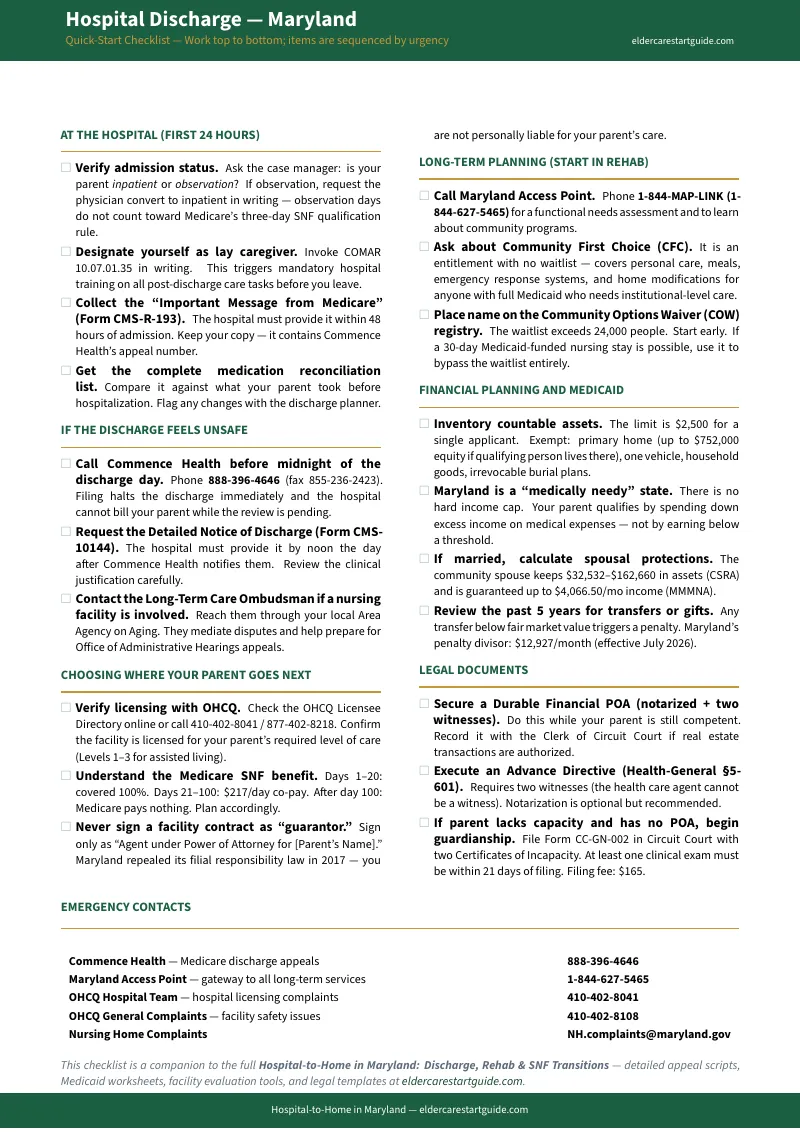
- Quick-Start Checklist (Free Download) — 20 actionable items organized by priority: status verification, discharge rights, appeal deadlines, facility selection, home safety, Medicaid screening, and legal document preparation. Know exactly what to do tonight, this week, and this month.
- Livanta Appeal Worksheet — Fillable one-page form to document your case before calling Commence Health, including the call script, critical deadline reminder, and a section to record your case number
- Facility Comparison Matrix — Side-by-side comparison sheet for evaluating up to 4 rehab or skilled nursing facilities on OHCQ licensing, CMS star ratings, therapy specialization, and cost
- Medicaid Spend-Down Tracker — Calculate your parent's excess income, log qualifying medical expenses, and track progress toward the medically needy threshold
- Medication Reconciliation Log — Verify every medication at discharge: pre-hospital list with status changes, new medications, and a verification checklist to confirm with the discharging nurse
- Non-Liability Signing Template — Printable addendum with the exact language to attach to nursing home admission paperwork, protecting you from personal financial liability
Who This Guide Is For
- Adult children in Maryland who just learned their parent is being discharged from the hospital and need to know their rights — including how to pause the discharge if it feels unsafe
- Families whose parent is under "observation status" and needs to understand why Medicare won't cover rehab and what to do about it
- Caregivers evaluating skilled nursing facilities under time pressure who need a structured framework — not a list of names from the discharge planner
- Families facing a nursing home eviction or transfer notice who need to understand the federal protections and Maryland appeal process
- Families navigating Maryland Medicaid for long-term care — including the medically needy spend-down, the CO Waiver waitlist bypass, and Community First Choice self-directed care
- Out-of-state siblings coordinating a Maryland parent's transition who need every contact number, deadline, and filing step in one document
Why the Free Information Isn't Enough
Maryland Access Point publishes the rules. The Department of Health posts COMAR regulations. The information is accurate. But it's scattered across dozens of agency websites, dense PDFs, and departmental portals that assume you already know the system. When you're standing in a hospital corridor with a discharge deadline measured in hours, you don't have time to piece together Maryland's lay caregiver law from one source, the Livanta appeal number from another, and the CO Waiver waitlist bypass from a third.
Elder law attorneys in Maryland charge $150 to $500 per hour. A Medicaid planning package runs $3,000 to $12,000. Their blog posts explain just enough complexity to convince you to schedule a consultation — not enough to take action yourself.
A Place for Mom and Caring.com rank well on Google, but their revenue comes from referral commissions paid by senior living facilities. They're structurally incentivized to move your parent into a partner facility, not to help you access state-funded Community First Choice services or file a Livanta appeal that keeps your parent in the hospital.
This guide fills the gap between the government portal that gives you rules without sequence, the law firm that gives you sequence through a $3,000+ engagement, and the referral site that steers you toward placements that may not be necessary.
Satisfaction Guarantee
If this guide doesn't give you a clear, actionable path through your parent's hospital discharge in Maryland, email [email protected]. We read every message.
— Less Than One Hour With an Elder Law Attorney
Maryland elder law attorneys charge $150 to $500 per hour. A single missed deadline — a Livanta appeal filed one day too late, an observation status left unchallenged, a nursing home intake form signed with personal guarantee language — can cost your family thousands in uncovered care or months of legal untangling.
This guide won't replace an attorney when you need one (and Chapter 13 tells you exactly when that is). But it will help you avoid the most expensive mistakes, organize the documents a lawyer would ask for anyway, and walk into every conversation — with the discharge planner, the nursing home administrator, the Medicaid caseworker, or an elder law firm — knowing exactly what Maryland law requires.
Download the free Quick-Start Checklist to see the 20 most urgent action items. When you're ready for the complete system, the full guide is waiting.