
Your Parent Needs Help at Home. Maryland Has Programs That Will Pay for It — If You Can Navigate Five Overlapping Systems.
Something changed. Maybe your mother fell and the hospital is about to discharge her with instructions to "arrange home care." Maybe your father has stopped bathing, stopped eating properly, and you realized last Tuesday that he hadn't refilled his prescriptions in two months. Maybe you've been the one providing care — driving over every morning, staying through dinner, skipping your own appointments — and you've finally hit the wall.
You Googled "Maryland home care" and discovered there are state programs. Then you discovered there are five state programs, each with different clinical thresholds, different financial limits, and different waitlists. You called Maryland Access Point and got placed on a registry you don't fully understand. Someone mentioned Community First Choice but couldn't explain how it differs from CPAS. You found the CO Waiver's income cap but then read about "spend-down" and couldn't figure out whether your parent's Social Security disqualifies them or not.
Meanwhile, you priced out private home care. In Maryland, that runs roughly $80,000 per year for 44 hours of care per week. Your parent's savings won't sustain that for long.
The Maryland Home Care Navigation System
This is not a reprint of the COMAR regulations you can find on the Maryland Department of Health website. It is the process around the regulations — the part that $150–$500/hour elder law attorneys explain in billable consultations and that county MAP counselors never have time to walk you through.
The guide covers every step from the first warning signs to stable, funded home care: establishing legal authority before your parent loses capacity, auditing finances against Maryland's specific program thresholds, choosing between CFC and CPAS, navigating the clinical assessment to ensure your parent's actual care needs are properly documented, getting paid as a family caregiver through consumer-directed services, protecting assets within the 60-month look-back rules, and connecting to county-level community supports for meals, transportation, respite, and home modifications.
Maryland has a structural advantage most families never learn about: Community First Choice (CFC) is a state plan entitlement with no waiting list. If your parent qualifies, services begin. No lottery, no multi-year queue. But qualifying requires documenting functional limitations precisely enough to meet the Nursing Facility Level of Care standard, navigating financial thresholds that confuse even experienced social workers, and understanding the Medically Needy spend-down mechanism that most families abandon as too complicated.
What's Inside
- Crisis Response Sequence — Your parent is being discharged and you've been told to arrange home care. This section tells you exactly who to call (Maryland Access Point: 1-844-627-5465), what to request from the hospital social worker, how to initiate an expedited AERS clinical assessment through the Local Health Department, and how to establish legal authority with a Maryland Advance Directive and Durable Power of Attorney before your parent's capacity declines further.
- CFC Application Walkthrough — The complete Community First Choice process in plain language. How to contact MAP to begin, what the interRAI Home Care assessment evaluates, how to document your parent's functional needs when they minimize their limitations during the face-to-face evaluation, and the specific strategies for ensuring the assessing nurse sees your parent's worst days rather than their best. No waiting lists — but a denial costs weeks of reapplication.
- Program Comparison Table — CFC versus CPAS versus CO Waiver versus ICS versus the Senior Care Program, side by side. Clinical eligibility requirements, 2026 financial thresholds, waitlist status, covered services, and self-directed care options for each. One table resolves what takes hours of reading across five different state agency websites.
- Financial Eligibility Audit — Maryland's $350/month Medically Needy Income Level confuses nearly every family. The guide walks through the spend-down calculation step by step: how to subtract the MNIL from gross income, what medical expenses count as spend-down credits during the six-month budget period, and the strict difference between income spend-down (which works like a deductible) and asset limits (which have no post-application spend-down — assets must be restructured before you apply). Includes the $2,500 asset limit for regular ABD Medicaid, the CO Waiver's $2,982/month income cap, and the spousal impoverishment standard protecting up to $162,660 in joint assets.
- Consumer-Directed Care — Getting Paid as a Family Caregiver — Maryland's CFC program allows your parent to hire a relative as their paid personal assistant — including a spouse. The guide covers the complete process: enrolling with a state-contracted Fiscal Management Services provider, background check requirements, the legal employer-employee relationship under consumer direction, scheduling flexibility, and the payroll and tax handling the FMCS manages on your parent's behalf.
- Asset Protection Within the Look-Back Rules — The 60-month look-back period, permissible pre-application asset restructuring methods (prepaying funeral expenses, necessary home modifications, Medicaid Asset Protection Trusts), the family home exemption for community spouses, and the documentation you need to withstand a Medicaid eligibility review without triggering a penalty period.
- Home Modifications and Safety — A room-by-room home safety assessment checklist, plus funding sources: CFC environmental modifications, the Maryland DHCD "Accessible Homes for Seniors" program (0% deferred loans up to $25,000 for households where at least one resident is 55+ and income falls below 80% of state median), AAA community programs, and Veterans Affairs home improvement grants.
- Community Resources Chapter — How to connect with your local Area Agency on Aging, Maryland Access Point county offices, Title III-E respite care vouchers through the National Family Caregiver Support Program, Meals on Wheels and home-delivered meal programs, non-emergency medical transportation, adult day care and Medical Day Care differences, the SOAR program, and the Longevity Ready Maryland Act community infrastructure being built to support aging in place.
- County-by-County Directory — Direct contact information for Maryland Access Point offices, county health departments, and Area Agencies on Aging across Maryland's 23 counties and Baltimore City.
Plus: Printable Worksheets and References
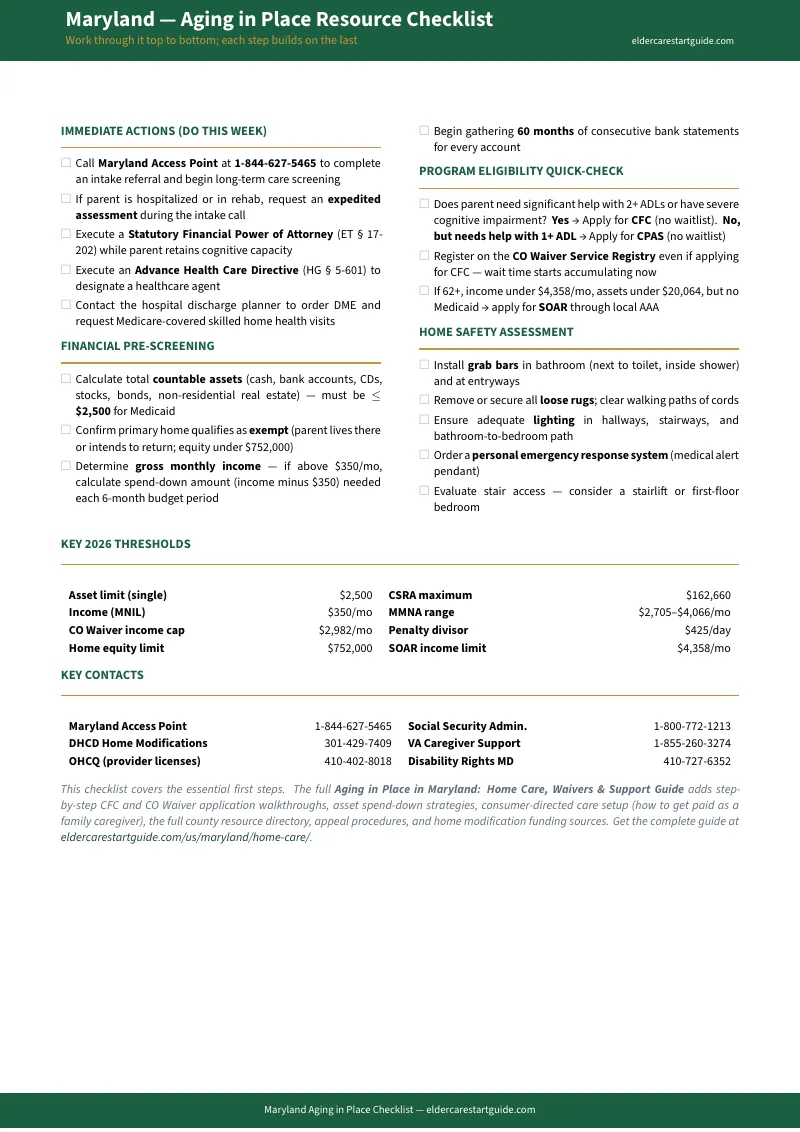
- Maryland Aging in Place Resource Checklist — A 17-item action list organized by priority: legal authority, financial eligibility check, program applications, and home safety assessment.
- Financial Eligibility Self-Assessment — Tally every countable asset against Maryland's 2026 limits for CFC, CPAS, CO Waiver, ICS, and SOAR, with spend-down calculation and spousal protection worksheet.
- 14-Day Care Log — Printable daily tracker for documenting every instance of assistance your parent needs — the single most important piece of evidence for the clinical assessment.
- Assessment Preparation Checklist — What the interRAI HC evaluation covers, how to prepare your parent, and what documentation to have ready.
- Spend-Down Expense Tracker — A pre-formatted log for tracking medical expenses during Maryland's six-month budget period, with running total to show when your parent has met the spend-down amount.
- Document Preparation Checklist — Every form, bank statement, and record needed for the Medicaid application, organized by the 60-month look-back requirement.
Who This Is For
- Adult children whose parent is being discharged from the hospital and someone needs to figure out how to pay for home care that costs roughly $80,000 a year at private-pay rates
- Families who looked at the $350/month Medicaid income limit, assumed their parent is disqualified, and have never heard of the spend-down pathway or the CO Waiver's higher $2,982/month threshold
- Caregivers who want to get paid through consumer-directed services under CFC but don't know how to set up the Fiscal Management Services relationship or whether their spouse qualifies
- Families paralyzed by the CO Waiver's 20,000-person waiting list who don't know that CFC — the no-waitlist entitlement — covers many of the same personal care services
- Anyone trying to protect a parent's home and savings from Medicaid recovery while still qualifying for state-funded care
- Out-of-state siblings coordinating Maryland home care remotely with no idea which county office to contact first
Why Not Free Government Resources?
Maryland's Department of Health publishes eligibility regulations. Maryland Access Point has a helpline. County health departments have application forms.
Here is what none of them provide:
- A step-by-step assessment preparation strategy showing you how the interRAI HC evaluation works and how to document your parent's care needs accurately — not just "call MAP and schedule an intake"
- A side-by-side comparison of CFC, CPAS, CO Waiver, ICS, and the Senior Care Program with the exact 2026 financial thresholds, covered services, self-direction options, and waitlist status for each — not 300 pages of COMAR regulations spread across five different program chapters
- A spend-down walkthrough explaining exactly how the six-month budget period works, which medical expenses count, and why the $350 MNIL is not the income cutoff most families think it is
- An asset protection analysis explaining how to use the 60-month look-back period strategically — prepaid funerals, home modifications, spousal protections — without triggering a penalty
- A complete consumer-directed care enrollment framework covering the FMCS provider relationship, background checks, employer responsibilities, and the spouse-hiring provision that most state program pages don't mention
Government sites publish regulations. This guide translates fragmented state policies — scattered across MDH, MAP, AAA, and county health department systems — into a single, sequential process you can follow from crisis to stable home care.
Your Parent's Safety Net
Every week you spend piecing together fragmented information is a week your parent goes without the funded care they may already be entitled to. CFC services are available immediately upon approval — but only if you apply correctly.
Get the Maryland Home Care Guide →
The free checklist gives you the 17-item action list to start immediately. The full guide gives you every chapter, every program comparison, every assessment preparation strategy, and the complete consumer-directed care enrollment framework.