
Maryland Runs Dementia Care Through Five Overlapping Programs, a Multi-Year Waitlist, a 60-Month Look-Back Audit, and a Memory Care Licensing System That Families Discover Only After Signing a Contract They Don't Fully Understand
Your parent has dementia. Maybe they left the stove on for the third time this month. Maybe they walked out the front door at midnight and a neighbor brought them back. Maybe a hospital discharge planner just told you they can't go home safely — and now you have 72 hours to find a placement in a state where memory care averages $9,000 per month and no one at the hospital can tell you which programs might help pay for it.
You start searching and hit walls immediately. Maryland Access Point tells you about the Community Options Waiver, but there is a registry waitlist and they cannot tell you how long. You learn that Maryland doesn't issue a standalone memory care license — your parent's facility operates an Alzheimer's Special Care Unit inside a licensed Assisted Living Program under COMAR 10.07.14.32, and the difference between a Level 1, Level 2, and Level 3 license determines whether the facility can legally keep your parent when their care needs escalate. You discover your parent's countable assets must fall below $2,500 for Medicaid eligibility, which means every financial transaction from the past five years is subject to review using a $12,927 monthly penalty divisor. And the new SOAR program might provide a subsidy — but only if your parent's income falls below $4,358 and their assets are under $20,064, and you apply through the correct county agency.
The Maryland Dementia Care Navigation System
This guide connects every Maryland-specific program, financial threshold, and application pathway into a single chronological sequence. It starts with the legal authority decisions you must make while your parent still has cognitive capacity, moves through safety planning and wandering preparation, and walks you through the complete Medicaid application process — including the 60-month look-back audit, the Community Options Waiver registry bypass, and the SOAR subsidy application that can reduce memory care costs by up to $1,000 per month.
What makes this different from state websites, national caregiving portals, and free senior placement services: it connects the systems that Maryland treats as separate bureaucracies. Your parent's Adult Evaluation and Review Services (AERS) functional assessment determines their clinical eligibility. That clinical eligibility determines which Medicaid programs they qualify for — Community Options Waiver, Community First Choice, Increased Community Services, or Community Personal Assistance Services. Each program covers different care settings and has different income thresholds. The financial eligibility analysis requires understanding the $2,500 asset limit, the $2,982 income cap, the Community Spouse Resource Allowance of $162,660, and the five-year look-back — all following Maryland-specific rules. And the SOAR program operates on completely separate eligibility criteria administered county-by-county. These are not independent decisions. The guide shows how each one flows into the next so you sequence the applications correctly and avoid the gaps that cost families months of coverage or tens of thousands in avoidable penalties.
What's Inside
- The Complete Guide (12 chapters, 50+ pages) — covers Maryland's dementia care landscape from initial legal authority (durable financial POA, Advance Directive, guardianship under Maryland Rules Title 10) through Silver Alert preparation, MAP and AERS coordination, memory care licensing evaluation, all four Medicaid home and community programs, the SOAR subsidy, the 60-month look-back period with two fully worked examples, VA Aid & Attendance pension eligibility, and building a professional support team
- Medicaid Financial Eligibility Worksheet — the 2026 asset limit ($2,500), income cap ($2,982/month), Community Spouse Resource Allowance ($162,660), and a fillable asset categorization tool that separates countable from exempt resources under Maryland rules
- 60-Month Look-Back Audit Organizer — a structured spreadsheet for organizing five years of bank statements and asset histories, with Maryland's $12,927 monthly penalty divisor built in, exempt transfer categories, and a Medicaid-compliant personal care agreement template to compensate family caregivers without triggering penalty periods
- Community Options Waiver Application Roadmap — step-by-step instructions for registering with Maryland Access Point, requesting an AERS assessment, and using the 30-day nursing home transition exception to bypass the community registry waitlist entirely
- SOAR Subsidy Application Worksheet — income and asset eligibility screening ($4,358 income / $20,064 assets), county-by-county application gateways with phone numbers and agency names, and the functional assessment process
- Memory Care Facility Audit Checklist — a printable comparison worksheet for evaluating facilities against COMAR 10.07.14.32 requirements: Level 1/2/3 license verification, mandatory Special Care Unit Disclosure Form, staff-to-resident ratios, the six-hour cognitive training regulatory floor, and awake overnight staffing
- Guardianship Filing Guide — Petition form CC-GN-002, the two required health professional certifications (Forms CC-GN-019, CC-GN-020, CC-GN-021, CC-GN-050), interested persons and their legal standing, and ongoing court reporting requirements
- Silver Alert and Wandering Preparation Sheet — pre-formatted with the information law enforcement needs to activate a search, the Tier 1/Tier 2 designation system, Project Lifesaver enrollment, physician letter preparation, and home safety measures
- VA Aid & Attendance Screening Worksheet — 2026 maximum pension rates, the $163,699 net worth limit, the 36-month VA look-back, qualifying service requirements, and application forms (21P-527EZ / 21P-534EZ)
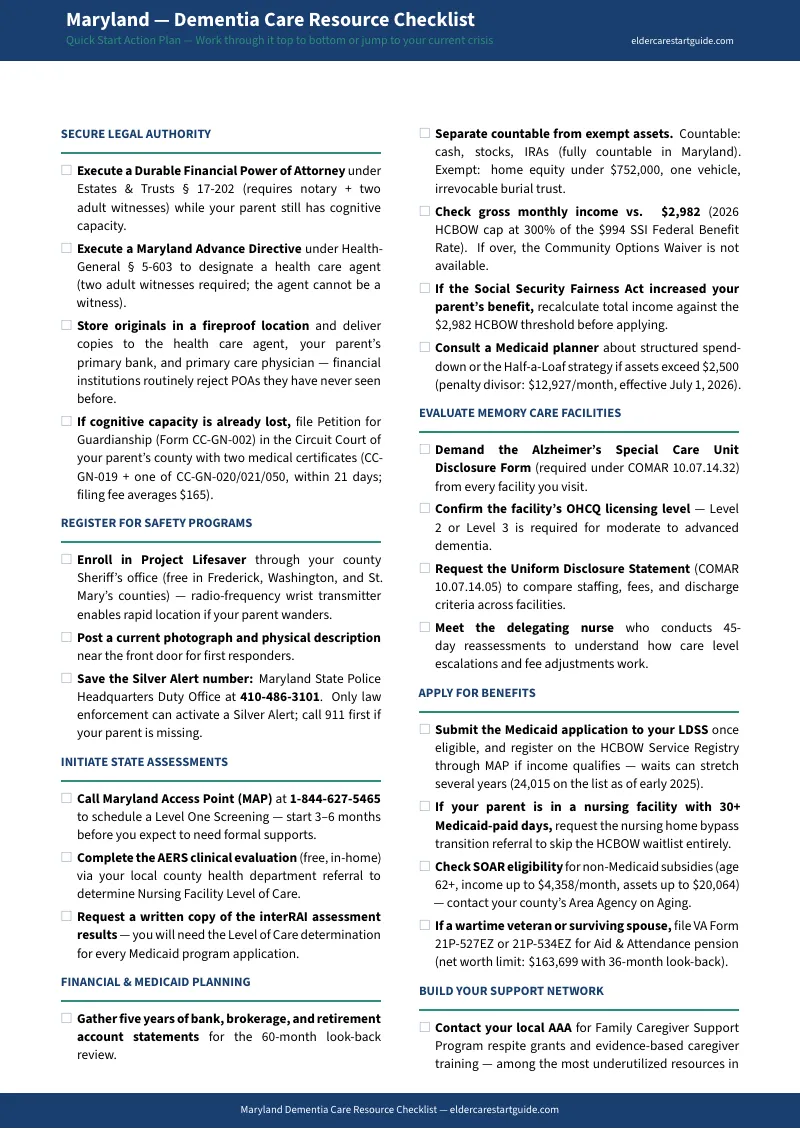
- 25-Item Dementia Care Checklist (free) — the essential actions from legal authority through safety planning, program enrollment, Medicaid application, facility evaluation, and caregiver support on a single printable page
Who This Is For
- Adult children managing a parent's dementia in Maryland who need to understand which state programs exist and how to apply for them in the right order
- Families facing a hospital discharge where the parent can't return home safely and a care placement decision must happen within days
- Caregivers whose parent is burning through savings on private-pay memory care at $9,000 per month and needs to transition to Medicaid-funded options before the money runs out
- Families trying to protect assets from the 60-month look-back period who need to understand Maryland's $12,927 penalty divisor and the Modern Half-a-Loaf strategy
- Anyone whose parent falls in the gap between Medicaid eligibility and private-pay affordability, where the SOAR subsidy could reduce monthly costs
- Out-of-state adult children coordinating care from a distance who need Maryland-specific agency contacts, program names, and application pathways — not generic national caregiving advice
Why Free Resources Leave You Stuck
Maryland Access Point publishes program descriptions and application forms. The Department of Aging maintains SOAR eligibility guidelines. The Office of Health Care Quality posts licensing databases. But these resources are written by compliance officers to meet regulatory obligations, not to help families secure benefits. You can find the Community Options Waiver description on the Department of Health website, but you won't find an explanation of how the registry waitlist works, how to use the 30-day nursing home transition exception to bypass it, or how to structure a personal care agreement that survives a look-back audit.
Free placement services like A Place for Mom will connect you with memory care facilities — the ones that pay them referral commissions, often equivalent to the first month's rent. They won't mention small, high-quality group homes outside their contracting network, won't help you apply for the Community Options Waiver or the SOAR subsidy, and won't explain why demanding the mandatory Special Care Unit Disclosure Form before signing a contract could prevent a forced relocation when your parent's care needs escalate from Level 1 to Level 3.
Elder law attorneys and Medicaid planning specialists provide expert, personalized guidance — at $300 to $500 per hour. For complex estate restructuring, including irrevocable trusts and contested guardianship petitions, professional counsel is essential. But you shouldn't be paying attorney rates to learn what the Community Options Waiver covers, understand the difference between HCBOW and CFC, or organize bank records for the look-back audit. Using this guide to prepare before your first consultation can save thousands in billable hours.
Satisfaction Guarantee
If the guide doesn't help you identify at least one program, eligibility pathway, or protection strategy you weren't already aware of, email us for a full refund. No forms, no waiting period.
Navigate Maryland Dementia Care with Confidence
Download the free checklist to get the essential action items — or get the full toolkit for and receive all the PDFs: the 12-chapter guide, Medicaid financial worksheet, look-back audit organizer, Community Options Waiver roadmap, SOAR subsidy worksheet, memory care facility audit checklist, guardianship filing guide, Silver Alert preparation sheet, VA Aid & Attendance worksheet, and the printable 25-item checklist.