Your Parent's Care Crisis Won't Wait for You to Figure Out Maryland's System
A hospital discharge planner just told you that Mom can't go home alone. Or Dad wandered out of the house at 2 AM again. Or your sibling insists everything is fine while you watch a parent decline from 500 miles away.
Now you're drowning in questions: Does she need home care or assisted living? What's the difference between Level 1, Level 2, and Level 3 licensing? Can you afford $7,173 a month for assisted living — and what happens when the money runs out? Is there a Medicaid program that pays for home care, or does she have to enter a nursing home first?
Maryland's elder care system is built for professionals who already know how it works — not for a terrified adult child making these decisions for the first time at 11 PM on a Tuesday.
The Maryland Care Decision Portfolio — Your Step-by-Step System for Getting This Right
This is not another article telling you to "explore your options." It's a structured decision system built specifically around Maryland's COMAR licensing regulations, Medicaid eligibility rules, and the exact programs available to your family right now.
Where government websites give you raw policy in bureaucratic language, the Care Decision Portfolio gives you a clear sequence: assess → decide → apply → vet → act. Each step tells you exactly what to do, who to call, and what documents to have ready.
What's Inside
- The COMAR Clinical Assessment Matrix — map your parent's actual ADL needs to Maryland's three assisted living licensing levels. Know whether Level 1, Level 2, or Level 3 is right before you tour a facility, so you never face a forced discharge because your parent "aged out" of their license tier.
- The Full Cost Breakdown (2026 Numbers) — home care at $35/hour, assisted living at $7,173/month, nursing homes at $12,927–$14,448/month. Monthly and annual projections at every common hours-per-week scenario, so you can model exactly when home care stops making financial sense.
- Maryland Medicaid Roadmap — the medically needy spend-down formula, the $350/month threshold, the 60-month look-back, and the $162,660 Community Spouse Resource Allowance. Explained in plain English with examples, not legalese.
- Community Options Waiver Strategy — how the HCBOW works, why the waitlist is 24,000+ people, and the critical 30-day nursing home bypass rule that lets your parent skip the years-long queue entirely.
- Community First Choice (CFC) Intake Walkthrough — the no-waitlist Medicaid home support program, eligibility rules, and exactly how to navigate the MAP → supports planner → MyMDTHINK application chain without getting stuck in bureaucratic limbo.
- Facility Vetting Toolkit — where to find nursing home inspection reports, how to read Form CMS-2567 deficiency ratings, what to ask the Long-Term Care Ombudsman, and the questions that reveal staffing problems during a tour.
- The Sibling Alignment Framework — COMAR-based clinical scoring your entire family can see, replacing emotional arguments with objective data about whether home care is still safe or a facility move is clinically required.
- Hospital Discharge Protocol — the exact 48-hour sequence when a parent can't return home after hospitalization, including your legal rights, Medicare SNF coverage rules, and how to push back on pressure to choose a facility today.
- Maryland Access Point (MAP) Call Script — what to say, what to have ready, and the specific screening questions that flag your parent as high-risk for faster intake.
- Estate Recovery Protection Worksheet — which assets pass outside probate, how TEFRA liens work in Maryland, and the specific spousal, minor child, and disabled child protections that prevent the state from forcing a home sale.
Who This Is For
- Adult children deciding whether a parent still safe at home or needs a care facility
- Families facing a hospital discharge with less than 48 hours to choose a placement
- Caregivers managing a parent with dementia whose safety risks are escalating
- Siblings who disagree about what level of care a parent needs — and need objective criteria
- Families approaching Medicaid spend-down who need to understand look-back rules before making a costly mistake
Why Government Websites and "Free" Referral Services Aren't Enough
State portals — Maryland Access Point and MHCC publish raw regulations in dense bureaucratic language. They tell you what programs exist but never give you a step-by-step action sequence for your family's situation. You end up with 47 browser tabs and no clear next step.
"Free" referral directories — A Place for Mom and similar services are paid massive commissions by member facilities. They won't recommend non-member assisted living programs, independent home care agencies, or public waiver programs that would save you thousands per month. When the advisor is free, your family is the product.
Elder-law attorneys — essential for final document execution, but billing $344/hour to explain basic care levels or organize financial statements is an expensive mistake. The Care Decision Portfolio handles the preparation work, turning a $5,000 consultation into a targeted $1,500 review.
Includes Both Tiers
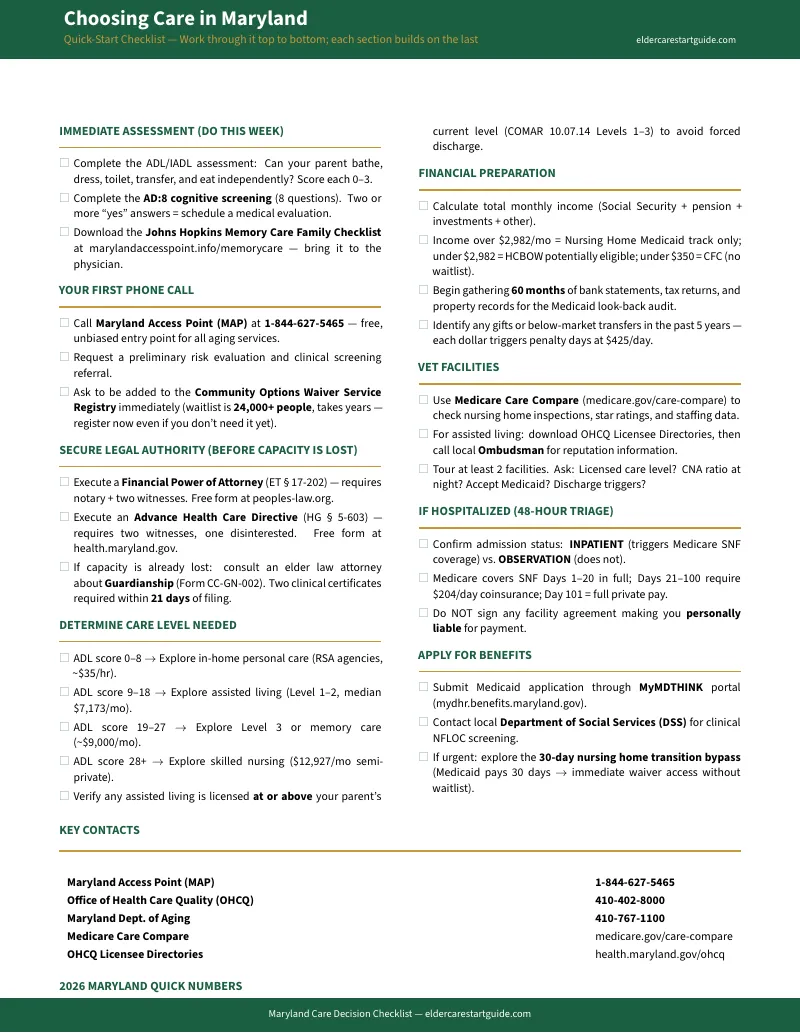
Free Decision Checklist — a one-page action checklist covering the critical first steps when you realize your parent needs more help. Yours immediately, no purchase required.
Full Care Decision Portfolio (10 PDFs) — the complete 13-chapter guide plus 8 standalone printable worksheets: Care Needs Assessment, Care Setting Comparison, Financial Snapshot, Hospital Discharge Crisis Roadmap, Waiver Pathway Guide, Facility Vetting Checklist, Facility Tour Scorecard, and Key Contacts Directory. Print what you need, share with siblings, bring to facility tours.
— less than 15 minutes of an elder-law attorney's billing clock. The portfolio pays for itself the first time it saves you from a single hour of unnecessary professional fees.
Satisfaction Guarantee
If the Care Decision Portfolio doesn't save you time, money, or family arguments within 30 days, email us for a full refund. No forms, no justification required.