
Your Parent's Nursing Home Costs $10,000 a Month. The Asset Limit Is $10,000. Nobody Told You Maine Doesn't Require Miller Trusts Because It Has a Medically Needy Pathway That Eliminates Income Caps Entirely.
The rehab facility just told you Medicare's 100-day skilled nursing window is closing. Your parent can't go home safely. The nursing home wants over $10,000 per month — private pay — and in Southern Maine it's higher. The social worker mentioned "spending down" to qualify for MaineCare, and you started searching online.
You found conflicting information. National Medicaid sites told you about Miller Trusts and $2,000 asset limits. Maine blogs from elder-law firms gave you just enough detail to scare you into scheduling a $400/hour consultation. A Place for Mom showed you assisted living costs but had zero actual MaineCare planning guidance — because their revenue comes from private-pay facility referrals, not from helping you qualify for public benefits.
What nobody told you during the discharge scramble: Maine's system is structurally different from most states. The individual asset limit is $10,000 — not $2,000. Maine doesn't use a hard income cap or Miller Trusts — it uses a Medically Needy Spend-Down pathway where there is no upper income limit. Clinical eligibility runs through Maximus Ascend on a completely separate track from financial eligibility at OFI. And Maine's estate recovery reaches into joint accounts and revocable trusts — but carves out real property held in joint tenancy, which is your strongest home-protection tool.
The MaineCare Asset Protection Navigation System
This isn't a summary of Medicaid rules you could piece together from DHHS pages, Brevy articles, and elder-law firm blogs. The MaineCare Asset Protection Navigation System maps the exact sequence of decisions, screenings, filings, and deadlines your family needs — starting from wherever you are right now — so you don't burn through savings because you did things in the wrong order or assumed national rules apply in Maine.
The critical mistakes most families make: they spend thousands on a Miller Trust attorney because a national website told them Maine requires one (it doesn't). They gift the family camp to a child without understanding the 60-month lookback and its $12,294 monthly divisor. They assume their parent's income disqualifies them, not knowing the Medically Needy pathway has no ceiling. They put the house in a revocable trust thinking that protects it from estate recovery — but in Maine, revocable trusts are explicitly recoverable while joint tenancy real property is explicitly exempt.
The guide puts you in the right order: determine clinical eligibility through Maximus first, understand what OFI will count and exempt, calculate spousal protections, execute the spend-down with approved methods, prepare your application documents, then file with OFI and manage both tracks simultaneously.
What You Get
- 18-Chapter Guide with 5 Appendices — The complete MaineCare Asset Protection Navigation System: clinical eligibility through Maximus (Form 123/122 process, ADL thresholds, 24-hour telephonic vs. 10-day in-person assessments), financial eligibility through OFI ($10,000 asset limit with the $8,000 savings disregard, $2,982 income threshold), the Medically Needy Spend-Down (the $315 MNIL, six-month budget period, documentation requirements), spousal impoverishment protections ($162,660 CSRA, $2,705 MMMNA, the $811.50 shelter standard), the 60-month lookback ($12,294 divisor, why the penalty clock only starts after asset depletion), Section 19 waiver (self-directed care, family-member-as-caregiver models through the five ADRCs), and estate recovery defense (joint tenancy carve-out, mandatory enforcement blocks, hardship and caregiver waivers). Every dollar figure reflects 2026 Maine regulations.
- Eligibility Calculator Worksheets — Run the same countable-versus-exempt test OFI caseworkers use. Plug in your parent's accounts, property, and income — get a clear pass/fail for both individual and couple scenarios, including the Medically Needy deductible formula that eliminates the income cap.
- Spousal Protection Calculator — When one spouse enters a facility and the other stays home: calculate the CSRA split (up to $162,660), the MMMNA income floor ($2,705), and the excess shelter allowance that can push the income transfer to $4,066.50/month. Know exactly what the community spouse keeps.
- 60-Month Lookback Audit — Log every transfer in the five-year window, identify exempt transfers (caregiver child, sibling equity interest, below-threshold gifts), calculate potential penalty months using the $12,294 divisor, and understand the trigger-date trap so you know exactly when the penalty clock actually starts.
- Spend-Down Planner — Track every MaineCare-approved method to reduce countable assets: mortgage payoff, home accessibility modifications, vehicle purchase, irrevocable pre-paid burial contracts up to $18,984.96, debt elimination, and more. Each row includes receipt tracking so OFI caseworkers cannot challenge your expenditures.
- Application Document Checklist — Every document OFI requires for the MaineCare long-term care application: identity, legal authority (POA), 60 months of bank and financial records, income documentation, property deeds, and medical records for the Maximus assessment. Includes the dual-track timeline so you know what happens at OFI versus what happens at Maximus.
- Estate Recovery Defense Worksheet — Assess your family's recovery exposure across probate assets, retained life estates, revocable trusts, joint accounts, and POD/TOD designations. Includes the joint tenancy real property exemption, the mandatory enforcement blocks (surviving spouse, child under 21, disabled child), the 180% FPL hardship waiver, and the 200% FPL caregiver waiver.
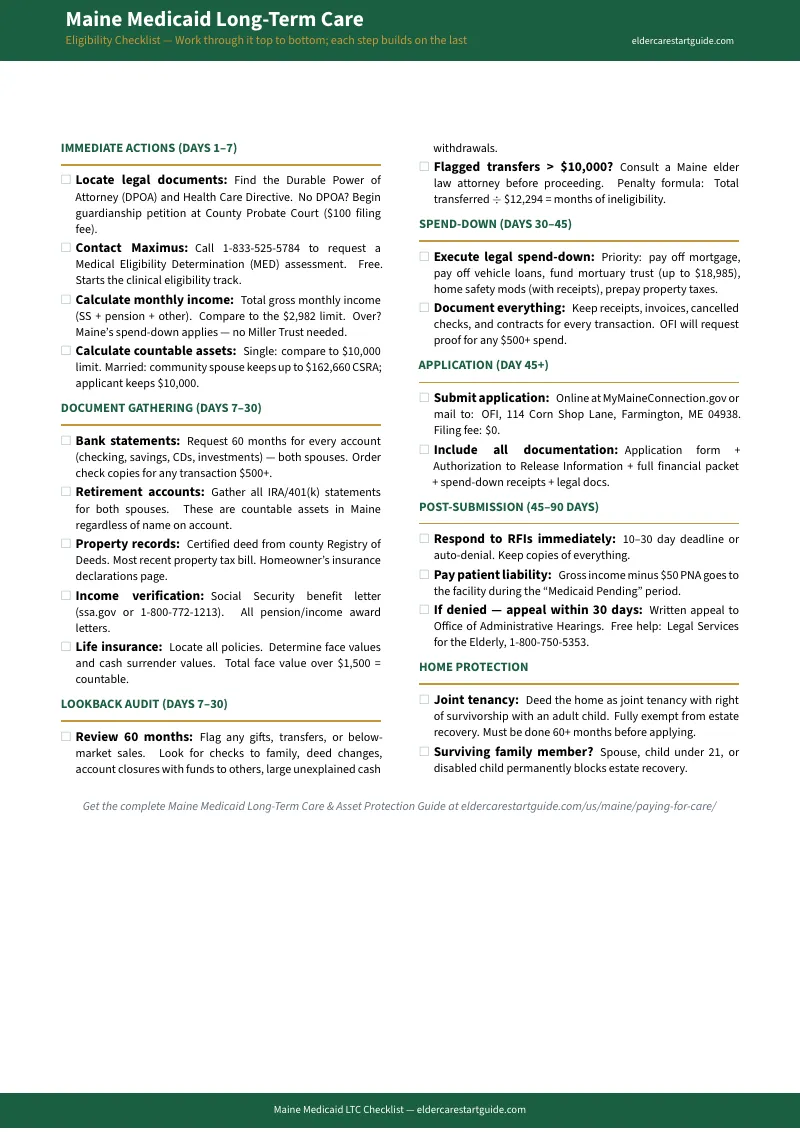
- Quick-Start Checklist (Free Download) — 20 actionable items organized by priority: gather financial records, identify exempt versus countable assets, check clinical eligibility criteria, calculate Medically Needy pathway, prepare application documents, and protect the family home. Know exactly what to do tonight, this week, and this month.
Who This Guide Is For
- Adult children in Maine who need to figure out how to pay for a parent's long-term care — nursing home, assisted living, or home care — without liquidating everything the family has
- Families facing a hospital discharge with no MaineCare application started and a facility demanding over $10,000 per month in private-pay rates
- Caregivers who want to keep a parent at home through the Section 19 waiver or self-directed care models but don't understand the dual-track clinical and financial eligibility process
- Married couples where one spouse needs nursing home care and the other needs to understand exactly how much of their joint savings Maine law protects — the $162,660 CSRA, the $2,705 income floor, and the excess shelter allowance
- Families who made financial transfers in the last five years and need to understand whether those gifts will trigger a MaineCare penalty — and how the penalty clock works differently than they expect
- Proactive planners whose parent has early-stage dementia and want to structure spend-downs and home protections before the lookback window matters
Why Free Information Isn't Getting You Anywhere
The Maine DHHS publishes its eligibility rules. They're accurate. But they're buried in the MaineCare Eligibility Manual — 300 pages of dense regulatory language designed for auditors, not for families in crisis. Caseworkers at OFI are legally prohibited from telling you how to structure your spend-down, how to protect your home, or how to avoid triggering a transfer penalty.
Elder law firms in Portland, Bangor, and Lewiston publish helpful blog posts about MaineCare planning. Each one ends with a call to schedule a $300-$500/hour consultation. Their content is designed to demonstrate complexity, not to give you a complete sequence of steps you can execute yourself.
National Medicaid directories like Brevy and Medicaid Planning Assistance publish Maine-specific numbers — and they're usually current. But they give you rules without sequence, facts without a decision framework. They don't tell you to address clinical eligibility through Maximus before worrying about the financial side at OFI. They don't explain that the penalty clock doesn't start until after asset depletion. They don't help you calculate whether the Medically Needy pathway applies to your parent's situation.
This guide fills the gap between the government manual that gives you facts without order, the law firm that gives you order but only through a $5,000-$12,000 engagement, and the national directory that gives you numbers without the decision framework that makes them actionable.
Satisfaction Guarantee
If this guide doesn't give you a clear, actionable path to paying for your parent's long-term care in Maine, email [email protected]. We read every message.
— Less Than One Hour of a Maine Elder Law Attorney's Time
Maine elder law attorneys charge $300 to $500 per hour. A comprehensive Medicaid crisis planning package runs $5,000 to $12,000. A single procedural mistake — a lookback penalty triggered by a gift to a grandchild, a Miller Trust filed in a state that doesn't require one, a revocable trust that Maine explicitly recovers from — can cost months of full private-pay nursing home bills at $10,000+ per month.
This guide won't replace an attorney when you need one (and it tells you exactly when that is). But it will save you weeks of research, prevent the most expensive mistakes, and ensure you walk into any conversation — with OFI, the nursing facility, your regional ADRC, or an elder law firm — knowing exactly what Maine law requires.
Download the free Quick-Start Checklist to see the 20 most urgent action items. When you're ready for the complete system, the full guide is waiting.