
Your Parent Needs Care. Maine Has Programs That Pay for It — If You Can Navigate the System Before the Window Closes.
The hospital called. Or maybe it wasn't a call — maybe you drove up for the weekend and found the refrigerator empty, the pills unsorted, and your parent pretending nothing was wrong. Either way, you're the one who noticed, and now you're the one trying to figure out what happens next.
You searched "elder care options Maine" and discovered that home care costs roughly $8,485 a month for 44 hours a week. You found out that assisted living averages $8,205 a month statewide but runs higher in Southern Maine. You learned that nursing homes cost even more. And somewhere between the DHHS website and a dense PDF about "Chapter 113 Assisted Housing Licensing Rules," you realized that nobody has explained how these programs actually connect — or what you're supposed to do first.
Meanwhile, your parent's doctor is talking about discharge. A social worker mentioned something called Maximus. Your sibling in Colorado thinks Dad can "just stay home." And you're sitting at the kitchen table at midnight trying to figure out whether MaineCare covers assisted living or only nursing homes, and what happens to the house if it does.
The Maine Care Transition System
This is not a list of eligibility rules you can find scattered across state agency websites. It is the process around the rules — the sequence of decisions, applications, and assessments that determines whether your parent gets safe, funded care or falls through the cracks while you spend weeks on hold with the wrong office.
The guide covers every step from recognizing the warning signs through documenting ADL limitations, surviving the Maximus clinical assessment, qualifying for MaineCare under the 2026 financial thresholds, choosing between home care and facility placement, accessing the Section 19 waiver (the one program with no waitlist), evaluating facilities using actual inspection records, and protecting the family home from estate recovery — organized in the order you will actually need them.
Maine has a structural reality that most families discover too late: the state is the third most expensive in the country for home care, with over 23,500 approved care hours going undelivered every week because there aren't enough workers. That means "staying at home" is not always the safe option families assume it is. And the decision between home care, assisted living, and nursing home placement isn't just about preference — it's about matching your parent's actual functional needs to the care setting and funding source that will sustain them.
What's Inside
- ADL Assessment Framework — Before any state assessor visits your parent, you need to document their real daily functioning. The guide walks you through every Activity of Daily Living and Instrumental Activity of Daily Living the state measures, shows you what to track in a written log, and explains the "acting hosting" phenomenon — how seniors with cognitive decline mask their limitations during formal assessments, and how your documented observations counteract that.
- Care Settings Comparison — The regulatory differences between home care, adult day health, Assisted Living Programs (ALPs), Residential Care Facilities (RCFs), and skilled nursing facilities in Maine. Not just costs — the actual licensing rules, staffing ratios, what each setting can and cannot provide, and the cost crossover point where home care becomes more expensive than facility placement.
- Maximus Clinical Assessment Preparation — Maximus Ascend conducts every Medical Eligibility Determination (MED) in Maine. The guide explains how the referral process works, what the assessor evaluates, the connection between the LTC MEDXX tool and your parent's care level, and the critical 20-day Medicare window — after which a daily co-insurance rate applies and coverage ends entirely at day 100.
- MaineCare Financial Eligibility — The complete 2026 financial picture: individual income limits, the countable asset threshold (Maine is more generous than most states thanks to the $8,000 savings disregard above the standard SSI resource limit), exempt vs. countable assets, home equity protections, spousal protections through the Community Spouse Resource Allowance, medically needy spend-down pathways, and how patient liability is calculated after approval.
- 60-Month Look-Back and Transfer Penalties — How Maine calculates penalty periods for asset transfers, the current transfer penalty divisor, what counts as a disqualifying transfer, the exceptions that apply (including transfers to a spouse, disabled child, or caretaker child), and what this means for gifts or transfers your family may have made years ago without thinking about Medicaid.
- Section 19 Waiver — The No-Waitlist Alternative — Maine's primary home and community-based waiver for nursing-home-eligible seniors. What it covers (personal care assistants, home-delivered meals, assistive technology, home modifications, respite care), how to qualify, and the decisive advantage: while state-funded programs like Section 63 and Section 69 have waitlists exceeding 1,000 people each, Section 19 currently has no waitlist for eligible applicants.
- Estate Recovery Protection — What Maine can recover from your parent's estate after death, the real property exception, when recovery is deferred (surviving spouse, disabled child, sibling with equity interest), and the circumstances under which recovery can be waived.
- Legal Authority — The two paths to making decisions for a parent who can no longer manage their own affairs: Durable Power of Attorney (while your parent still has capacity) and Guardianship/Conservatorship (when they don't). What each requires, what each costs, and why waiting too long forces you into the expensive, slow court process.
- Facility Evaluation System — How to use the DLC Licensed Provider Search to pull actual inspection reports, how to read a Statement of Deficiencies, how to cross-reference complaints through the Long-Term Care Ombudsman Program, and the specific questions to ask during facility tours that go beyond marketing brochures.
- 60-Day Action Plan — A phased timeline from crisis to stable care: immediate legal authority and documentation (Days 1–7), financial assessment (Days 7–21), clinical assessment (Days 14–30), care matching and placement (Days 21–45), and finalization (Days 30–60). Each phase tells you who to call, what to bring, and what to expect.
- Regional Resource Map — Maine's five Area Agencies on Aging (which serve as Aging and Disability Resource Centers), their coverage areas, the services they offer for free (Options Counseling, SHIP Medicare counseling, caregiver respite grants), and how to route to the correct regional office through the statewide toll-free number.
- Professional Advisor Guide — When you need an elder law attorney, when a geriatric care manager is worth the hourly rate, what the hospital social worker can and cannot do for you, and how to arrive at any professional consultation with organized documentation that reduces billable intake time.
Who This Is For
- Adult children whose parent is being discharged from the hospital and needs to understand their care options before the Medicare skilled nursing coverage runs out
- Families trying to decide between keeping a parent at home with hired caregivers versus moving them into assisted living or a nursing home — and who need the real cost comparison, not marketing estimates
- Long-distance coordinators who live out of state and need to evaluate Maine care providers, navigate state programs, and manage applications remotely
- Burned-out caregivers who have been providing hands-on care themselves and need to understand what state-funded relief is actually available — and what has a waitlist
- Anyone who needs to qualify a parent for MaineCare long-term care coverage and wants to understand the financial eligibility rules, look-back period, and spend-down strategies before paying an elder law attorney to explain them
Why Not Free Government Resources?
The Maine DHHS publishes eligibility rules. The Office of Aging and Disability Services maintains program descriptions. Your local Area Agency on Aging offers free counseling appointments — when they can schedule you.
Here is what none of them provide:
- A Maximus assessment preparation strategy showing you how to document your parent's functional limitations in the language the assessor uses — not just "apply and wait for the appointment"
- A care-setting comparison that includes actual staffing ratios, licensing distinctions between ALPs and RCFs, and the cost crossover math — not a brochure
- A MaineCare financial walkthrough with the fillable worksheet that elder law attorneys use during intake — covering the savings disregard, exempt assets, spousal protections, and look-back penalties in plain language
- A facility evaluation framework built on actual DLC inspection reports and Ombudsman complaint data — not referral-network recommendations from sites that only show facilities that pay them
- A 60-day action plan organized by phase so you know what to do this week, next week, and next month — instead of trying to piece together a sequence from 15 different state web pages
Government sites publish regulations. Referral directories recommend paying partners. This guide compiles fragmented state, federal, and regional information into a single sequential process you can follow from crisis to stable care — without paying a professional to walk you through what you can learn yourself.
Your Parent's Next 60 Days
Every week you spend searching is a week your parent goes without care they may already qualify for. Section 19 waiver applications are processed based on clinical eligibility — but only if the application is filed, and only if the Maximus assessment documents your parent's real limitations instead of the "good day" performance they put on for visitors.
Get the guide. Document the needs. File the forms. Start the clock.
Get the Maine Care Decision Guide →
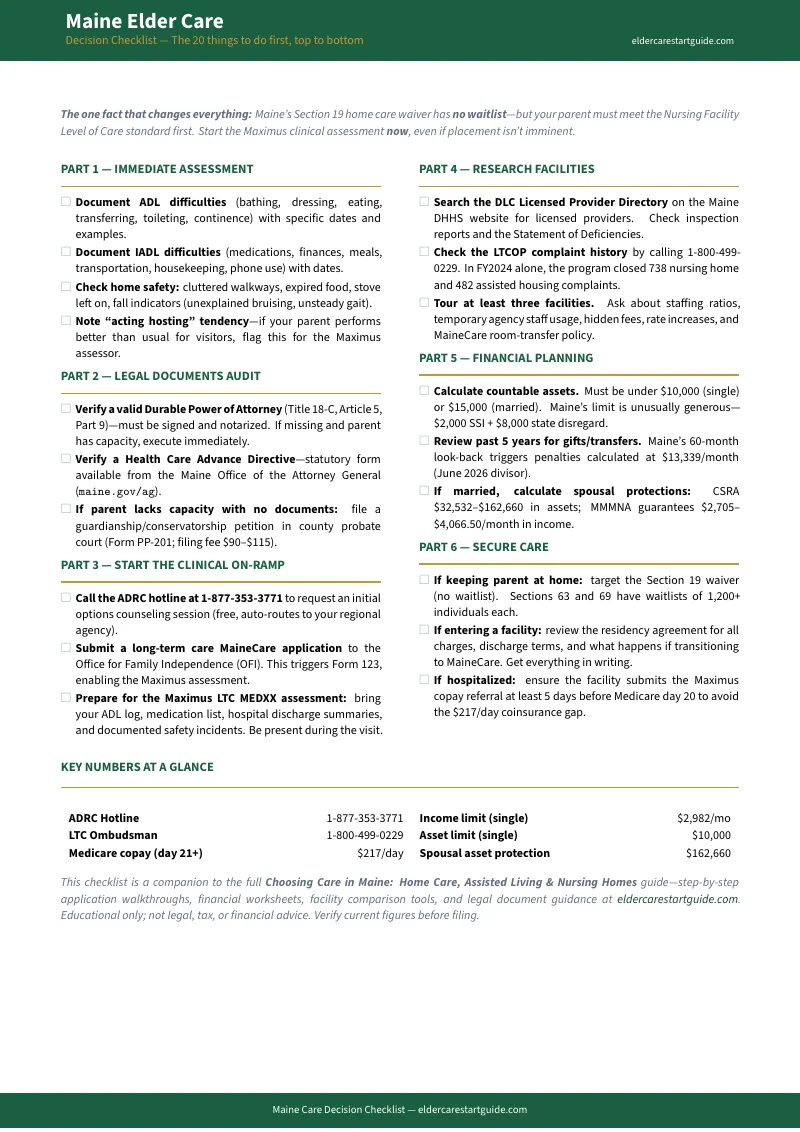
The free checklist gives you the 20-item action list to start immediately. The full guide gives you every chapter plus 7 standalone printable worksheets — the ADL assessment log, financial eligibility worksheet, care settings comparison, 60-day action plan, facility tour questions, ADRC contact card, and look-back audit — so you can document, compare, and act without flipping back to the guide.