
Your Parent Needs Help. Louisiana's Legal System Doesn't Work Like Any Other State.
You searched for "power of attorney for elderly parent" and the top results told you to download a form, get it notarized, and you're done. Then you found out that Louisiana doesn't call it a power of attorney — it's a mandate. And the form you downloaded? Built for common-law states. Louisiana banks will reject it.
Or maybe it's already too late for paperwork. Your parent had a stroke, or the dementia has progressed past the point where they can sign anything. The hospital wants to discharge them, the bank won't let you pay their mortgage, and someone told you that you need to file for "guardianship" — except Louisiana doesn't have guardianship either. It's called interdiction, and it starts with a civil court petition that costs $500 to $1,000 in filing fees alone before you pay for an attorney.
Meanwhile, the Community Choices Waiver has a waiting list, the Medicaid office won't talk to you without legal standing, and your siblings have opinions about everything but won't take responsibility for anything.
The Civil-Law Authority System
This is not a collection of generic legal forms with "Louisiana" stamped on the header. It is a process navigation system built specifically for Louisiana's civil-law framework — the only system in the country rooted in French and Spanish legal traditions instead of English common law.
The guide walks you through every path to legal authority over an aging parent's affairs: executing a durable mandate while your parent still has capacity, setting up healthcare decision-making with integrated HIPAA access, filing for interdiction when capacity is already gone, and navigating the OAAS and Medicaid bureaucracy with the legal standing to actually get answers.
Every chapter uses Louisiana's actual legal terminology — mandates, mandataries, procurations, curators, interdicts — because those are the words the notary, the bank, the hospital, and the court will use. And every step is explained in plain language so you don't need a law degree to follow it.
What's Inside
- Durable Financial Mandate — The Authentic Act — Louisiana requires a mandate authorizing real estate or banking transactions to be executed as an Authentic Act: signed by the principal, a notary, and two witnesses, all present at the same time. The guide walks through the exact execution requirements, the express authority clauses you must individually list under Civil Code Article 2997, and the specific powers most families miss — inter vivos donations for Medicaid asset protection, succession acceptance, self-dealing authorization, and healthcare facility placement.
- Healthcare Power of Attorney + HIPAA Release — How to set up medical decision-making authority as a standalone document with integrated federal HIPAA authorization. Covers what decisions a healthcare agent can and cannot make, how to handle the statutory surrogate consent hierarchy when multiple family members disagree, and the LaPOST (Louisiana Physician Order for Scope of Treatment) form for end-of-life care.
- Interdiction — Complete Court Filing Roadmap — When your parent can no longer sign, interdiction is the only path. The guide covers the full process: drafting the petition, sheriff service, court-appointed defense counsel, independent medical examination, the hearing itself, curator qualification and bonding, undercurator oversight, and the ongoing annual accounting requirements. Includes full vs. limited interdiction, provisional (emergency) interdiction, and the strict restriction preventing temporary curators from admitting a parent to a care facility without a formal hearing.
- Supported Decision-Making Agreement — The least restrictive alternative to interdiction for parents who need help but haven't fully lost capacity. Louisiana's SDMA framework lets your parent keep their legal rights while designating supporters for specific categories of decisions — no court petition, no bond, no annual accountings.
- Medicaid and OAAS Navigation — How to become your parent's Medicaid Authorized Representative using BHSF Form 1-A Appendix C, the Community Choices Waiver eligibility requirements and the priority-based Request for Services Registry waitlist, and the LT-PCS expedited placement trigger that most families don't know about: 32 approved hours of personal care can bypass the standard queue.
- Representative Payee for Federal Benefits — The SSA and VA processes for becoming your parent's designated payee, including the separate application requirements, ongoing reporting obligations, and how Representative Payee status interacts with a financial mandate and Medicaid eligibility.
- Continuing Tutorship for Disabled Adult Children — When a child with developmental or intellectual disabilities reaches 18, parental authority ends by default in Louisiana. The guide covers the continuing tutorship petition that prevents your disabled adult child from falling through the legal cracks — a process distinct from interdiction with different eligibility requirements and filing procedures.
- Mandate Protection Against Legal Challenges — How siblings, estranged family members, or institutions can challenge a mandate's validity — and how to prevent it. Covers the common grounds for contest (incapacity at signing, undue influence, improper execution), the documentation practices that make a mandate challenge-proof, and what to do when sibling disputes escalate to litigation threats.
- Decision Flowchart + Timeline — A visual decision tree showing which legal tool you need based on your parent's current capacity, plus a proactive planning timeline showing when to execute each document to avoid emergency filings.
Plus: 11 Printable Standalone Worksheets
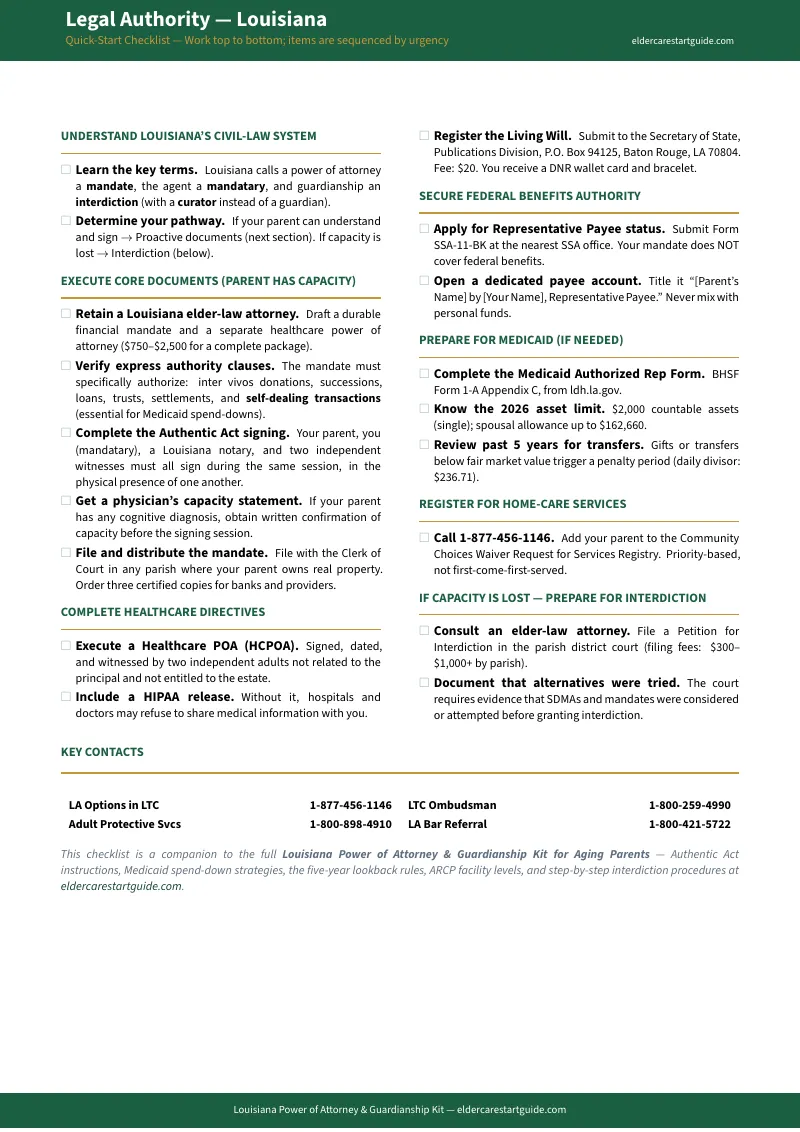
- 20-Item Quick-Start Checklist — Every step from capacity evaluation through mandate execution, OAAS registration, and interdiction preparation on one printable page
- Mandate Execution Checklist — Authentic Act signing session checklist with all six express authority clauses required under Civil Code Article 2997
- Healthcare POA Reference — HCPOA execution requirements, HIPAA release, LaPOST, Living Will registration, and statutory surrogate consent hierarchy
- Interdiction Filing Worksheet — Step-by-step court filing process with cost summary, parish filing fees, and ongoing curator obligations
- Medicaid Eligibility Worksheet — 2026 financial eligibility limits, income and asset worksheets, five-year lookback calculator, and spousal impoverishment protections
- Decision Flowchart — Visual decision tree showing which legal tool you need based on your parent's current capacity level
- Forms and Contacts Directory — Every official form, agency phone number, and parish filing fee on one printable sheet
- Proactive Planning Timeline — 4-to-8-week timeline with cost estimates and post-execution distribution checklist
- Care Level Comparison — Louisiana ARCP Levels 1-4 vs. skilled nursing, plus LT-PCS, CCW, and PACE home-care programs
- Signing Day Preparation — Mandate protection strategies, signing log template, and sibling dispute resolution options
- Home Care Programs Reference — LT-PCS entitlement details, CCW waitlist priority rules, and PACE eligibility
Who This Is For
- Adult children who need to pay a parent's bills, manage their bank accounts, or sell their home in Louisiana — and the bank just rejected the POA form they downloaded from a national website
- Families dealing with a sudden health crisis — stroke, fall, hospitalization — with no legal documents in place and a discharge planner asking who has authority
- Caregivers whose parent has early-stage dementia and can still sign documents during lucid intervals — but only if the paperwork is done right
- Anyone confused by Louisiana's unique legal vocabulary — mandates, procurations, mandataries, curators, interdicts — and paralyzed by the fear of filing the wrong form
- Families navigating the OAAS system, Community Choices Waiver registry, or Medicaid applications who keep being told they don't have standing to act
- Siblings trying to agree on who should have authority before it becomes a court fight
Why Not Free Online Forms?
The Louisiana Judicial Council publishes a handful of self-help resources. Legal aid organizations offer basic information. National legal websites sell template packages.
Here is what none of them provide:
- A mandate template with all the express authority clauses that Civil Code Article 2997 requires — not a generic POA form that gets rejected the moment you try to use it at a Louisiana bank or title company
- The full interdiction filing process with parish-specific filing fees, examiner requirements, and curator bonding — not a one-page overview that tells you to "consult an attorney"
- The OAAS navigation path from ADRC intake through the SUN screening to CCW registry placement — not a link to the Department of Health's website
- Supported Decision-Making as a documented alternative when interdiction is too aggressive — not a footnote in a legal aid brochure
- Mandate protection strategies for families with sibling conflicts — not a warning that "family disputes may arise"
National legal websites don't even support Louisiana for estate planning documents because the civil-law system is too different from what their software was built for. Local elder-law firms do excellent work — at $300 to $500 per hour. This guide bridges the gap between a free form that gets rejected and a $3,000 to $5,000 legal engagement.
Satisfaction Guarantee
If the guide doesn't give you a clearer path forward, email [email protected] and we'll make it right.
— Less Than One Hour of a Louisiana Elder-Law Attorney's Time
An initial consultation with a Louisiana elder-law attorney runs $300 to $500 per hour. A full interdiction proceeding costs $3,000 to $5,000 in court fees, legal representation, medical examinations, and curator bonds. That's the price of not having a valid mandate in place before your parent loses capacity.
This guide won't replace an attorney for contested interdictions or multi-million-dollar estate planning. But for the mandate execution, healthcare directives, Medicaid representation, and OAAS navigation that most Louisiana families need, it covers the ground at a fraction of the cost — and if you do need an attorney, you'll walk in with organized documentation instead of a folder of questions.
Start with the free checklist to see if the approach fits your situation. The full guide goes deeper — every Civil Code article, every filing procedure, every contact number, every deadline.