
Louisiana Uses Civil Law, a Medically Needy Spend-Down Instead of Miller Trusts, and a Waiver Waitlist With 11,000 People — and Most Families Don't Discover Any of This Until They're Already in Crisis
Your parent has dementia. Maybe they wandered out the front door at 3 a.m. and a neighbor brought them back. Maybe a hospital discharge planner just told you they can't go home — and now you have days to find a care placement in a state where skilled nursing runs $5,700 to over $10,000 per month. Maybe you're trying to set up a power of attorney and a lawyer just told you that's not what it's called in Louisiana.
You start searching and immediately hit walls. The Office of Aging and Adult Services publishes waiver fact sheets in policy language. The Community Choices Waiver could fund home care — but the Request for Services Registry has over 11,000 people waiting for 8,053 funded slots. You look up Medicaid income eligibility and find advice about setting up a Miller Trust — except Louisiana isn't a Miller Trust state. Your parent's income exceeds the $2,982 monthly cap, and the only pathway is a Medically Needy Spend-Down that requires a calculation most online guides don't explain. And nobody mentions that Louisiana's civil law system means a "power of attorney" is legally a "Durable Mandate" — and unless it explicitly delegates the Article 2997 powers, your agent can't restructure assets for Medicaid planning even though the document looks valid.
The Louisiana Dementia Care Navigation System
This guide connects every Louisiana-specific program, financial threshold, legal pathway, and application process into a single chronological sequence. It starts with the legal authority decisions you must make while your parent still has cognitive capacity, moves through safety planning and the Silver Alert protocol, and walks you through facility evaluation, the complete Medicaid eligibility process — including the spend-down math, spousal protections, and waiver registration — so you sequence the applications correctly and avoid the gaps that cost families months of coverage or tens of thousands in private-pay care they didn't need to shoulder.
What makes this different from state websites and national caregiving portals: it connects the systems that Louisiana treats as separate bureaucracies. Your parent's LOCET clinical assessment determines whether they meet Nursing Facility Level of Care. That determination controls which waiver services they can access. The CCW waitlist has priority groups that most families never learn about until they've already waited months in the general queue. The Medicaid financial calculation follows a spend-down formula that no Miller Trust guide can help with. And the legal authority pathway — Durable Mandate vs. judicial interdiction — determines whether you can even make the financial and placement decisions the other systems require. These are not independent decisions. The guide shows how each one flows into the next.
What's Inside
- The Complete Guide (12 chapters) — covers Louisiana's dementia care landscape from initial legal authority (Durable Mandates with Article 2997 explicit powers, conditional procurations, full and limited interdiction, curator and undercurator roles) through Silver Alert activation, memory care facility evaluation under the ARCP four-tier licensing system, the R.S. 40:1101 Alzheimer's Special Care Disclosure requirement, Medicaid financial and clinical eligibility, the Medically Needy Spend-Down pathway, spousal impoverishment protections, Community Choices Waiver registration and priority groups, Long-Term Personal Care Services as an immediate entitlement, caregiver support programs, and a 180-day action plan
- Medicaid Spend-Down Worksheet — walks you through the actual formula Louisiana uses: gross income minus the $20 standard disregard minus the $92 MNIES, then offset with allowable medical expense deductions including projected facility or waiver costs. Includes the $2,000 asset limit, the $752,000 home equity cap, exempt vs. countable asset classification, and the 60-month look-back period
- Spousal Protection Calculator — Louisiana's 100% CSRA rule (protecting up to $162,660 for the community spouse), the Minimum Monthly Maintenance Needs Allowance floor ($2,705), the housing expense adjustment ceiling ($4,066.50), and income transfer calculations
- CCW Waitlist Strategy Sheet — the five RFSR priority groups, clinical triggers for expedited Group 5 access (32+ hours of LT-PCS), how to register, and how to leverage LT-PCS as an immediate entitlement while waiting for a waiver slot
- Legal Authority Decision Tree — Durable Mandate vs. judicial interdiction pathways, the Article 2997 powers that must be explicitly delegated, conditional (springing) procuration setup, interdiction filing process, curator bonding, and annual reporting requirements
- Memory Care Facility Assessment Checklist — a printable comparison worksheet for evaluating facilities against ARCP licensing level, R.S. 40:1101 disclosure document review, Pennington-certified dementia training verification, staffing ratios, night and weekend coverage, admission and discharge triggers, and cost breakdowns
- Silver Alert Preparation Sheet — pre-formatted with the fields Louisiana State Police require, the 15-minute facility search protocol, and a home safety assessment for wandering prevention
- 180-Day Action Plan — month-by-month checkbox timeline from diagnosis through legal authority, financial planning, program enrollment, and care placement
- Key Contacts Directory — OAAS, regional Area Agencies on Aging, Councils on Aging, Elderly Protective Services, Medicaid application hotline, and the Long-Term Care Ombudsman on one printable page
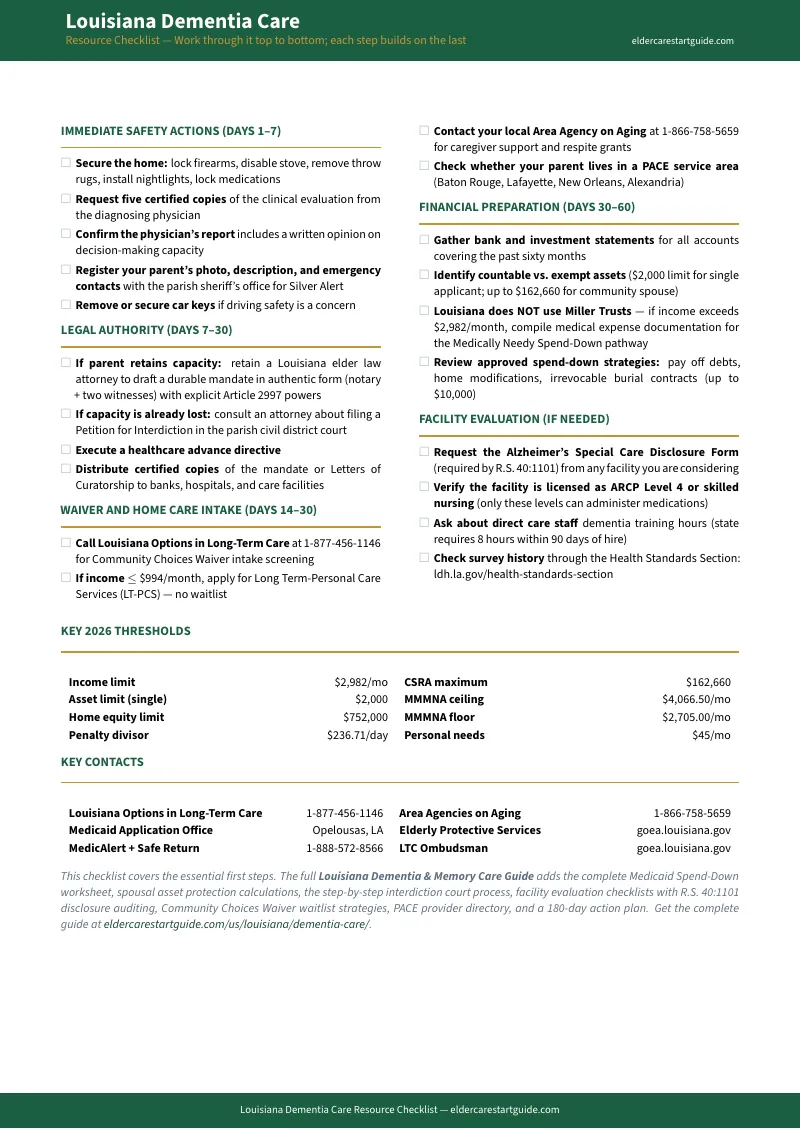
- 20-Item Dementia Care Checklist (free) — the essential actions from legal authority through program enrollment, facility evaluation, and safety planning in a single printable page
Who This Is For
- Adult children managing a parent's dementia in Louisiana who need to understand which state programs exist and how to apply for them in the right order
- Families facing a hospital discharge where the parent can't return home safely and a care placement decision must happen within days
- Caregivers whose parent is burning through savings on private-pay memory care and needs to transition to Medicaid-funded options before the money runs out
- Anyone whose parent earns above the $2,982 income limit and needs to navigate the Medically Needy Spend-Down instead of a Miller Trust
- Families trying to register for the CCW waitlist and access immediate support through LT-PCS while they wait
- Out-of-state adult children encountering Louisiana's civil law vocabulary for the first time — "Durable Mandate" instead of power of attorney, "interdiction" instead of guardianship, "curator" instead of guardian
Why Free Resources Leave You Stuck
The Louisiana Department of Health publishes program descriptions, eligibility manuals, and application forms. But these documents are written by policy administrators to comply with federal reporting requirements, not to help families navigating a crisis. You can find the Community Choices Waiver fact sheet on the LDH website, but you won't find an explanation of how the five priority groups actually work, how to document cognitive deficits so the LOCET assessment captures your parent's real care needs, or why a family that qualifies for LT-PCS today should still register for the CCW immediately.
Free placement services like A Place for Mom will connect you with memory care facilities — the ones that pay them referral commissions. They don't mention that Louisiana has no standalone memory care license, that you should request the R.S. 40:1101 Special Care Disclosure before signing any residency agreement, or that ARCP Level 3 facilities cannot administer medications — a critical distinction for a parent with dementia. And they have no incentive to help you navigate the Medicaid process that would eliminate their commission.
Elder law attorneys in Louisiana provide expert, personalized guidance — at $350 to $500 per hour. For complex interdiction proceedings or asset protection strategies, professional counsel is essential. But you shouldn't be paying attorney rates to learn what a Durable Mandate is, understand why Article 2997 matters, or figure out the difference between the spend-down pathway and a Miller Trust. Using this guide to organize your documentation and understand the system before your first consultation can save thousands in billable hours.
Satisfaction Guarantee
If the guide doesn't help you identify at least one program, eligibility pathway, or protection strategy you weren't already aware of, email us for a full refund. No forms, no waiting period.
Navigate Louisiana Dementia Care with Confidence
Download the free checklist to get the essential action items — or get the full toolkit for and receive all the PDFs: the 12-chapter guide, Medicaid spend-down worksheet, spousal protection calculator, CCW waitlist strategy sheet, legal authority decision tree, facility assessment checklist, Silver Alert preparation sheet, 180-day action plan, key contacts directory, and the printable checklist.