
The Bank Said No. The Hospital Needs a Signature. The SSA Won't Talk to You.
Your parent needs help. They fell, or the dementia is progressing, or the bills are piling up while they sit confused at the kitchen table. You try to step in — and three different institutions tell you that without the right legal documents, you have no authority to act.
The bank won't let you access their accounts. The hospital discharge planner needs a legal representative to sign rehab facility papers. Social Security tells you a state power of attorney doesn't work for federal benefits. And the Medicaid office wants a form you've never heard of before they'll even discuss your parent's eligibility.
You're not a lawyer. You're an adult child trying to keep your parent safe. But in Kentucky, there are five separate legal channels you may need to navigate — and each one has rules that can invalidate your authority with a single missed step.
The Kentucky Legal Authority Process Kit
This is not a set of generic POA forms downloaded from a legal template site. It's a process kit — the step-by-step procedural roadmap that connects each legal document to the institutions that need to accept it and the agencies that need to process it.
Kentucky's legal framework for elder care authority is split across five separate statutory and federal systems. A durable power of attorney under KRS Chapter 457 handles finances. A healthcare surrogate designation under KRS Chapter 311 handles medical decisions. Guardianship and conservatorship under KRS Chapter 387 are the court routes when capacity is gone. The SSA representative payee program is a standalone federal process. And Kentucky Medicaid has its own Authorized Representative form (MAP-14) that unlocks the kynect portal. This kit walks you through all five in the order you'll actually need them.
What's Inside
- Durable Power of Attorney Roadmap (KRS Chapter 457) — The full execution process for a financial POA that Kentucky institutions will actually accept: notary acknowledgment requirements, when to record the document with the county clerk under KRS 382.370 for real property transactions, and the critical "hot powers" under KRS 457.245(1) — trust creation, gifting, beneficiary changes, digital access, and delegation — that must be explicitly listed or they simply don't exist. Includes the Medicaid-specific gifting clause that overrides the standard annual gift tax exclusion cap for asset protection planning.
- The Wiley Witness Audit — After the Kentucky Supreme Court's ruling in Wiley v. Masonic Homes (2024), any financial POA executed between July 14, 2018 and July 15, 2020 without two disinterested witnesses may be legally invalid — even if it was notarized. The guide walks you through how to check whether your parent's existing POA falls in this gap, what to do if it does, and how to re-execute properly under the current statute.
- Healthcare Surrogate Designation Guide (KRS Chapter 311) — How to set up medical decision-making authority through Kentucky's Living Will Directive Act, including the two signing options (notary OR two witnesses), the strict witness conflict-of-interest exclusions (blood relatives, heirs, attending physicians, facility employees), and the critical arbitration carve-out after Lexington Alzheimer's v. Norris (2025) — your surrogate cannot bind your parent to a nursing home's arbitration agreement.
- Guardianship & Conservatorship Court Guide (KRS Chapter 387) — The full District Court process for when your parent can no longer sign: filing AOC Forms 740 and 747, the Guardian Ad Litem appointment, the interdisciplinary evaluation team (physician + psychologist + social worker), the six-person jury trial requirement under KRS 387.570, full vs. limited guardianship, the 60-day asset inventory, biennial financial accountings, and the fiduciary bonding scale from $150 for small estates through progressive rates for larger ones.
- Emergency Guardianship Procedure — When your parent faces immediate danger to their health, safety, or property and you can't wait for the standard court timeline. Covers the specific criteria under KRS 387.740, how to file AOC Form 745 alongside your main petition, securing the notarized physician's letter, and the one-week hearing timeline.
- SSA Representative Payee Application — The separate federal process for managing your parent's Social Security and SSI benefits. A state power of attorney will not work — the SSA has its own application, background check, and annual reporting requirements. Step-by-step instructions for applying at your local Kentucky Social Security office or by phone.
- Medicaid & HCB Waiver Navigation — How to become your parent's Authorized Representative using the MAP-14 form, navigate the kynect portal for eligibility applications, understand the HCB Waiver income cap ($2,982/month in 2026 — and what happens when Social Security COLA pushes income over by a single dollar), and the chronological waitlist reality — over 19,000 Kentuckians waiting across three waiver programs, with slots allocated strictly by application date.
- Capacity Assessment & Lucid Interval Documentation — How to evaluate whether your parent retains the cognitive capacity to sign voluntary planning documents. Covers the legal standard under Kentucky law (understanding the nature and consequences of the document at the moment of signing), practical assessment approaches, getting a supportive physician's statement, and documentation practices that protect the document from future challenges.
- Sibling Dispute Framework — When family members disagree about who should have authority. Covers the default co-agent independence rule under KRS 457.110 (co-agents can act separately unless the POA explicitly requires joint action — a frequent source of conflict), POA revocation under KRS 457.100, recording the revocation with the county clerk, and when a court-supervised guardianship is the only path to break a family deadlock.
Plus: Printable Worksheets and Checklists
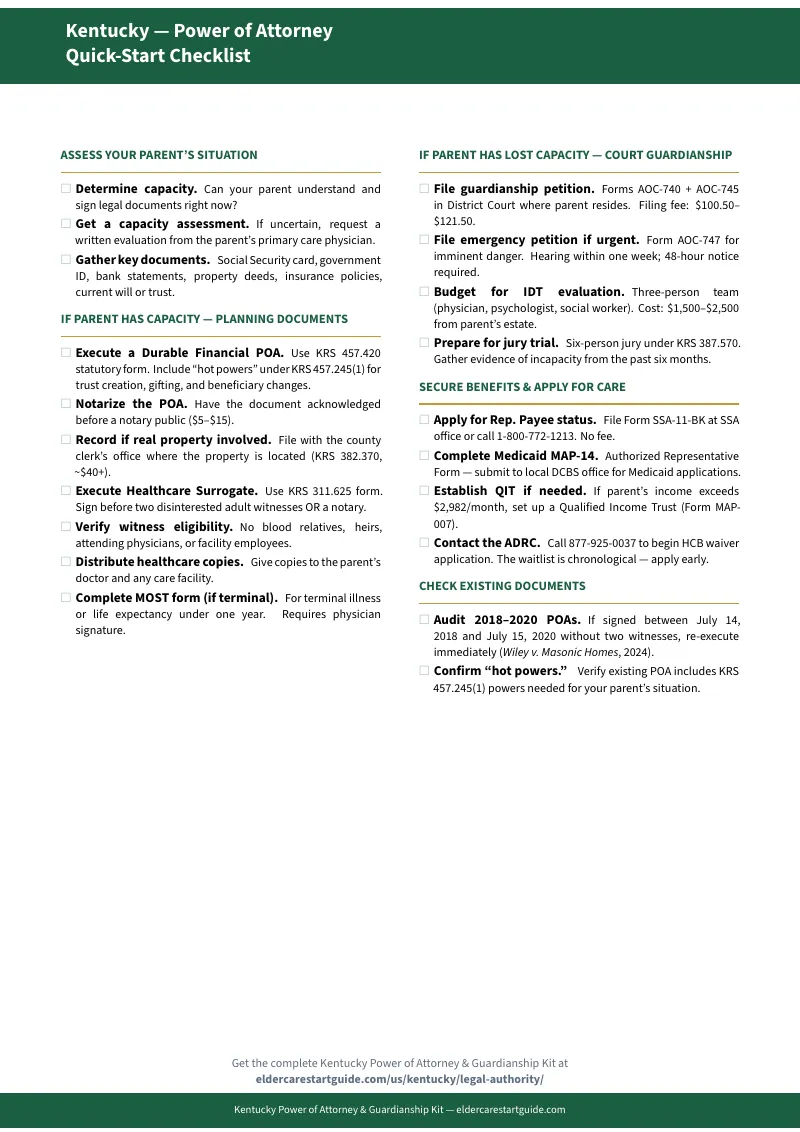
- 20-Item Legal Authority Checklist — Every step from initial capacity evaluation through document execution, notarization, institutional acceptance, and government agency applications — in the order you'll actually do them
- Parent Capacity Assessment Sheet — Screening questions to help determine whether your parent can still sign voluntary documents or whether the guardianship path is necessary
- ADRC Intake Readiness Log — The information Kentucky's Area Agencies on Aging need before they'll begin processing an HCB Waiver application
- 2026 Medicaid Financial Pre-Screen — Quick calculator to check whether your parent's income exceeds the $2,982 cap and needs a Qualified Income Trust
- County Clerk Recording Checklist — County-level filing requirements and fees for registering POA documents in Kentucky's land records
- Document Validity Audit — For families with existing planning documents that may fall in the 2018–2020 Wiley gap or have other execution defects
Who This Is For
- Adult children who just discovered they can't pay their parent's bills, access their bank account, or sign facility admission papers because they don't have legal authority
- Families whose parent is being discharged from the hospital and needs someone to sign rehab or skilled nursing facility admission agreements
- Caregivers whose parent has early-stage dementia — the window to execute voluntary documents is closing and every week matters
- Anyone whose parent signed a power of attorney between July 2018 and July 2020 and needs to check whether it survived the Wiley ruling
- Families navigating Kentucky's AAAIL or ADRC system who need formal legal standing before the state will discuss their parent's eligibility
- Siblings in conflict over who should manage a parent's care and finances — needing either clearer POA terms or court-supervised guardianship
Why Free Templates Don't Work for Kentucky
National legal template sites give you a fillable form and a "sign here" arrow. They don't tell you that Kentucky's "hot powers" rule means your POA won't let you create a trust, make gifts, or manage digital assets unless those powers are individually listed. They don't mention the Wiley witness trap. They don't explain that signing a nursing home arbitration agreement is not a healthcare decision after Norris. And they have no idea that the SSA ignores your state POA entirely for federal benefits.
Elder law attorneys charge $200–$500 per hour, with flat-rate estate planning packages running $1,500–$6,000. A contested guardianship can cost $3,000–$7,000+. This kit covers the same Kentucky-specific legal framework those attorneys explain in billable consultations — organized in the order you'll actually need it, written in plain language, and available the same day you realize you need it.
100% Satisfaction Guarantee
If the kit doesn't give you the legal authority process you need, email us for a full refund. No forms to fill out, no questions asked.
— A Fraction of One Attorney Consultation Hour
Download the complete kit now and get the legal authority you need to protect your parent — before the next institutional barrier stops you cold.
Included free: The Kentucky — Power of Attorney Quick-Start Checklist comes with every purchase. Want to start with just the checklist? Download it free below.