
Your parent is being discharged tomorrow. The hospital says they're ready. They can barely stand.
The discharge planner tells you the bed is needed. Your parent is still confused, still unsteady, still unable to get from the bed to the bathroom alone. You ask if this is safe. The answer you get is that the clinical team has signed off.
What no one at the hospital explained: you have a federal right to appeal — and in Kentucky, you have until the calendar day the discharge is scheduled to file with Acentra Health, the state's independent medical review organization, and legally halt the discharge. But that deadline only matters if you know it exists.
And the discharge isn't the only trap. If the hospital classified your parent under observation status instead of as an inpatient, those days in the hospital bed don't count toward Medicare's three-midnight rule — and rehab at a skilled nursing facility may cost the family $5,000 to $15,000 a month out of pocket. Then there are Kentucky's filial responsibility statutes, which families discover at 2 AM and read as a threat that they'll be jailed for a parent's nursing home bills.
Every one of these problems has a documented regulatory pathway through it. The pathways just aren't written anywhere a panicked family can actually find and follow them — until now.
The Kentucky Discharge Navigator System
This isn't a pamphlet of general caregiving tips or a directory of phone numbers. The Hospital-to-Home in Kentucky Guide is a chronological execution system — 14 chapters organized in the order the crises actually hit, starting with the hour your parent is admitted and running through Medicaid eligibility, skilled nursing contracts, and the HCB Waiver waiting list. Every chapter translates dense Kentucky administrative regulation into a step-by-step decision script that an adult child can follow at 10 PM on a weeknight.
What makes this structurally different from free resources: state websites explain the rules but don't give you a strategy. Elder-law attorneys give you strategy but charge $300 to $500 an hour. Senior placement agencies are free to families — because they earn commission from private-pay facilities and never cover Medicaid pathways, the HCB Waiver, or state-funded home care. This guide covers all of it, with no financial conflict and no billable clock.
What's Inside
- The Acentra Health Appeal Playbook — the exact timeline, phone script, and documentation checklist for filing an emergency QIO appeal to halt an unsafe discharge. Includes the Immediate Advocacy Discharge Assistance (IADA) process for confusing discharge plans that don't rise to a formal appeal.
- The Observation Status Audit — how to determine if your parent was classified as outpatient, what the MOON notice means, how to advocate for inpatient reclassification with the attending physician and utilization review committee, and what appeal rights exist under Bagnall v. Cochran when the hospital changes an inpatient admission to observation.
- The SNF Admission Contract Decoder — which clauses in the admissions packet create personal financial liability for adult children, how federal law prohibits personal guarantees, and exactly how to sign as a representative without exposing your own savings. Includes the PASRR screening process and CMS Care Compare facility evaluation.
- The Medicaid Financial Qualification Workbook — asset limits ($2,000 single applicant), income cap ($2,982 gross monthly), the Community Spouse Resource Allowance, the five-year look-back, and Kentucky's penalty divisor for transfer violations. Step-by-step worksheets for calculating eligibility.
- The QIT/Miller Trust Setup Kit — how to establish a Qualifying Income Trust using Kentucky's official MAP-007 form when your parent's income exceeds the Medicaid cap. Covers opening the dedicated bank account, calculating monthly deposits, and managing the trust — the same procedure elder-law attorneys charge $1,500 to $3,000 to handle.
- The Medicaid-Pending Survival Protocol — what legal protections prevent nursing home eviction during the 45-to-90-day application processing period, how to calculate and pay the estimated Patient Liability, and why you should never sign a personal guaranty agreement or pay private-pay rates out of pocket during the pending phase.
- The HCB Waiver Intake Strategy — how Kentucky's Home and Community Based Waiver funds in-home care for seniors at nursing-facility level of care, how "Emergency" prioritization bypasses the chronological waiting list, and how to work with your regional AAAIL/ADRC to strengthen the functional assessment. Includes the complete 15-region AAAIL directory with direct phone numbers.
- The Filial Responsibility Briefing — what KRS 405.080 and KRS 530.050 actually say, why nursing homes almost never enforce them, how federal Medicaid law blocks states from counting a child's income, and what the practical risk looks like — so the statutes stop being a source of panic and start being background context.
- The Participant Directed Services (PDS) Enrollment Guide — how Kentucky's Medicaid waiver lets an adult child be legally hired and paid as their parent's caregiver, providing financial stability when you've already reduced your work hours.
- The Home Setup and DME Coordination Checklist — room-by-room safety preparation, Medicare Part B equipment coverage, Certificate of Medical Necessity process, and how to coordinate home health referrals before discharge so a nurse visits within 48 hours.
- The 907 KAR 1:022 Level of Care Worksheet — a simplified version of the nursing-facility level of care assessment used by Kentucky Medicaid evaluators, so you can document your parent's deficits and build the clinical paper trail that determines whether they qualify for Medicaid long-term care or the HCB Waiver.
Who This Is For
- The adult child at the hospital right now — your parent is being discharged tomorrow and it doesn't feel safe. You need the Acentra Health appeal number, the filing deadline, and the exact steps to legally pause the discharge.
- The family facing an observation status surprise — the hospital says the stay was outpatient. The SNF bill just became your problem. You need to know how to challenge the classification and what financial alternatives exist.
- The family navigating a nursing home admission — the admissions coordinator is asking you to sign a contract. You need to know which clauses to strike, what a "responsible party" signature actually means, and what your parent's Medicaid eligibility looks like.
- The adult child who found KRS 405.080 at 2 AM — you're terrified that Kentucky's filial responsibility law means you'll be jailed for your parent's care costs. You need facts, not more anxiety.
- The family that wants to keep a parent at home — your parent meets nursing-facility criteria but wants to stay home. You need to navigate the HCB Waiver waiting list, the emergency prioritization rules, and the financial eligibility test.
- The adult child who can't afford an elder-law attorney — a full Medicaid planning retainer starts at $3,000. You need to organize records, understand the thresholds, and complete the QIT/Miller Trust paperwork yourself.
Why Free Resources Don't Solve This
Kentucky's Cabinet for Health and Family Services publishes the regulations. CMS publishes the Medicare rules. The 15 regional AAAILs each run their own intake process. Acentra Health has its own portal. The result: dozens of PDFs, form numbers, and phone trees across five different agencies — with no single document that shows how they connect chronologically.
Free senior placement services (A Place for Mom, local referral agencies) market themselves as "100% free to families." They are — because facilities pay them the first month's rent as commission. That business model means they never help with Medicaid beds, the HCB Waiver, or state-funded home care. Those pathways don't generate commissions.
This guide exists in the space between the $0 phone directory and the $400-an-hour attorney. It's the chronological execution plan — the step-by-step regulatory navigation system — that every other resource assumes someone else already gave you.
The Guarantee
If the guide doesn't give you a clearer path through your parent's transition, email [email protected] and we'll make it right.
Start Tonight
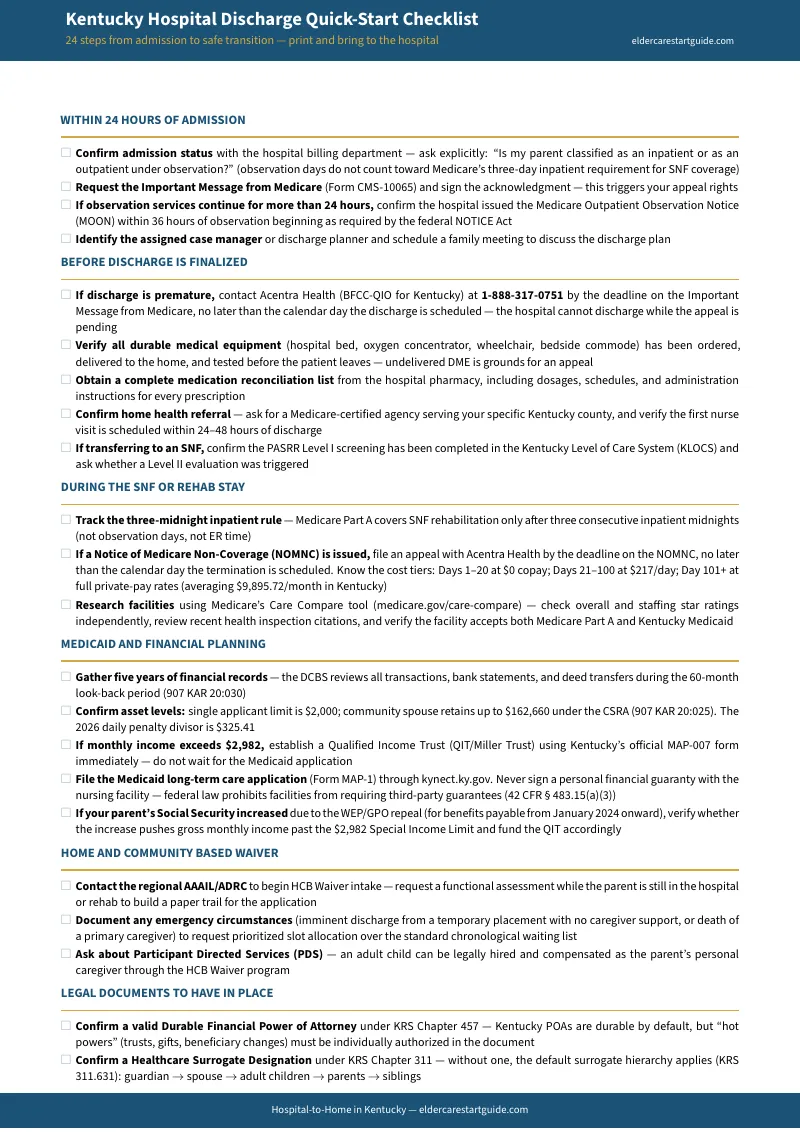
Download the free Kentucky Hospital Discharge Checklist — the one-page triage reference with every critical deadline, phone number, and action item. When you're ready for the full system — 14 chapters of Kentucky-specific strategy covering discharge rights, Medicaid eligibility, asset protection, and long-term care pathways — get the complete guide.