
Your parent has dementia and Kentucky's system feels designed to lose your application before it helps your family.
The DCBS caseworker put your mother on standard Medicaid instead of the long-term care category — so the HCB waiver application has been sitting in the wrong queue for six weeks. Your father was found two miles from home at midnight and the police keep asking about a "Silver Alert" that doesn't exist in Kentucky. The MAP-10 form your doctor submitted last month apparently timed out because nobody told you there was a deadline. And you just learned that the birthday checks you've been sending to your grandkids for the last four years each add days to a Medicaid penalty period you didn't know existed.
You are not losing your mind. You are navigating a system that scatters its own rules across Kynect, CHFS, DAIL, fifteen Area Agency websites, and three different sets of administrative regulations — none of which will tell you what to do next.
The rules exist. The roadmap doesn't.
Kentucky's agencies publish the eligibility thresholds, the waiver guidelines, the licensing codes. But they publish them as dense administrative regulations written for caseworkers and attorneys, fragmented across disconnected portals with no strategic instructions. They'll tell you the countable asset limit is $2,000. They won't tell you which spend-down purchases are Medicaid-compliant and which trigger a penalty calculated at $325.41 per day. They'll tell you the HCB waiver exists. They won't warn you that if you don't select a case management agency within 60 days of approval, the state automatically terminates your eligibility and you start over from zero.
That gap — between raw rules and a family's step-by-step action plan — is where families lose months they don't have.
Introducing the Kentucky Dementia Care Navigator
This is a complete, self-directed workbook — not another article, not a facility directory, not a lead-generation funnel for a placement service collecting commissions. It's the exact worksheets, decision templates, and sequential checklists a Kentucky family uses to secure legal authority, navigate the HCB waiver without getting lost in the intake loop, protect assets from the 60-month look-back, and vet memory care facilities by their actual OIG license level — without spending thousands on professional retainers you may not need.
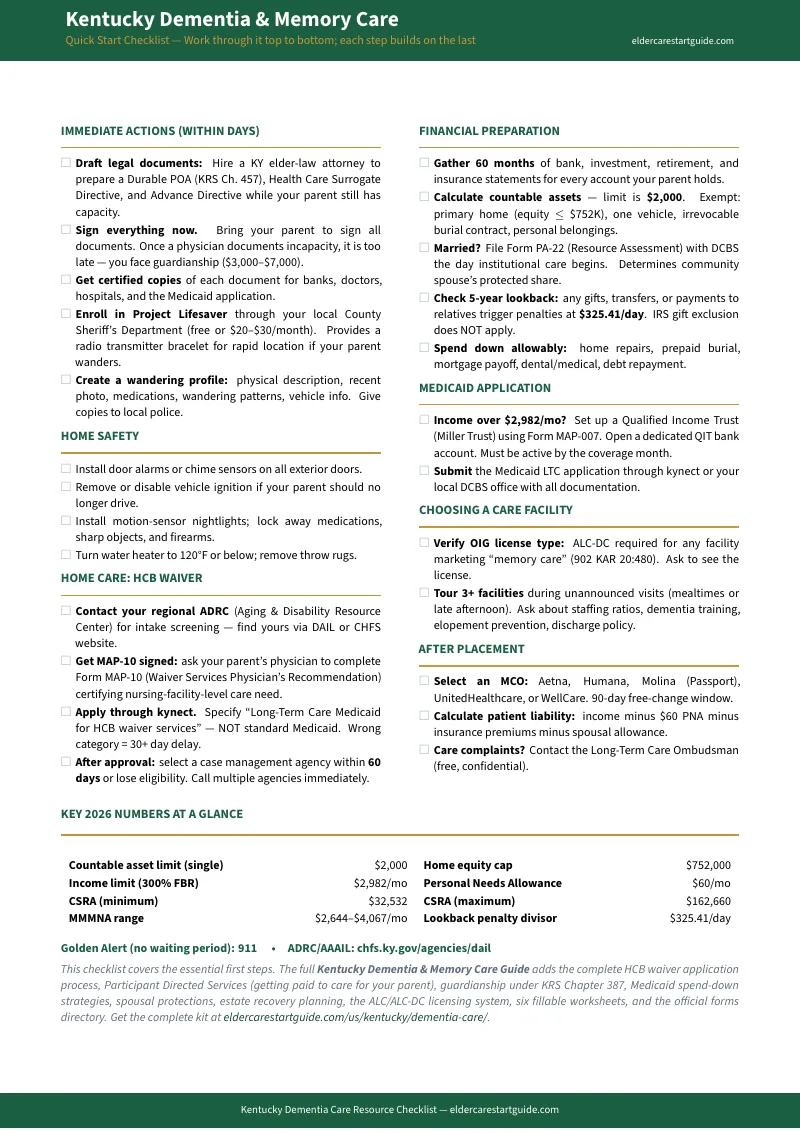
Eight files — a 57-page guide plus six standalone printable worksheets and a one-page resource checklist — organized around the precise moments that force a family to act.
What's inside — each file solves a specific problem
The Complete Guide (57 pages)
Fourteen chapters covering every stage from the day of diagnosis through estate recovery — legal planning while your parent still has capacity, Golden Alert emergency protocols, the three-tier ALC licensing system, the full HCB waiver application, Participant Directed Services, Medicaid eligibility and spend-down strategy, Qualified Income Trusts, MCO enrollment and nursing facility placement, guardianship under KRS Chapter 387, caregiver support programs, the long-term care ombudsman, estate recovery rules, official forms, and a key contacts directory.
Wandering Profile for Law Enforcement
The problem: Sixty percent of people with dementia wander at least once, and Kentucky law enforcement needs specific details the moment they arrive — not when you're panicking at 2 a.m. trying to remember medications.
A pre-formatted handout with your parent's diagnosis, medications, physical description, vehicle details, and known wandering destinations. Fill it in today, keep it on the fridge, hand it to the officer who responds to the Golden Alert.
60-Month Financial Record Tracker
The problem: Missing a single bank statement over a five-year window can delay or deny a Medicaid application outright.
A fillable month-by-month log for every active and closed account your parent held over the past 60 months — the exact documentation Kentucky caseworkers audit during the look-back review.
PA-22 Asset Inventory Worksheet
The problem: You need to know what's countable, what's exempt, and what the gap is before you can plan a spend-down — but the state's own resource assessment form tells you nothing about strategy.
A structured asset inventory organized by exemption category — primary home, one vehicle, prepaid burial, personal effects — with the current Kentucky limits pre-filled so you can see exactly where your parent stands against the $2,000 threshold.
Spend-Down Planner
The problem: Families burn through savings on random purchases, then learn half of them trigger penalty days at $325.41 each.
A fillable ledger of Medicaid-compliant spend-down categories — home modifications, medical equipment, prepaid irrevocable burial contracts, outstanding debts — so every dollar moves your parent closer to eligibility without creating a new penalty.
Care Setting Comparison
The problem: A memory care tour is a sales pitch, and you can't tell a safe ALC-DC unit from a nicely renovated building that doesn't actually hold the right license.
A structured comparison sheet covering OIG license level, staff-to-resident ratios, night-shift staffing, secured perimeter details, medication protocols, and discharge policies — designed for side-by-side evaluation of at least three facilities.
Monthly Patient Liability Calculator
The problem: After Medicaid approval, you still owe a monthly "Patient Liability" to the care facility — and nobody explains how the number is calculated or what deductions you're allowed to keep.
A step-by-step calculator that walks you through the exact formula: gross income minus the $60 Personal Needs Allowance, minus health insurance premiums, minus any Minimum Monthly Maintenance Needs Allowance for a community spouse — so you know the real out-of-pocket number before you sign the facility agreement.
Who this is for
- The adult child who just got a call that Mom was found wandering and needs an emergency safety plan tonight
- The primary caregiver who has hit the wall and needs to know whether PDS, the HCB waiver, or residential placement is the right next step
- The proactive planner acting now — while a parent still has the cognitive capacity to sign a durable POA and healthcare surrogate designation
- The family coordinator who needs objective, third-party benchmarks to align siblings on a care plan and a spend-down strategy
Why not just use the free tools?
Free placement services like A Place for Mom? When the service is free, you're not the client — the facility is. These directories earn commissions from private-pay assisted living chains, so they're structurally incentivized to steer you toward expensive residential options. They won't walk you through the HCB waiver, explain Participant Directed Services, or help you build a Medicaid-compliant spend-down plan — because those programs divert families away from their paying partners. This guide accepts zero commissions and lays out every option — public and private.
State websites? Kynect, CHFS, DAIL, and the Area Agency portals have the rules scattered across disconnected pages written in dense regulatory language. You'd be assembling a MAP-10 form, a waiver application, and a facility license search from four different portals — with no instructions on sequencing, no deadline warnings, and no worksheets.
An elder law attorney? Essential for complex estates. But at $195–$500 an hour in Kentucky, their clock shouldn't be burned organizing your parent's financial records or explaining what the HCB waiver is. Use this workbook as a pre-consultation kit: walk in with your asset inventory, 60-month bank records, and spend-down plan already organized, and compress a multi-hour engagement into one efficient session.
A fair, simple guarantee
If this guide doesn't give you a clearer, more confident path forward than the free tools you've been fighting with, reply to your receipt within 30 days and we'll refund you in full. No forms, no friction. You're already dealing with enough of both.
Start where you are
Not ready to buy? Start with the free Kentucky Dementia Care Resource Checklist — a one-page map of the state programs, waivers, and agencies you'll need. When you're ready to move from "what exists" to "here's exactly how I navigate it," the full Kentucky Dementia Care Navigator is — less than a single hour of an elder law attorney's time, and yours to keep.
Get the guide today and stop losing months to a system that was never built to help you find your way through it.