
Your parent can't live alone anymore. Now what?
The hospital says your parent needs a "safe discharge plan" by Friday. A social worker hands you a list of assisted living communities. A neighbor recommends A Place for Mom. Your sister thinks home care would be fine. Your brother thinks Mom is fine the way she is.
Meanwhile, you're the one sitting in the hospital hallway googling "assisted living Kentucky" and getting 47 ads from facilities that want to tour you through their lobby but won't explain what happens when the money runs out.
Here's the problem: Kentucky runs elder care through two separate gates — a clinical gate (does your parent qualify for this level of care?) and a financial gate (who pays for it?) — and neither system explains the other. The state publishes regulations under KAR/KRS codes. Free placement services recommend only the facilities that pay them commissions. Elder law attorneys charge $300 an hour to explain thresholds you could look up yourself, if you knew where to look.
The Kentucky Care Transition Roadmap
This isn't a pamphlet that tells you "consider your options." It's the step-by-step decision system that walks you through Kentucky's entire elder care process in the order families actually face it — from recognizing decline, through comparing every licensed care setting with real 2026 costs, to qualifying for state-funded supports and protecting family assets.
It translates the regulatory codes, consolidates the fragmented state portals, and gives you the exact checklists, phone scripts, and financial worksheets that no free referral service or government website provides in one place.
What's inside
Care-level assessment framework
Score your parent across the same six ADLs that Kentucky assessors use under 907 KAR 1:022. The assessment log mirrors the state's functional criteria, so when you call the ADRC for a screening, you already know whether your parent meets the nursing facility level of care — and you can document it accurately instead of underreporting decline.
Every Kentucky care setting compared
Social-model ALCs that can only remind your parent to take pills. ALC-BH facilities where nurses administer medication. ALC-DC secured memory care units for wandering and cognitive decline. Personal Care Homes with 24/7 nursing oversight. Skilled nursing facilities for complex medical needs. Home care through agencies or the Participant Directed Services model where a family member gets paid to provide care. Each setting's legal limits, 2026 median costs, and the specific circumstances where it fits — and where it breaks down.
Medicaid eligibility and the HCB waiver
The 2026 income cap ($2,982/month), the asset limit ($2,000), how to set up a Qualified Income Trust when income is too high, the 60-month lookback rule and the $9,895.72 penalty divisor for unauthorized transfers, and the exact process for applying to the 1915(c) Home and Community Based waiver through your local ADRC — including the waiting list reality and when slots actually open.
Facility inspection decoder
A step-by-step worksheet for pulling and reading OIG inspection reports from the CHFS portal. It explains what the survey codes mean (C for Complaint, FR for Facility-Reported, R for Recertification), how to identify patterns of repeat violations, and what to ask facility administrators about their plan of correction — before you sign anything.
Asset protection strategies
The countable vs. exempt asset ledger that shows exactly what Kentucky Medicaid counts and what it doesn't — the primary residence (up to $752,000 equity), one vehicle, prepaid burial plans, and household goods. The spend-down worksheet calculates how much your family needs to convert before applying. The caregiver agreement template ensures payments to family members are documented as compensation, not gifts that trigger penalty periods.
Transition toolkit
Phone scripts for the ADRC intake call. A pre-admission medical exam checklist for assisted living under KRS 216.765(1). A Resident Personal Needs Allowance auditor for the $60/month trust fund that nursing facilities manage. A sibling alignment framework built on objective clinical observations instead of arguments about whether Mom is "really that bad."
Who this is for
- The crisis caregiver — your parent was hospitalized and you have days to decide where they go next. You need the fastest path through Kentucky's system without making irreversible mistakes.
- The planning-ahead family — decline is gradual, and you have time to compare every care setting, explore the HCB waiver, and structure assets before a crisis forces your hand.
- The long-distance advocate — you live in another city or state and need a clear framework for auditing your parent's safety, managing Kentucky-specific agencies, and coordinating with local care providers remotely.
- The sibling mediator — you're doing the caregiving work but your siblings disagree about what's needed. You need an objective, evidence-based decision tool that turns family arguments into data-driven decisions.
Why not use the free tools?
Free placement services like A Place for Mom and Senior Home Transitions earn commissions from the facilities they recommend — up to 100% of the first month's rent. They'll tour you through their contracted communities but won't mention the Medicaid-funded nursing homes, the HCB waiver, family care homes outside their network, or the Participant Directed Services program that can pay a family member to provide care. Their business model determines their recommendations.
State websites publish the raw regulations and licensing databases, but they're spread across CHFS, OIG, DAIL, DMS, and DCBS portals — each written in administrative code for regulators, not families. Finding the right form on the right portal for the right program requires hours of searching and a tolerance for dense bureaucratic language.
Elder law attorneys provide expert guidance when you need it — and the guide tells you exactly when that is (complex asset restructuring, contested guardianship, trust creation). But attorneys bill $300–$500 per hour, and much of that time goes to gathering basic financial and clinical information you could organize yourself. This guide gets you attorney-ready, so you're paying for strategy — not data collection.
This guide consolidates everything — regulations, forms, thresholds, checklists, phone scripts, cost comparisons — into one step-by-step roadmap with no facility affiliations and no commissions.
What you get
- The main guide — 14 chapters covering every stage of Kentucky's care decision process, from recognizing decline through Medicaid qualification and facility transition
- ADL Assessment Log — mirrors the state's 907 KAR 1:022 functional criteria so your ADRC screening starts with accurate documentation
- OIG Inspection Decoder Worksheet — walk through any facility's regulatory history with a structured audit
- Countable vs. Exempt Asset Spend-Down Ledger — categorize assets by Kentucky Medicaid rules and calculate the exact spend-down required
- QIT / Miller Trust Setup Checklist — determine whether your parent needs a Qualified Income Trust and walk through the setup step by step with your attorney and bank
- Family Caregiver Agreement Template — document payments to family caregivers to prevent lookback penalties
- ADRC Intake Phone Script — know exactly what to say during the initial HCB waiver screening
- Resident Personal Needs Allowance Auditor — track and verify the $60/month trust fund managed by nursing facilities
- ALC-DC Memory Care Audit Checklist — evaluate secured dementia care units against state-mandated standards
- Care Comparison Worksheet — score up to four facilities or care settings side by side across cost, clinical match, inspections, staffing, and Medicaid conversion policy
- Sibling Alignment Meeting Guide — structured agenda that replaces opinions with the same clinical criteria Kentucky regulators use
Satisfaction guarantee
If the guide doesn't give you a clearer, more confident framework for your parent's care decision, email us and we'll refund you — no questions, no time limit.
Start tonight
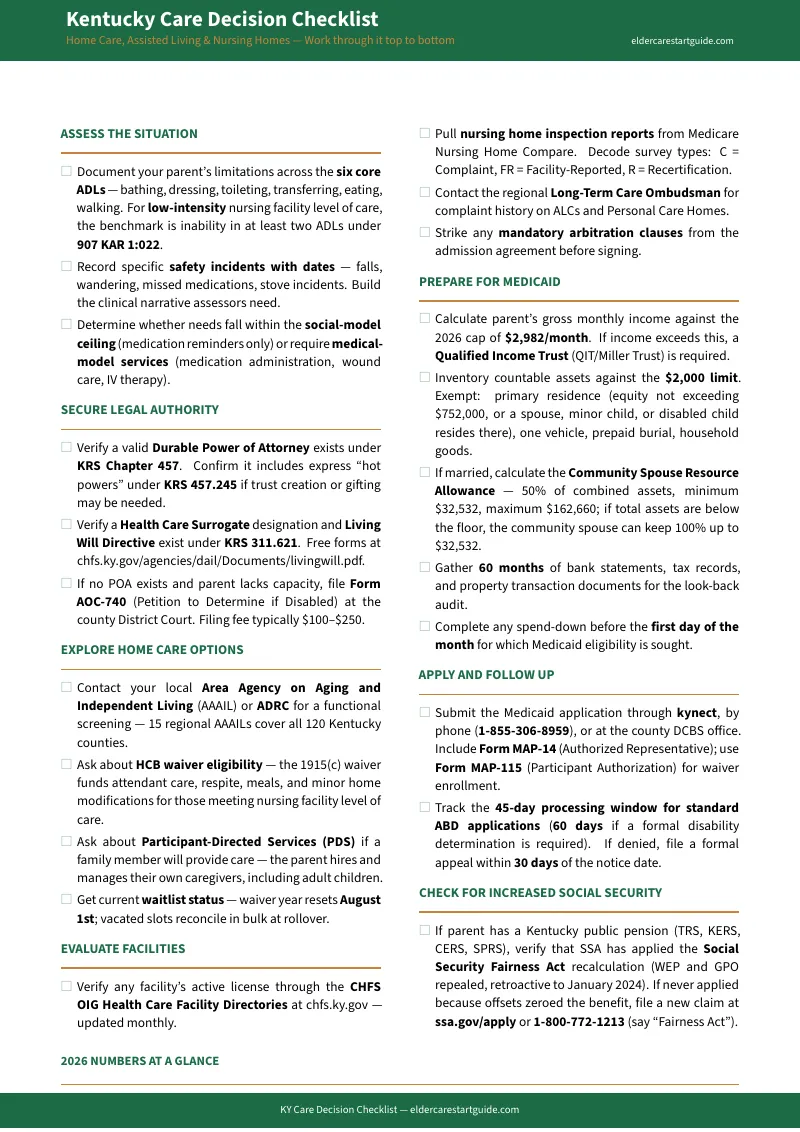
Download the free Kentucky care decision checklist to assess your parent's situation right now — or get the full guide for the complete decision system with every care setting comparison, every financial worksheet, and every facility audit tool Kentucky families need.
The care decisions you make in the next few weeks will shape your parent's daily life for years. This guide makes sure you make them with the full picture — not under pressure from a discharge planner, a commission-driven referral service, or a sibling who hasn't seen Mom in six months.